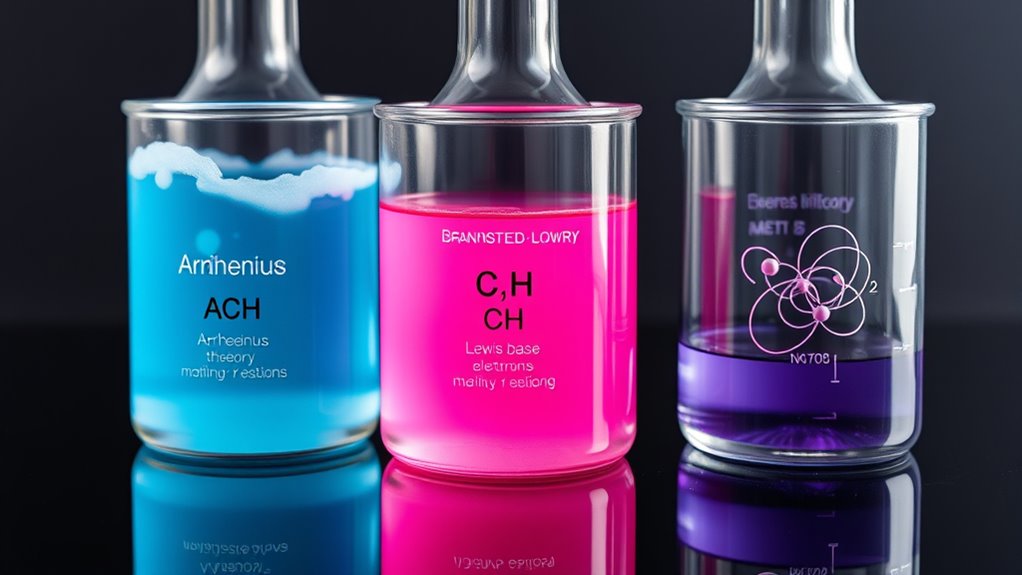

Arrhenius, Brønsted-Lowry, and Lewis theories explain acid-base interactions from different angles. Arrhenius focuses on acids producing H⁺ and bases producing OH⁻ in solution. Brønsted-Lowry defines acids as proton donors and bases as proton acceptors, emphasizing proton transfer. Lewis broadens the view by describing acids as electron pair acceptors and bases as donors, explaining reactions without involving protons. Exploring these theories reveals how acids and bases behave across many chemical processes.

Prime made for students and young adults
- Fast, free delivery for dorm and study essentials
- Prime Video and Amazon Music included
- Member-only deals
Key Takeaways
- Arrhenius defines acids as proton donors and bases as hydroxide donors, focusing on ion production in aqueous solutions.
- Brønsted-Lowry broadens this by describing acids as proton donors and bases as proton acceptors, applicable in various solvents.
- Lewis theory considers acids as electron pair acceptors and bases as electron pair donors, explaining a wider range of reactions.
- These theories are complementary; Arrhenius emphasizes ionization, Brønsted-Lowry emphasizes proton transfer, and Lewis focuses on electron pairs.
- Understanding all three provides a comprehensive view of acid-base interactions across different chemical contexts.

Understanding acid–base theories is essential for grasping how substances interact in chemical reactions. At the core of these interactions are mechanisms like proton transfer and electron pair donation, which help define the behavior of acids and bases. When you look at acids and bases through these lenses, you see a more detailed picture of their roles. Proton transfer mechanisms are fundamental in many acid-base reactions, especially in Brønsted-Lowry theory. Here, acids are proton donors, and bases are proton acceptors. When an acid encounters a base, it donates a proton, and the base accepts it. This transfer of protons is what drives the reaction forward, creating new substances. You’ll notice that this process depends heavily on the ability of a substance to donate or accept protons efficiently, which clarifies why some acids and bases are stronger than others.
On the other hand, Lewis theory expands the concept of acids and bases by focusing on electron pair donation. According to Lewis, acids are electron pair acceptors, and bases are electron pair donors. This means you don’t need a proton transfer to understand the interaction—sometimes, reactions occur solely through the sharing or transfer of electron pairs. When a Lewis base donates an electron pair to a Lewis acid, it creates a coordinate covalent bond, stabilizing the new compound. This perspective is especially useful for understanding reactions where no protons are involved but electron sharing is still essential. For example, metal complexes and many organic reactions hinge on electron pair donation, making Lewis theory highly versatile.
These theories aren’t mutually exclusive; rather, they complement each other. Proton transfer mechanisms underpin Brønsted-Lowry reactions, while electron pair donation explains a broader spectrum of interactions, including many that don’t involve protons at all. When you study acid-base behavior, recognizing the importance of electron pair donation can help you predict how different substances will react. It clarifies why certain compounds act as acids or bases in specific situations, based on their ability to transfer protons or donate electron pairs. Understanding these mechanisms allows you to analyze reactions more thoroughly, whether you’re working in a lab or trying to grasp complex chemical concepts. Recognizing the role of proton transfer and electron pair donation gives you a clearer, more complete view of acid–base interactions, making it easier to predict reaction outcomes and understand the underlying principles of chemistry.
As an affiliate, we earn on qualifying purchases.
Frequently Asked Questions
How Do Acid-Base Theories Apply to Biological Systems?
You see acid-base theories in biological systems through their impact on enzyme activity and blood buffering. When pH levels fluctuate, acids and bases interact with molecules, affecting enzyme functions essential for metabolism. Blood buffers, like bicarbonate, help maintain pH stability by neutralizing excess acids or bases. By understanding these theories, you can appreciate how organisms regulate their internal environment to keep biochemical processes running smoothly.
What Are the Limitations of Each Acid-Base Theory?
Remember, every theory has its limits. Arrhenius theory only works in aqueous solutions and can’t explain acid-base behavior in non-aqueous systems. Brønsted-Lowry theory is broader but struggles with reactions involving Lewis acids or bases that don’t transfer protons. Lewis theory is the most inclusive but can be complex to apply. So, while useful, each has its limitations in fully explaining all acid-base interactions.
How Do These Theories Influence Industrial Chemical Processes?
You influence industrial processes by understanding how acid-base theories guide reactions. In industrial catalysis, knowing whether acids or bases activate catalysts improves efficiency. It also helps prevent material corrosion by predicting which substances might react with equipment. Recognizing these theories allows you to optimize processes, reduce costs, and enhance safety, making your work in areas like manufacturing and material protection more effective.
Can These Theories Be Integrated for a Comprehensive Understanding?
Think of theoretical integration as assembling a toolbox, where each framework offers unique tools. You can combine Arrhenius, Brønsted‑Lowry, and Lewis theories into a holistic understanding of acids and bases, enhancing industrial processes like catalyst design. This integration creates robust conceptual frameworks, allowing you to analyze reactions more thoroughly and innovate more effectively, just as a versatile toolbox prepares you for any repair challenge.
How Do Acid-Base Theories Relate to Ph Measurement?
You relate acid-base theories to pH measurement by understanding that pH indicators change color depending on the solution’s hydrogen ion concentration. Buffer solutions help maintain stable pH levels, making precise measurements possible. When you use pH meters or indicators, you’re applying these theories to quantify acidity or alkalinity, which is essential in many chemical, biological, and environmental processes.
pH test strips for acids and bases
As an affiliate, we earn on qualifying purchases.
As an affiliate, we earn on qualifying purchases.
Conclusion
Understanding acid-base theories helps you see chemistry in action. For example, over 85% of reactions in your body involve acids or bases, highlighting their importance. The Arrhenius, Brønsted-Lowry, and Lewis theories each offer unique insights into how acids and bases behave. By grasping these concepts, you gain a clearer picture of chemical interactions around you daily. So, next time you see a reaction, remember these theories are the key to understanding it all.
As an affiliate, we earn on qualifying purchases.
As an affiliate, we earn on qualifying purchases.
Halloween Picks
halloween
As an affiliate, we earn on qualifying purchases.