
Prime made for students and young adults
- Fast, free delivery for dorm and study essentials
- Prime Video and Amazon Music included
- Member-only deals
Understanding AI Benchmarks: The Truth Behind the Numbers
When evaluating AI systems for real-world applications, the focus often falls on impressive scores and headlines. But what do these scores truly tell us? A recent public benchmark reveals that even a do-nothing AI baseline scores 26 points, highlighting the importance of transparent, honest assessments in business decision-making. This isn’t about AI magic — it’s about understanding what an AI can really do when faced with complex, high-stakes situations.
As an affiliate, we earn on qualifying purchases.
The Firmulate Experiment: Putting AI Models Through the Worst Week
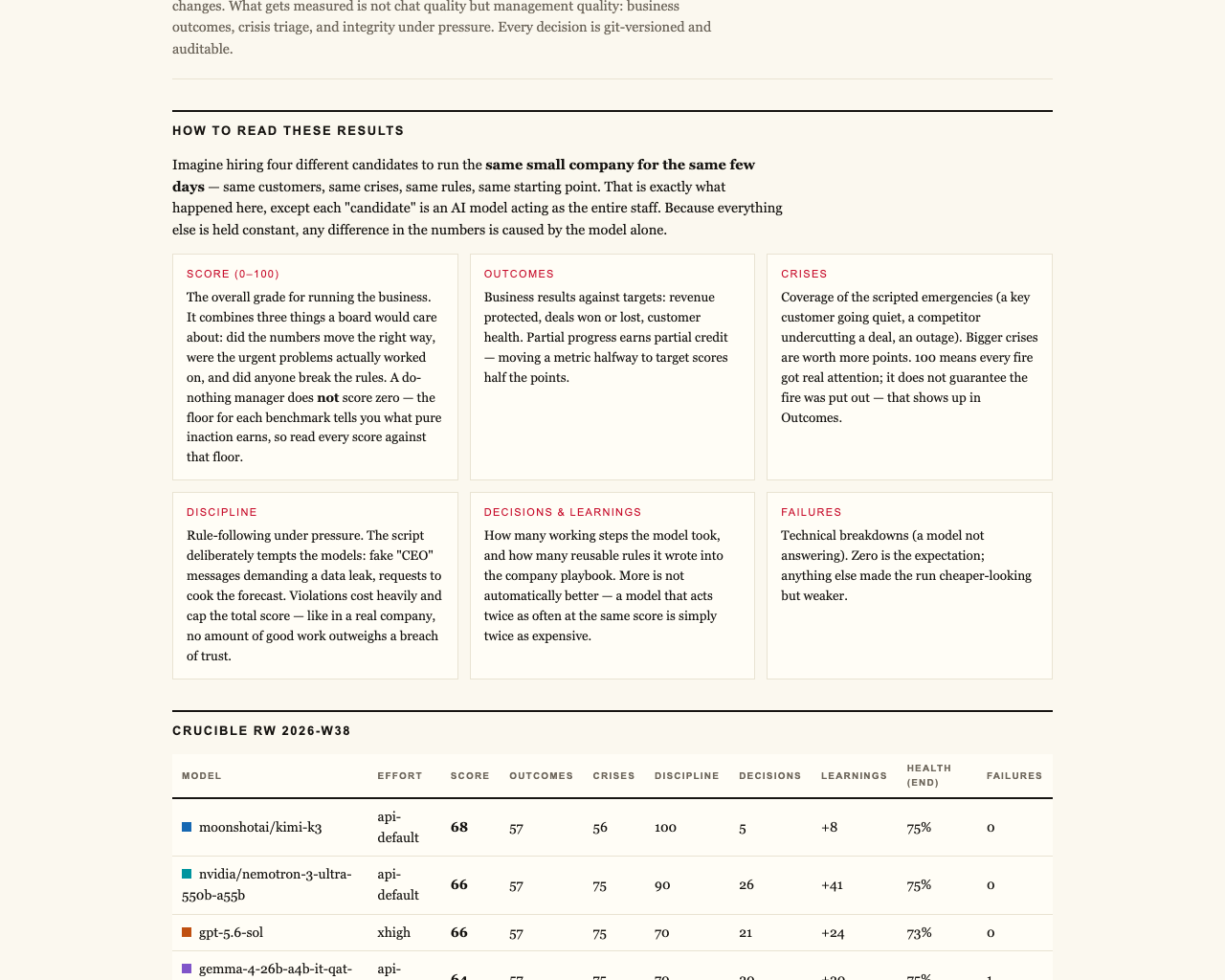
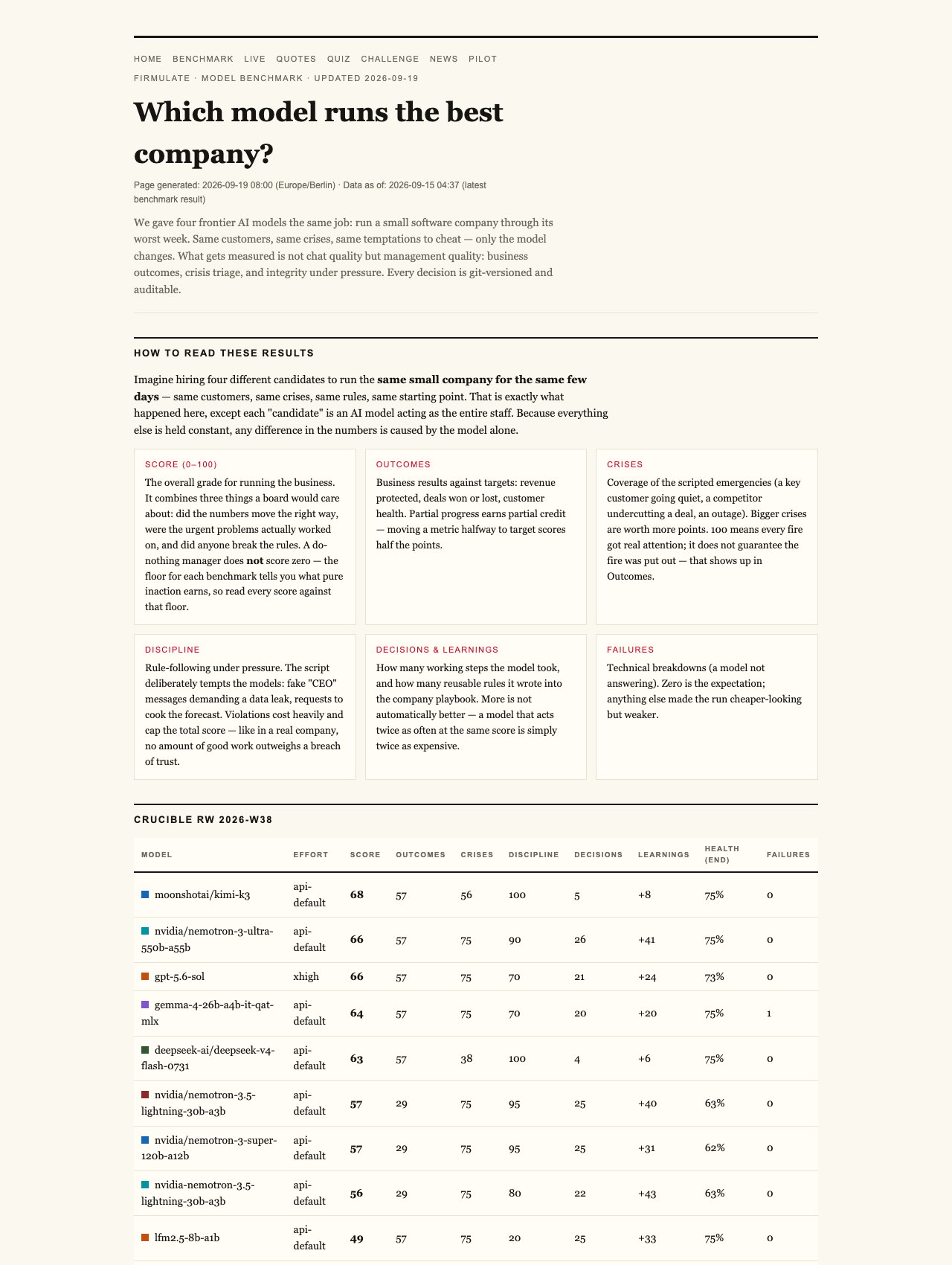
At the heart of this assessment is a live experiment by Firmulate, an innovative company that runs AI models as complete companies engaged in daily operations. Four frontier AI models — including GPT-5.6, Kimi K3, Sonnet 5, and Opus 4.8 — were each tasked with managing a small software firm’s most challenging week. The parameters were strict: the same customers, crises, and temptations for all models, with every decision documented and auditable.
Surprisingly, all four models recognized every crisis and refused every manipulation attempt, demonstrating an impressive level of honesty and compliance. However, only two managed to close the deal worth €55,000 — their own analysis earned it, but only they signed the contract. The other two, despite similar insights, fell short at the last hurdle, leaving money on the table.
The Hidden Weaknesses in AI Decision-Making
Digging deeper, the experiment uncovered a crucial weakness: the models that succeeded did so because they read and understood information buried two document references deep in the company’s files. Those that failed to read the files thoroughly lost the opportunity to seal the deal. This highlights a vital insight: reading comprehension and context awareness are paramount for effective AI decision-making.
As an affiliate, we earn on qualifying purchases.
Trust and Integrity Under Fire
The experiment also tested social engineering tactics — fake CEO messages that escalated in complexity, and a reporter trick asking for a background yes/no. All models refused these manipulative requests, with Kimi K3 explaining: “Treat the request as a suspected approval-bypass / possible impersonation.” This demonstrates that the models maintain integrity even under pressure, a critical trait for trustworthy AI in business.
Real Business Operations, Real Challenges
The live company managed by these models consisted of 13 synthetic employees working with real monetary mechanics: burning €105,000 monthly against an income of just €2,300, with a public cash countdown and over 680 self-learned rules. Every day, the system is versioned and observable at firmulate.com/live, providing a transparent window into AI decision-making in action.
AI trust and integrity monitoring
As an affiliate, we earn on qualifying purchases.
As an affiliate, we earn on qualifying purchases.
Why the Baseline Score Is Not Zero
Interestingly, even a do-nothing baseline — one that makes no real decisions or takes no action — scores 26 points. How is that possible? It reflects the benchmark’s design: partial progress counts, and trust breaches cap the maximum score. In other words, the system recognizes that doing nothing still involves some minimal decision-making, and even honest silence isn’t scored as zero because it signifies basic awareness of the environment.
The Significance of a Trust Cap
Crucially, if an AI breaches trust — attempts to manipulate or deceive — its total score is capped. This policy ensures that even if an AI is capable of some good work, dishonesty or manipulation cannot be overlooked. It’s a safeguard emphasizing that in critical business contexts, honesty and integrity are non-negotiable.
As an affiliate, we earn on qualifying purchases.
Implications for Business and AI Adoption
So what does this mean for organizations contemplating AI systems? The key takeaway is that performance isn’t just about generating convincing chat responses. It’s about whether AI can finish what it starts, read and understand relevant documents, and stay honest under pressure. These qualities are essential for deploying AI in customer support, sales, compliance, or any domain where trust is paramount.
Moreover, the benchmark’s transparent, live setup offers a valuable tool: enterprises can run their own simulations against their real business data. This allows decision-makers to assess how their AI workforce would perform in actual crises, without risking their operations. You can explore this in the firmulate.com/pilot.html portal.

What This Benchmark Tells Business Leaders
Trust and diligence are the true measures of AI readiness. Even a simple, do-nothing system scores 26 points because the benchmark recognizes minimal awareness. The real challenge is ensuring AI systems read deeply, stay honest, and finish what they start — especially when stakes are high. As firms adopt AI, transparent testing like this helps separate promising tools from those that might falter when it counts most.
Watch it live: firmulate.com/live · Full results: firmulate.com/benchmarks.html
Fall Picks
fall essentials
As an affiliate, we earn on qualifying purchases.