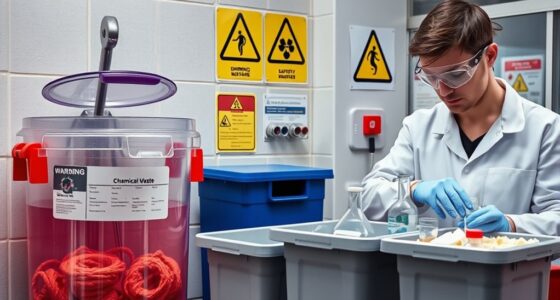
Instrument calibration is non-negotiable in modern labs because it guarantees your measurements are accurate, consistent, and meet industry standards. Regular calibration prevents errors caused by environmental factors, wear, or handling, keeping your equipment reliable. It also helps you quickly detect deviations and maintain data credibility. Skipping calibration risks compromising your results and the integrity of your work. If you want to understand how maintaining calibration boosts your lab’s accuracy, keep exploring these fundamentals.
Key Takeaways
- Accurate calibration ensures reliable, reproducible results essential for scientific integrity.
- Regular calibration prevents measurement drift caused by environmental factors and equipment wear.
- Traceable calibration standards maintain compliance with industry regulations and quality standards.
- Calibration acts as a crucial part of quality assurance, enabling early detection of deviations.
- Skipping calibration risks data validity, compromising project outcomes and overall lab credibility.
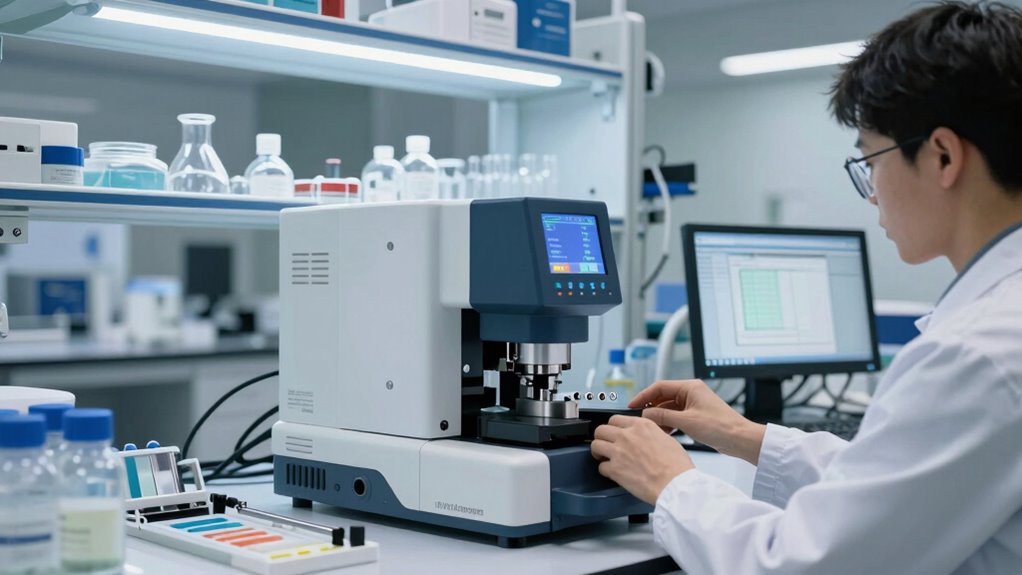
In modern laboratories, precise measurements are essential for reliable results, making instrument calibration a critical process. Without proper calibration, your equipment’s accuracy can drift over time, leading to flawed data and compromised experiments. Calibration frequency plays a significant role here; you need to establish a regular schedule that aligns with the equipment’s usage and the criticality of the measurements. For highly sensitive instruments, more frequent calibration is necessary to maintain optimal performance, while less critical equipment might require less often. By adhering to a consistent calibration routine, you ensure that your measurements stay within acceptable tolerances, which directly impacts the integrity of your results. Additionally, incorporating Free Floating design principles can help maintain stability and reduce external influences on your equipment, further supporting calibration accuracy. You might think that once your equipment is calibrated, it stays accurate indefinitely. However, that’s not the case. Environmental factors like temperature fluctuations, mechanical wear, and handling can cause instruments to lose their precision over time. That’s why ongoing calibration isn’t just a best practice; it’s a necessity. When you calibrate your instruments regularly, you’re actively maintaining their accuracy, which minimizes errors and ensures consistency across your measurements. Ensuring your calibration procedures are traceable to standards is vital for maintaining confidence in your results and ensuring compliance with industry regulations. Equipment accuracy isn’t just about getting the right numbers; it’s about trust in your data. When your instruments are correctly calibrated, you can confidently interpret your results, knowing they reflect true values. Conversely, inaccurate equipment can produce false positives or negatives, leading to incorrect conclusions and potentially dangerous decisions. Maintaining accuracy involves not only choosing the right calibration schedule but also using calibrated standards and traceable references, which are essential for establishing measurement traceability and ensuring compliance with industry standards. This ensures your calibration process is traceable to national or international standards, further reinforcing your data’s credibility. In essence, consistent calibration frequency and a focus on equipment accuracy form the backbone of credible laboratory work. They help you detect deviations early, correct them promptly, and uphold the quality standards required in scientific research, manufacturing, or quality control environments. Skipping or delaying calibration might seem like a time-saver initially, but it risks undermining your entire project. Ultimately, you need to view calibration as an integral part of your laboratory’s quality assurance system—non-negotiable if you want trustworthy, precise, and reproducible results.
instrument calibration standards
As an affiliate, we earn on qualifying purchases.
As an affiliate, we earn on qualifying purchases.
Frequently Asked Questions
How Often Should Calibration Be Performed on Laboratory Instruments?
You should perform calibration regularly, typically based on the calibration frequency recommended by the instrument manufacturer or industry standards. Maintenance scheduling plays a vital role, so set a routine—whether daily, weekly, or monthly—to guarantee accuracy. Keep detailed records of each calibration, and adjust intervals if instruments show signs of drift. This proactive approach helps maintain reliable results and prevents costly errors.
What Are the Consequences of Using Uncalibrated Equipment?
Using uncalibrated equipment compromises measurement accuracy, leading to unreliable data and potential errors in your results. It can also cause regulatory compliance issues, risking fines or project setbacks. Without calibration, you might unknowingly produce invalid data, affecting quality control and safety standards. Regular calibration guarantees your instruments stay precise, helping you maintain high standards, meet legal requirements, and avoid costly mistakes in your laboratory work.
Which Calibration Methods Are Most Reliable for Sensitive Instruments?
You should rely on advanced techniques like traceable standards, automated calibration systems, and regular cross-checks to guarantee calibration accuracy. These methods minimize human error and provide consistent results, especially for sensitive instruments. By adopting these reliable calibration methods, you maintain precision and compliance, reducing measurement uncertainties. Regular validation using these advanced techniques guarantees your equipment stays within calibration tolerances, safeguarding the integrity of your data and the reliability of your laboratory operations.
How Do Calibration Standards Vary Between Different Types of Labs?
Calibration standards vary between labs based on their specific requirements, standardization protocols, and regulatory guidelines. You need to follow industry-specific standards to guarantee accuracy and consistency, whether in clinical, industrial, or research settings. Proper calibration documentation is essential to track procedures and compliance. By understanding these differences, you confirm your instruments remain accurate, reliable, and compliant with relevant standards, safeguarding the integrity of your lab results.
What Training Is Necessary for Proper Instrument Calibration Procedures?
Think of calibration training as equipping your toolkit; it’s essential for accuracy. You need thorough instruction on calibration documentation and procedures, ensuring you record every step properly. Technician certification is critical, validating your skills and knowledge. Proper training involves hands-on practice and understanding industry standards. When you’re well-trained, your calibrations become reliable, safeguarding data integrity and maintaining lab compliance, like a finely tuned instrument performing flawlessly.

Test Block IIW2 V2 Calibration Block #304 Stainless Steel T=20mm, d=Φ1.5mm
- Model: Test Block IIW2 V2
- Material: 304 Stainless Steel
- Thickness: 20mm
As an affiliate, we earn on qualifying purchases.
As an affiliate, we earn on qualifying purchases.
Conclusion
In modern labs, skipping instrument calibration isn’t just risky—it’s downright irresponsible. You might think a slight deviation won’t matter, but scientific accuracy hinges on precise measurements. The theory that minor errors are negligible has been debunked; even small inaccuracies can skew results and compromise your work’s integrity. Regular calibration isn’t just a best practice—it’s essential for ensuring reliable, reproducible data that stands up to scrutiny and advances scientific knowledge.
calibration equipment for scientific instruments
As an affiliate, we earn on qualifying purchases.
As an affiliate, we earn on qualifying purchases.
As an affiliate, we earn on qualifying purchases.