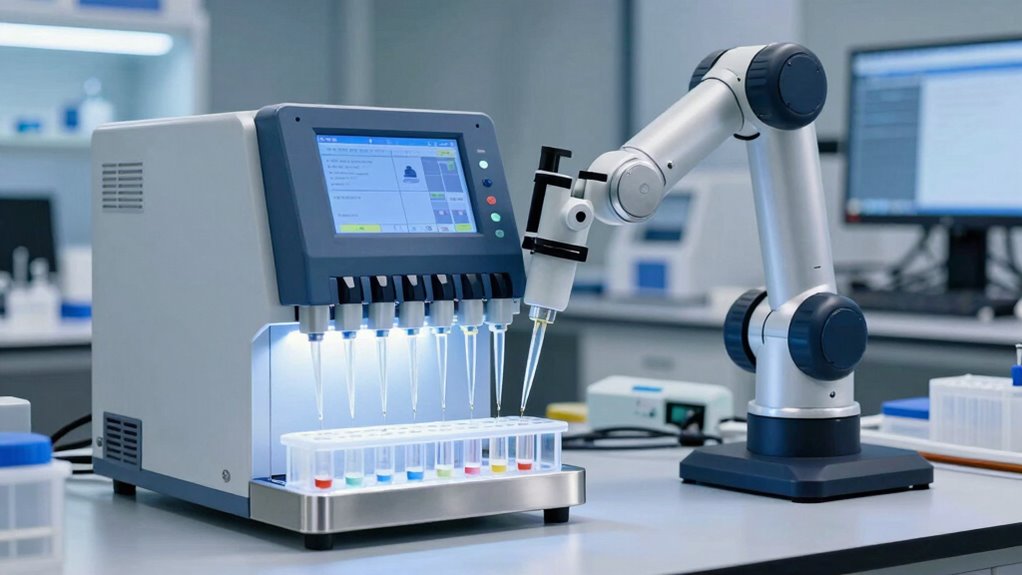

Automatic pipetting systems guarantee you achieve high repeatability in your lab by providing precise and consistent liquid handling. They reduce human errors, maintain accuracy over time with regular calibration, and incorporate sensors to detect deviations. This leads to better reproducibility of results and improved efficiency, especially for large sample batches. Proper maintenance and calibration are essential for reliable performance. Keep exploring to discover how integrating these systems can elevate your laboratory’s accuracy even further.

Prime made for students and young adults
- Fast, free delivery for dorm and study essentials
- Prime Video and Amazon Music included
- Member-only deals
Key Takeaways
- Automated systems enhance repeatability by delivering consistent liquid volumes across multiple samples.
- Regular calibration and maintenance prevent drift, ensuring ongoing accuracy in pipetting performance.
- Advanced sensors and feedback mechanisms detect deviations, supporting precise and reliable liquid handling.
- Integration of calibration routines with automated feedback improves overall reproducibility.
- Proper system upkeep combined with routine calibration sustains high repeatability in laboratory procedures.
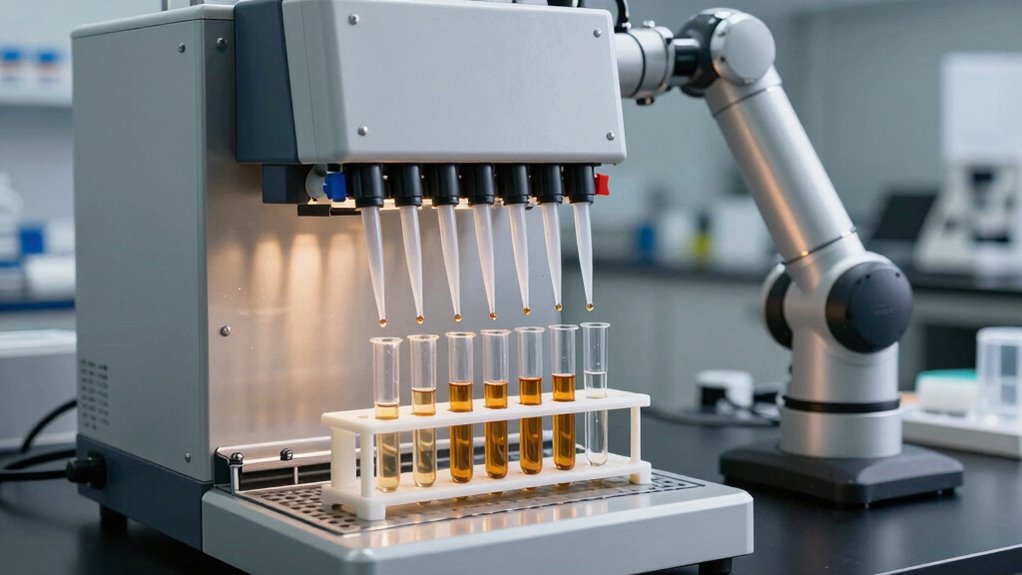
Have you ever wondered how laboratories achieve consistent and accurate liquid handling? It all comes down to the precision of their equipment and the meticulous procedures they follow. Automatic pipetting systems play a essential role in ensuring that liquids are transferred accurately, especially when handling small volumes that require high precision. These systems are designed to minimize human error, increase throughput, and improve reproducibility. But even the most advanced pipettes need proper calibration procedures to maintain their accuracy over time. Calibration involves adjusting the pipette’s settings or verifying its performance against a standard, guaranteeing that each dispense matches the intended volume. When you use automatic pipetting systems, regular calibration is indispensable to sustain their repeatability and reliability. Proper calibration procedures are crucial for maintaining the accuracy and longevity of these systems. Additionally, implementing standard operating procedures ensures consistent calibration practices across different operators and time points, further enhancing reliability. Liquid handling is at the core of many laboratory processes, from sample preparation to assay development. High repeatability means that each time you perform a transfer, the volume dispensed is consistent, reducing variability in your results. Automatic pipetting systems are engineered to deliver this repeatability through precise mechanics and software control. They often incorporate advanced sensors and feedback mechanisms to detect and correct deviations during operation. By automating the pipetting process, you eliminate inconsistencies caused by manual handling, which can be affected by factors like user fatigue or technique. This consistency is especially critical when you’re conducting experiments that demand stringent reproducibility or when you’re processing large sample batches. Regular system maintenance further supports optimal performance and reduces the risk of calibration drift over time. Incorporating quality control measures can help detect and address potential issues before they impact your data. Calibration procedures are a foundation of maintaining this accuracy. They usually involve measuring the dispensed volume using gravimetric or volumetric methods and then adjusting the system accordingly. Some systems come with built-in calibration routines that guide you through the process, making it easier to uphold performance standards. Regular calibration not only guarantees the accuracy of your liquid handling but also prolongs the lifespan of the pipetting system. Neglecting calibration can lead to drifts in volume delivery, compromising your data quality. As you integrate automatic pipetting systems into your workflow, establishing a routine calibration schedule is indispensable to keep your results consistent and trustworthy. Incorporating automated feedback mechanisms can further enhance the precision and compensate for potential deviations during operation.
Regular calibration ensures automatic pipetting systems deliver precise, consistent results over time.
In essence, the combination of advanced automatic pipetting systems and diligent calibration procedures creates a robust foundation for dependable liquid handling. This synergy allows you to focus on your experiments, confident that your volumes are precise and repeatable. When you prioritize calibration and proper maintenance, you’re investing in the accuracy and repeatability that are essential for high-quality, reproducible scientific work.
As an affiliate, we earn on qualifying purchases.
Frequently Asked Questions
How Do Automatic Pipetting Systems Impact Lab Safety Protocols?
Automatic pipetting systems greatly improve lab safety protocols by reducing manual handling of hazardous substances, which minimizes exposure risks. Their automation efficiency ensures precise, consistent pipetting, decreasing errors that could lead to accidents. Safety enhancements come from fewer spills and less contact with dangerous chemicals, creating a safer work environment. You’ll notice a boost in productivity and safety, making laboratory operations smoother and more secure for everyone involved.
What Maintenance Is Required for Long-Term System Reliability?
You need to follow regular calibration schedules and perform system cleaning to guarantee long-term reliability. Calibration ensures your pipetting accuracy stays consistent, while cleaning prevents contamination and buildup that could affect performance. Check manufacturer guidelines for specific intervals, and keep detailed maintenance logs. Regular inspections and replacing worn parts also help maintain precision and reduce downtime, ensuring your automated system remains dependable for accurate, repeatable results over time.
Can These Systems Be Integrated With Existing Laboratory Software?
Think of integrating automatic pipetting systems with your lab software like fitting puzzle pieces together. Yes, these systems are designed for software compatibility, making integration feasible. However, you might face some challenges, like compatibility issues or data transfer hiccups. With careful planning, updating, and communication with vendors, you can smoothly incorporate these systems into your existing software ecosystem, streamlining your workflow and enhancing efficiency.
What Are the Cost Differences Between Manual and Automated Pipetting?
A manual pipetting process generally costs less upfront, as you only buy pipettes and supplies, but it can lead to higher long-term expenses due to human error, inconsistent results, and increased labor time. Automated pipetting systems have higher initial costs but can save money over time by improving precision, reducing waste, and increasing throughput. The cost comparison depends on your lab’s scale, accuracy needs, and long-term efficiency goals.
How Do Different Liquids Affect Pipetting Accuracy?
Imagine each liquid as a different dance partner—some glide smoothly, others resist. Your pipetting accuracy varies with liquid viscosity; thicker liquids are harder to aspirate precisely, while thinner ones flow easily. Temperature effects also matter: warmer liquids may expand, altering volume, while colder ones contract. By adjusting your technique and understanding these properties, you guarantee more reliable measurements across diverse liquids, keeping your results both consistent and accurate.
As an affiliate, we earn on qualifying purchases.
Conclusion
In embracing automatic pipetting systems, you subtly elevate your lab’s precision and consistency, ensuring every sample tells a clearer story. While manual methods might still whisper their charm, these advanced tools quietly promise a future where repeatability isn’t just a goal but a gentle standard. By trusting in their subtle efficiency, you open doors to more reliable results, all without the noise of doubt. Sometimes, the quietest improvements lead to the most significant breakthroughs.
automated liquid handling system
As an affiliate, we earn on qualifying purchases.
As an affiliate, we earn on qualifying purchases.
As an affiliate, we earn on qualifying purchases.
Halloween Picks
halloween
As an affiliate, we earn on qualifying purchases.