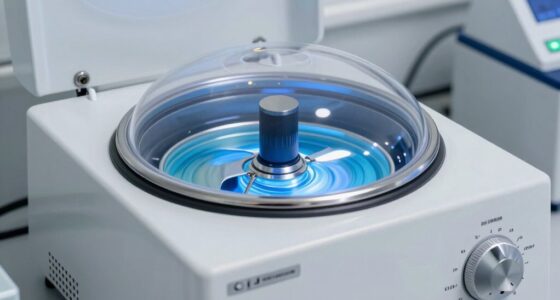
You should choose a polarizing microscope when analyzing the optical properties of crystalline materials, minerals, or biological specimens. It’s especially useful for detecting birefringence and revealing details invisible to regular microscopes. Proper sample preparation and understanding optical responses are key for accurate results. If you want to see internal structures, identify mineral phases, or assess tissue quality, a polarizing microscope is your best option. Keep exploring to learn how to maximize its capabilities.
Key Takeaways
- When analyzing optical properties, birefringence, or crystalline structures in minerals and biological specimens.
- For distinguishing minerals with similar appearances under normal light.
- When detailed internal structures and phase identification are required.
- To assess tissue quality and crystalline phases with enhanced contrast.
- When manipulating polarization helps reveal features invisible with standard microscopes.

A polarizing microscope is often the best choice when you need to analyze the optical properties of crystalline materials, minerals, or thin biological specimens. Its ability to detect and interpret birefringence makes it essential for applications where understanding how light interacts with a sample is critical. When using this microscope, your success hinges on proper sample preparation. You want your specimens to be thin and evenly mounted to allow light to pass through without distortion. For crystalline materials and minerals, this often means creating thin sections or polished slices, ensuring the sample is free of scratches or contaminants. In biological specimens, thin-sectioning or staining can improve contrast, making the optical properties more evident under polarized light. Preparing samples correctly enhances the clarity of the observation and prevents misleading results. Additionally, understanding the specific optical properties of your samples can help you interpret the birefringence patterns more accurately. Knowing how to interpret birefringence patterns can reveal detailed information about the internal structure and stress within the sample. Recognizing the importance of sample quality can significantly impact the accuracy of your analysis. Proper sample preparation is fundamental to obtaining reliable and meaningful results from your observations.
Once your sample is properly prepared, the microscope’s ability to reveal optical properties becomes apparent. You can observe birefringence—the phenomenon where a material splits a beam of light into two rays traveling at different speeds—by rotating the polarizer and analyzer. This rotation causes changes in color, brightness, or extinction angles that are characteristic of specific minerals or biological tissues. These optical responses help you identify composition, structure, and even stress patterns within the sample. Because the polarizing microscope provides visual cues based on the optical properties, it’s invaluable in mineralogy, geology, and biological research.
Compared to other microscopes, a polarizing microscope offers a unique advantage: it shows details invisible to standard light microscopes. You can distinguish between minerals with similar appearances under regular light but different optical behaviors under polarized light. This capability allows you to analyze mineral purity, identify crystalline phases, or assess the quality of biological tissues. The key to getting meaningful results lies in understanding how to manipulate the polarizer and analyzer, as well as interpreting the optical properties revealed through these adjustments. Proper sample preparation complements this by ensuring your observations are accurate, free from artifacts, and representative of the true nature of your specimen.

AmScope OMAX 40X-600X Lab Trinocular Polarizing Quadruple Nosepiece Microscope+Bertrand Lens with 9MP Camera
Head: Trinocular, 45 degrees inclined 360 degrees rotatable; Nosepieces: Quadruple, objective center adjustable; Eyepieces: a pair of wide…
As an affiliate, we earn on qualifying purchases.
As an affiliate, we earn on qualifying purchases.
Frequently Asked Questions
Can a Polarizing Microscope Identify All Mineral Types?
A polarizing microscope can’t identify all mineral types because mineral classification varies widely, and some minerals have similar optical properties that make differentiation difficult. While it excels at analyzing optical properties like birefringence and pleochroism, it doesn’t provide definitive identification for every mineral. You’ll need additional techniques, such as chemical analysis or X-ray diffraction, to accurately classify minerals that share similar optical features under polarized light.
How Does Polarization Improve Microscopic Imaging Accuracy?
Polarization acts like a filter that sharpens your view, much like a gentle sunrise revealing details unseen before. It improves microscopic imaging accuracy through optical enhancement, reducing glare and unwanted reflections. This leads to better image clarity, allowing you to distinguish mineral features with precision. By controlling light’s vibrations, polarization guarantees you see fine structures clearly, making it an invaluable technique for detailed mineral analysis and other microscopic investigations.
Are Polarizing Microscopes Suitable for Biological Tissue Analysis?
Yes, polarizing microscopes are suitable for biological tissue analysis. They enhance contrast and reveal structural details by using specialized optical components that manipulate polarized light. You’ll need proper sample preparation, like thin tissue sections, to optimize results. These microscopes are particularly effective for studying crystalline structures or fibers in tissues, providing clearer insights into tissue composition and organization that aren’t visible with standard microscopes.
What Is the Cost Difference Between Polarizing and Standard Microscopes?
The cost comparison between polarizing and standard microscopes shows that polarizing microscopes are generally more expensive. You’ll find they cost anywhere from 20% to 50% more due to specialized components. If you’re working within a tight budget, consider your specific needs carefully. Polarizing microscopes are worth the investment if you require detailed analysis of birefringent materials; otherwise, standard microscopes might be more practical and cost-effective.
How Easy Is It to Train Personnel to Use Polarizing Microscopes?
Training personnel to use polarizing microscopes is quite manageable, with about 80% achieving user proficiency within a week. The main training challenges involve understanding how to adjust polarizers and interpret optical effects. You’ll find that with clear instructions and hands-on practice, users quickly become comfortable. Although slightly more complex than standard microscopes, polarizing microscopes aren’t difficult to master, making them a valuable tool for specialized analyses.
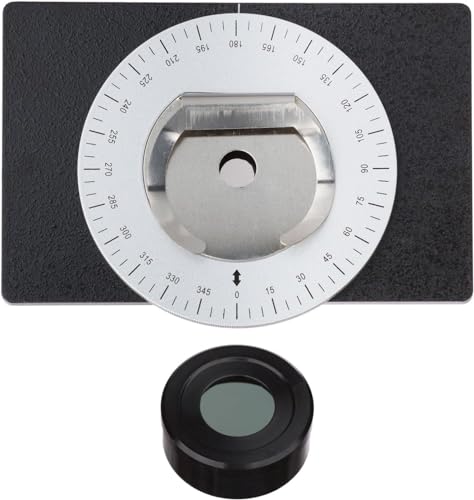
AmScope PZK Simple Polarizing Kit for Compound Microscopes, Graduated Round Stage, 1-1/8" Lens
Polarizing kit provides polarization features for compound microscopes
As an affiliate, we earn on qualifying purchases.
As an affiliate, we earn on qualifying purchases.
Conclusion
When you peer through a polarizing microscope, you unveil a world where light dances in vibrant patterns, revealing hidden textures and intricate structures. It’s like illuminating a secret garden, each detail brought into sharp relief against the darkened backdrop. In moments like these, you realize that this tool isn’t just for observation—it’s a gateway to understanding nature’s subtle artistry, where clarity and color converge to tell stories invisible to the naked eye.
polarized light microscope accessories
As an affiliate, we earn on qualifying purchases.
As an affiliate, we earn on qualifying purchases.
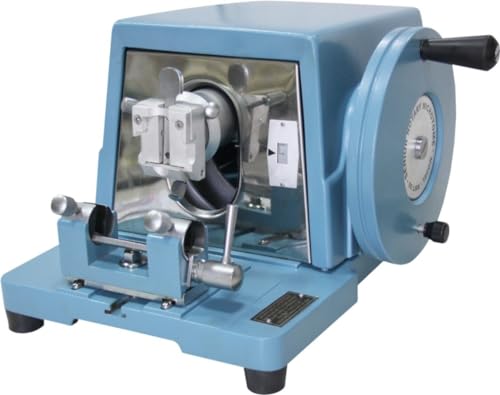
KASHSURG Professional Histology Pathology Lab Erma Type Microtome for Microscopy Slide Sections Pack 1
Feed adjustments : 1-50 microns
As an affiliate, we earn on qualifying purchases.
As an affiliate, we earn on qualifying purchases.