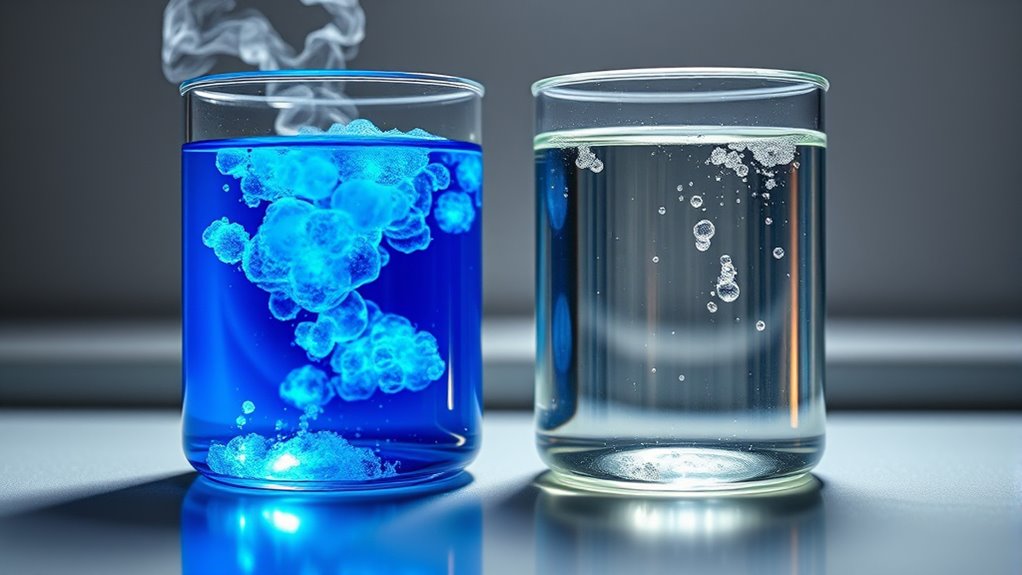

An acid’s strength depends on how easily it releases hydrogen ions (H⁺) in a solution, which is largely influenced by its molecular structure. Strong acids have structures that promote complete ionization, making it easy for them to dissociate and produce more H⁺ ions. Weak acids, on the other hand, have structures that hinder this process, leading to partial ionization. If you want to understand how molecular arrangements affect acid strength, keep exploring the details behind their structures and behaviors.
Key Takeaways
- Strong acids have molecular structures that promote complete ionization, releasing more H⁺ ions into solution.
- Weak acids have structures that hinder ionization, resulting in a lower degree of dissociation.
- The stability of the resulting ions influences how easily an acid can dissociate.
- The energy barrier to dissociation varies with molecular structure, affecting acid strength.
- Equilibrium position shifts toward ion formation in strong acids, while weak acids favor undissociated molecules.
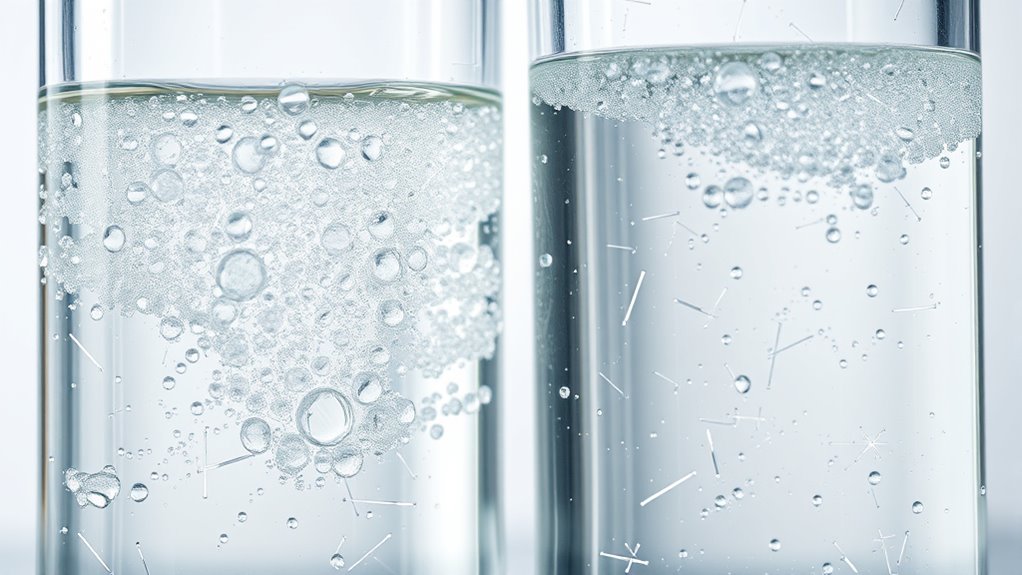
Understanding what makes an acid strong or weak is essential to grasping how acids behave in different situations. At the core of this understanding is the molecular structure of the acid itself and how it influences the ionization degree. The molecular structure determines how easily an acid can release hydrogen ions (H⁺) into a solution. Strong acids have a molecular structure that promotes complete or near-complete ionization, meaning most of the acid molecules dissociate into ions when dissolved. Weak acids, on the other hand, have a molecular structure that hinders ionization, resulting in only a fraction of the molecules releasing H⁺ ions.
The key difference lies in the ionization degree, which measures how much of the acid actually dissociates in solution. For strong acids, the ionization degree approaches 100%, meaning nearly all acid molecules break apart into their constituent ions. This high ionization degree is often due to the molecular structure of the acid, which allows for stable ion formation and minimal energy barriers to dissociation. For example, hydrochloric acid (HCl) has a simple molecular structure that easily breaks apart in water, producing a high concentration of H⁺ ions and making it a strong acid.
In contrast, weak acids have a molecular structure that creates a higher energy barrier for ionization. Their molecules tend to hold onto their hydrogen ions more tightly, resulting in a lower ionization degree. Acetic acid (CH₃COOH) is a common example of a weak acid. Its structure contains a carboxyl group attached to a methyl group, which stabilizes the molecule and makes it less prone to releasing H⁺ ions. As a result, only a small portion of acetic acid molecules dissociate in water, leading to a weaker acid with a lower concentration of free hydrogen ions.
The molecular structure also influences the equilibrium position of the dissociation process. Strong acids have dissociation reactions that favor the formation of ions, shifting the equilibrium far to the right. Weak acids, however, tend to have an equilibrium that favors the undissociated molecules, maintaining a significant amount of intact acid in solution. This balance impacts not only the acidity but also the reactivity and behavior of the acid in various chemical reactions. Additionally, the structure of the acid plays a crucial role in determining its strength and dissociation characteristics.
Top picks for "acid strong weak"
Open Amazon search results for this keyword.
As an affiliate, we earn on qualifying purchases.
Frequently Asked Questions
How Is Acid Strength Measured Experimentally?
You measure acid strength experimentally by evaluating acid dissociation through titration techniques. During titration, you add a base to the acid solution until it neutralizes, and you track the pH change. A strong acid dissociates completely, showing a rapid pH increase near the equivalence point, while a weak acid dissociates partially, resulting in a gradual pH change. This method helps you determine the acid’s strength accurately.
Do Strong Acids Always Have Higher Ph?
No, strong acids don’t always have higher pH. In fact, strong acids have lower pH because they fully dissociate, increasing hydrogen ion concentration. However, pH variability can occur depending on the acid’s concentration. If you dilute a strong acid, its pH rises, but it remains strong because its acid strength stays the same. So, while strong acids typically have low pH, concentration influences pH variability.
Can Weak Acids Become Strong Under Certain Conditions?
Can weak acids become strong under certain conditions? Absolutely! When you change environmental factors like pH, temperature, or introduce specific buffers, you can influence an acid’s dissociation. By increasing buffer capacity, you allow more acid dissociation, making a weak acid act more like a strong one. So, while inherently weak, acids can seem stronger when conditions shift, showcasing chemistry’s clever, customizable nature.
How Does Molecular Structure Influence Acid Strength?
Your molecular structure influences acid strength through molecular geometry and electron distribution. If the geometry allows easy release of hydrogen ions, the acid is stronger. Electron distribution matters because a more stabilized conjugate base, due to resonance or electronegative atoms, makes the acid stronger. When electrons are spread out or shared effectively, it weakens the bond to hydrogen, increasing acid strength. So, your acid’s shape and how electrons are arranged directly affect its strength.
Are There Any Natural Examples of Strong and Weak Acids?
You’ll find natural examples of both strong and weak acids in everyday life. For instance, citrus fruits like lemons and oranges contain organic acids such as citric acid, which are weak acids. Conversely, stomach acid, primarily hydrochloric acid, is a strong acid produced naturally in your body. These natural sources showcase how acids vary in strength, from gentle citrus to potent biological acids, illustrating the diverse nature of organic acids in the environment.
Conclusion
Remember, the strength of an acid depends on how easily it releases hydrogen ions into solution. Strong acids completely dissociate, while weak acids do so only partially. Keep in mind the saying, “A chain is only as strong as its weakest link.” Similarly, even a weak acid can be powerful in the right conditions. Understanding these differences helps you predict how acids will behave, so always consider their dissociation when working with them.