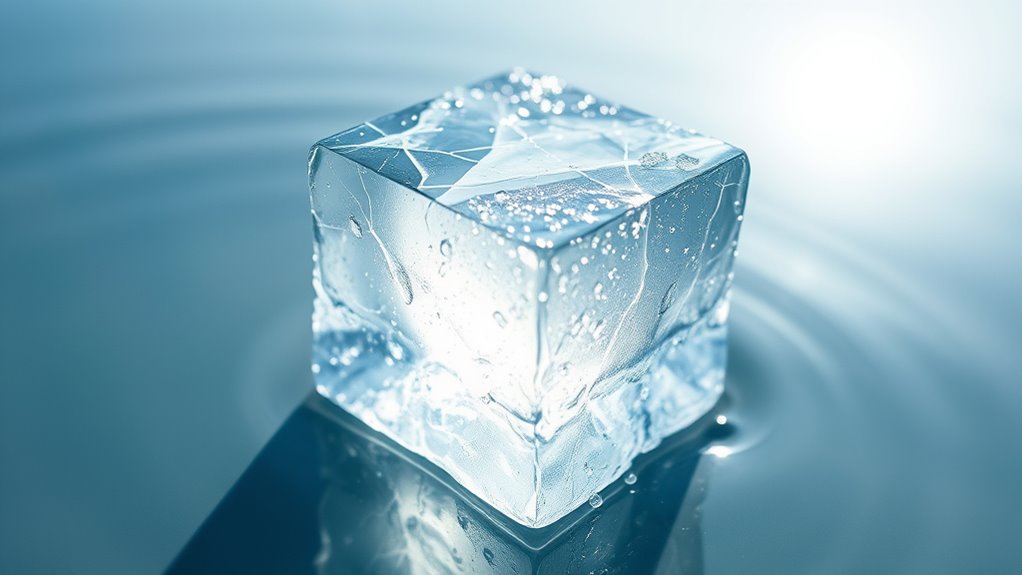

Ice floats on water because its molecules form a specific hexagonal crystal structure that takes up more space, making it less dense than liquid water. As water cools near freezing, molecules slow down and organize into this open, lattice pattern driven by hydrogen bonds. This structure causes ice to expand and become buoyant. Want to discover how this unique molecular arrangement influences water’s behavior and Earth’s ecosystems? Keep exploring to uncover the full story.

Prime made for students and young adults
- Fast, free delivery for dorm and study essentials
- Prime Video and Amazon Music included
- Member-only deals
Key Takeaways
- Ice molecules arrange in a hexagonal crystal lattice with open spaces, making it less dense than liquid water.
- Hydrogen bonds in ice create an organized, open framework that expands the structure.
- As water freezes, it transitions from a disorganized liquid to a structured, crystalline form.
- The lower density of ice causes it to float on water because it is less heavy per unit volume.
- This density difference is unique to water and vital for supporting aquatic ecosystems in cold climates.

Have you ever wondered why ice floats on water instead of sinking? It’s a fascinating question that ties into the unique properties of water and its molecular makeup. At the core of this phenomenon are density anomalies, which make water behave differently than most other substances. Typically, when substances cool, they become denser and sink. But water breaks this rule when it approaches freezing point, and that’s where the molecular structure comes into play.
When water is in its liquid form, its molecules are constantly moving and sliding past each other. They’re packed fairly tightly, but not in an ordered way. As the temperature drops and water approaches 0°C, the molecules start to slow down. Instead of simply getting closer together, they begin to arrange themselves into a more structured pattern, forming a crystalline lattice. This is the key to understanding the density anomalies in water. In this lattice, molecules are spaced farther apart than they are in liquid form. So, even though the water is colder, it becomes less dense because of this organized structure.
This change in molecular structure is what causes ice to be less dense than liquid water. The molecules in ice are arranged in a hexagonal pattern that creates open spaces within the crystal lattice. These spaces make ice about 9% less dense than water at the same temperature. Because density determines whether an object sinks or floats, ice’s lower density allows it to sit on top of water. The floating ice insulates the water below, which is essential for aquatic life during cold seasons.
Your understanding of this process highlights how unusual and significant water’s density anomalies are. Unlike most substances that shrink uniformly when cooled, water expands as it freezes. This expansion is directly tied to its molecular structure and the way molecules form hydrogen bonds in a specific, open framework. It’s this unique behavior that makes ice float, and it’s a perfect example of how molecular structure influences physical properties in surprising ways. So, next time you see ice floating in your drink, you’ll know it’s not just a random occurrence — it’s a consequence of water’s extraordinary molecular structure and its density anomalies, which have profound effects on Earth’s climate, ecosystems, and even your everyday life.
Frequently Asked Questions
How Does the Density of Ice Compare to Water?
You’ll find that the density of ice is lower than water’s because of its molecular arrangement in a crystalline structure. When water freezes, its molecules form a hexagonal lattice that creates more space between them, making ice expand and become less dense. This crystalline structure causes ice to float on water, as its molecules are spread further apart, reducing overall density compared to liquid water.
Does the Temperature Affect Ice’s Buoyancy?
Think of ice as a boat in water, where temperature impact and thermal expansion play vital roles. As temperature rises, ice melts, shrinking in size and reducing buoyancy. Conversely, colder ice contracts slightly, making it more buoyant. So, temperature directly affects ice’s buoyancy by influencing its density and structure. You can see this in frozen lakes, where colder ice floats higher, demonstrating thermal expansion’s subtle effects.
Why Is Ice Less Dense Than Liquid Water?
You notice that ice is less dense than liquid water because its molecular arrangement forms a crystal lattice structure. When water freezes, molecules slow down and arrange themselves in a regular pattern, creating more space between them. This expanded crystal lattice makes ice occupy more volume without adding mass, reducing its density. As a result, ice floats on water, demonstrating how molecular structure influences buoyancy.
How Does the Structure of Ice Cause It to Float?
You might find it fascinating that ice floats because of its unique crystalline structure, which forms through hydrogen bonding. This structure creates open spaces between molecules, making ice less dense than water. Coincidentally, as water cools and freezes, these hydrogen bonds lock into a stable pattern, causing the solid to expand and float. So, your experience of ice floating is directly tied to this remarkable molecular arrangement.
Are There Other Substances That Float on Water?
Yes, other substances float on water due to their density comparison and buoyancy factors. Materials like oil, wood, and certain plastics are less dense than water, allowing them to stay on the surface. You can observe this when oil floats on salad dressing or wood floats in a pond. The key is that these substances have lower density than water, which creates enough buoyant force to keep them afloat.
Conclusion
So, next time you see ice gliding effortlessly on water, remember it’s not just floating—it’s defying expectations with a clever trick of nature. The unique way water’s molecules arrange themselves in ice creates a solid that’s less dense, like a secret handshake between molecules. Isn’t it fascinating how something so simple can hold such a profound mystery? Ice’s buoyancy reminds us that sometimes, the most unexpected things reveal the universe’s quiet genius.
Fall Picks
fall essentials
As an affiliate, we earn on qualifying purchases.