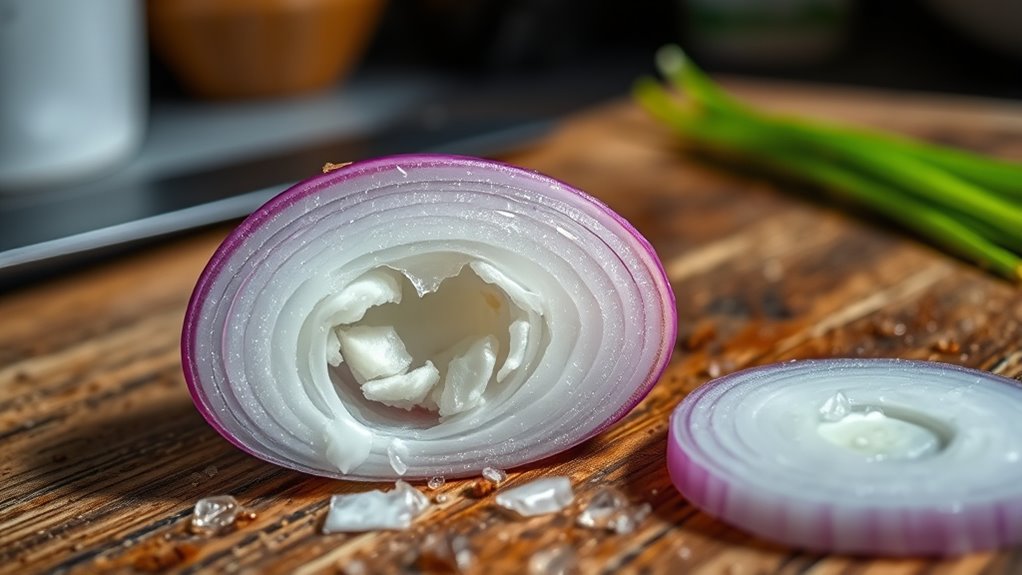

When you chop an onion, its cells release enzymes that turn sulfur-containing compounds into volatile, pungent molecules. These molecules react with the moisture in your eyes, forming sulfuric acid that irritates nerve endings. This causes a burning sensation and triggers tears to wash away the irritants. Different onions have varying sulfur levels, and techniques like chilling or using sharp knives can reduce tears. To discover how to cut onions without crying, keep exploring.
Key Takeaways
- Cutting onions releases enzymes that convert sulfur compounds into volatile irritants.
- These sulfur compounds react with eye moisture to form sulfuric acid, causing irritation.
- The acid stimulates nerve endings, leading to a burning sensation and tear production.
- Cooking or chopping techniques can reduce the release of irritating sulfur compounds.
- Different onion varieties and freshness levels influence the amount of tears they cause.
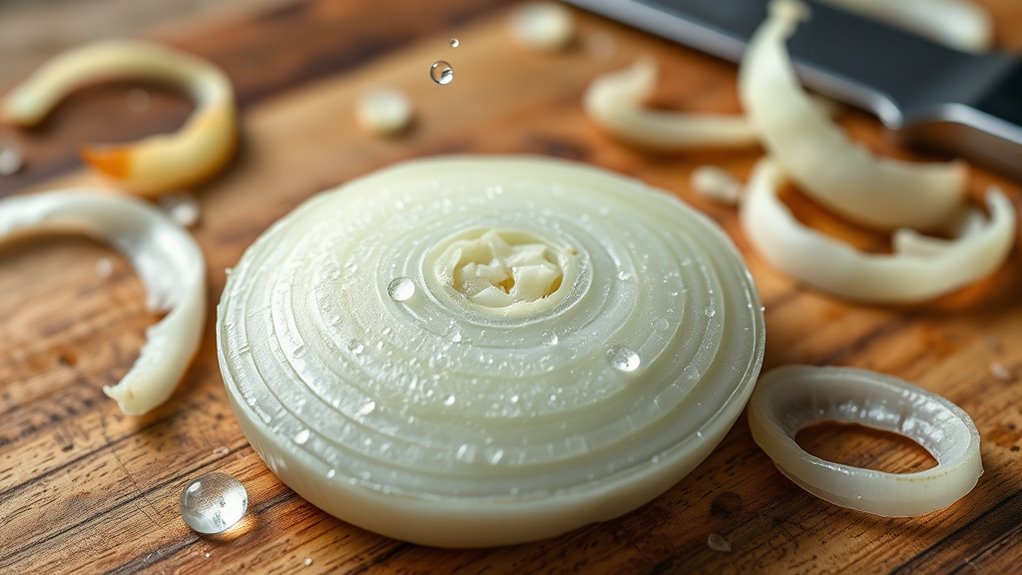
When you cut into an onion, your eyes often water and sting because of a natural chemical reaction. This discomfort happens because onions contain specific chemical compounds that are released when you slice through them. These chemical compounds are part of what gives onions their distinctive flavor and aroma, and they play a vital role in their culinary uses. When you chop an onion, you break its cells, releasing enzymes and other molecules that would normally stay separated inside the onion’s structure. Once these compounds come into contact with each other, they react and form new substances that are responsible for the eye irritation.
The key chemical compounds involved are sulfur-containing molecules. Inside the onion, sulfur exists in a stable form, but when you cut into it, enzymes called alliinases break down the sulfur-containing amino acids into volatile sulfur compounds. These compounds are responsible for the pungent smell and flavor of onions, but they also cause the tearing effect. When these sulfur compounds are released into the air, they quickly react with moisture in your eyes to form sulfuric acid. This acid irritates the sensitive nerve endings on your cornea, resulting in that familiar burning sensation and tear production.
Understanding these chemical compounds helps explain why onions are so versatile in culinary uses. Chefs and home cooks incorporate onions into countless dishes because they add depth, sweetness, and aroma. Their ability to enhance flavor relies on these very compounds, which develop and intensify as onions cook. When cooked properly, many of the harsh sulfur compounds are broken down or evaporate, reducing eye irritation and making onions more pleasant to handle and eat. This is why sautéing or caramelizing onions is a common technique—heat diminishes the impact of the irritant chemicals while amplifying the natural sweetness and umami flavor.
The irritation caused by these chemical compounds isn’t just a flaw; it’s a sign of onion’s complex chemistry that contributes to their culinary versatility. Different onion varieties contain varying levels of sulfur compounds, which is why some onions make you tear more than others. Freshness also matters: fresher onions tend to release more of these irritants when cut. Additionally, research shows that the cell structure of onions influences how much of these compounds are released during chopping. Knowing about these chemical compounds allows cooks to adopt techniques like chilling onions beforehand, using sharp knives, or wearing protective goggles to minimize tears. Ultimately, the chemistry behind why onions make you cry is intertwined with their role in cooking, where these compounds create the flavors we love and the aromas that make dishes memorable.
Frequently Asked Questions
Can Cooking Onions Prevent Tears?
Yes, cooking onions can prevent tears by reducing the onion aroma that triggers tear production. When you heat onions, their sulfur compounds break down, releasing fewer irritants into the air. This lessens tear production and makes chopping easier. Keep in mind, though, that cooked onions still have a strong aroma, but they’re less likely to cause tears compared to raw onions. So, cooking onions is a good way to avoid crying while preparing them.
Do Different Onion Varieties Cause More Tears?
Think of onion varieties like different storms—some release a gentle drizzle, while others bring a fierce thunderstorm. Certain onion varieties, like yellow and white onions, tend to cause more tears, resulting in higher tear severity. Red onions are milder and often less irritating. Your tear response depends on the onion’s sulfur compounds and how strongly they activate your eyes’ tear glands. So, choose your onion variety based on how much you want to cry—or not.
Are There Ways to Stop Crying When Chopping Onions?
To stop crying when chopping onions, try using culinary techniques like chilling the onion beforehand or cutting it under running water to reduce fumes. Wearing goggles can also protect your eyes. Store onions properly in a cool, dry place, which minimizes the release of irritating sulfur compounds. These simple steps can help keep tears at bay, making your chopping experience much more comfortable.
Why Do Some People Cry More Than Others?
Like a delicate symphony, your tear sensitivity and genetic factors compose how much onion-induced tears you produce. Some people’s eyes are more like open windows, letting in the pungent air and causing tears to flow freely. Others have built-in defenses, a genetic shield that minimizes the reaction. So, if you find yourself crying more, it’s often your unique makeup, a biological melody dictating how your eyes respond to onion’s sharp notes.
Does Age or Health Affect Onion-Induced Tears?
Your age influence and health impact can affect how much you cry when chopping onions. As you get older, your tear production may decrease, making you less prone to tears. Conversely, health conditions like allergies or dry eyes can increase sensitivity, leading to more tears. Overall, both age and health impact your body’s response to onion fumes, influencing how intensely you tear up during food prep.
Conclusion
So, next time you cut onions and find yourself tearing up, remember it’s no accident. That tear might just be a coincidence, a tiny reminder of how nature’s little tricks work behind the scenes. It’s funny how something so simple can cause such a big reaction, isn’t it? Embrace the moment—your tears are a sign you’re part of a fascinating biological dance, turning a mundane task into a tiny, shared mystery between you and the onion.