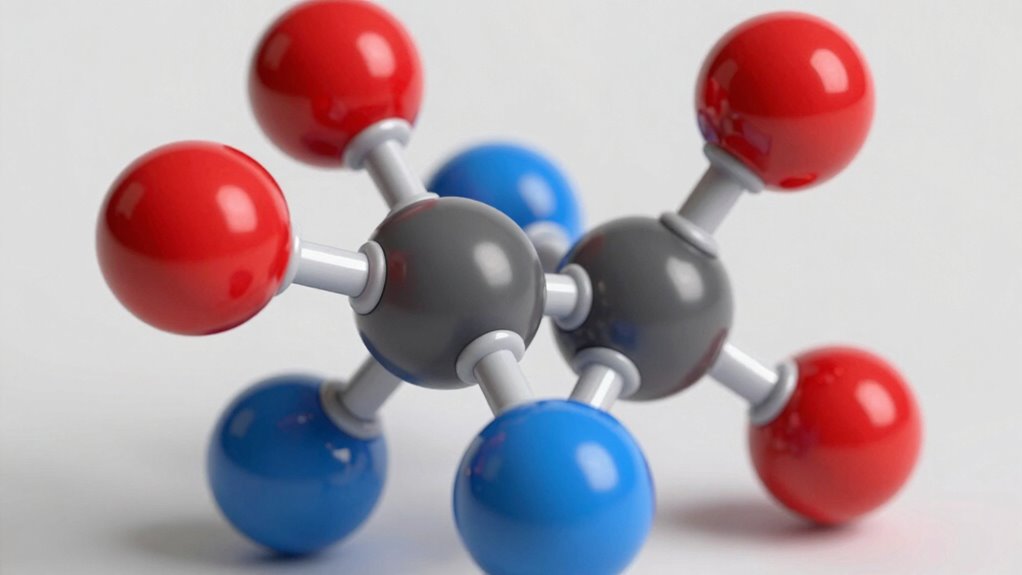

You might wonder why some molecules are polar while others aren’t. It mainly depends on their shape and the difference in electronegativity between atoms. If a molecule has an asymmetrical shape and polar bonds, it creates an overall dipole, making it polar. Symmetrical shapes with polar bonds can cancel out, resulting in nonpolar molecules. Understanding how shape and bond polarity work together can help you predict molecular behavior and interactions more confidently. Keep exploring these concepts to see how they fit together.

Prime made for students and young adults
- Fast, free delivery for dorm and study essentials
- Prime Video and Amazon Music included
- Member-only deals
Key Takeaways
- Molecules are polar when they have uneven charge distribution due to differences in electronegativity between bonded atoms.
- Asymmetrical molecular shapes prevent dipole moments from canceling, resulting in overall polarity.
- Larger electronegativity differences create stronger dipoles, increasing molecular polarity.
- The combination of bond polarity and molecular shape determines whether a molecule is polar or nonpolar.
- Polar molecules interact strongly with water and other polar substances, affecting solubility and physical properties.
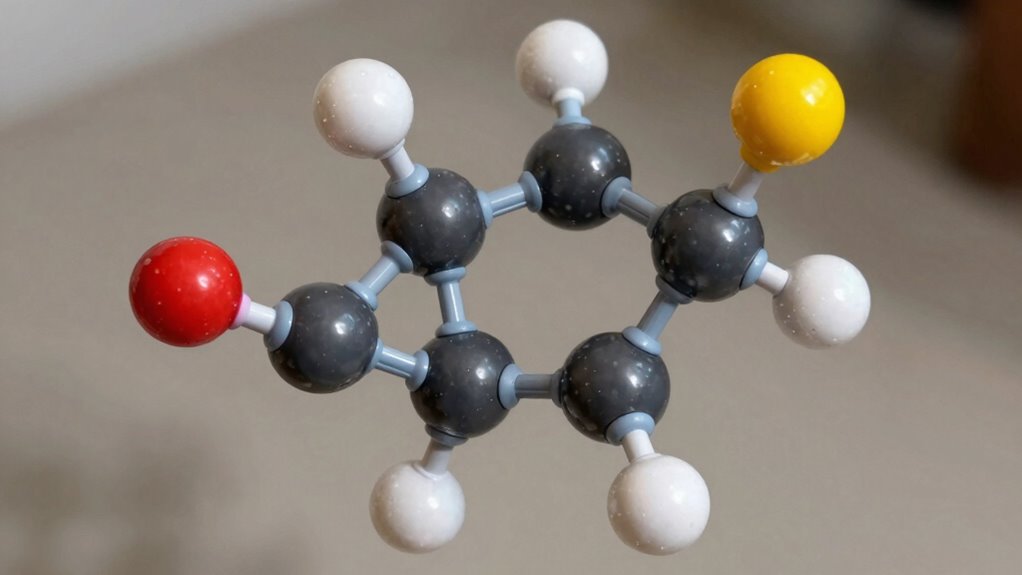
Have you ever wondered why some molecules dissolve easily in water while others don’t? The answer lies in the way their atoms are arranged and the differences in electronegativity between those atoms. When you look at a molecule, its molecular shape plays a vital role in determining whether it’s polar or nonpolar. If the shape is symmetrical—like in carbon dioxide—the individual bond polarities cancel out, making the overall molecule nonpolar. But if the shape is asymmetrical—such as in water—the dipoles don’t cancel, resulting in a polar molecule. Your understanding of molecular shape helps you see why some molecules interact strongly with water, which is a polar solvent, and others don’t.
Electronegativity differences are equally important. Electronegativity is a measure of how strongly an atom attracts electrons in a bond. When two atoms with different electronegativities form a bond, the shared electrons tend to spend more time around the more electronegative atom. This creates a partial negative charge on that atom and a partial positive charge on the other, generating a dipole. The larger the electronegativity difference, the more pronounced this dipole becomes. For example, in hydrogen fluoride (HF), fluorine’s high electronegativity pulls more on the shared electrons than hydrogen does, resulting in a highly polar bond. Conversely, in molecules like methane (CH₄), the electronegativities of carbon and hydrogen are similar, so the bonds are nearly nonpolar.
Furthermore, the interplay between molecular shape and polarity** determines how molecules behave in different environments and influences properties like boiling point and solubility. Recognizing the role of electronegativity in bond formation allows chemists to predict the polarity of molecules more accurately. Understanding molecular geometry also helps explain why some molecules have higher boiling points due to stronger intermolecular forces. Additionally, the distribution of charge within a molecule can further influence its polarity and interactions. Now, when you combine molecular shape with electronegativity differences, you get the full picture of a molecule’s polarity. Even if bonds are polar, the overall molecule might be nonpolar if its shape causes the individual dipoles to cancel out. Take carbon tetrachloride (CCl₄)—its tetrahedral shape is symmetrical, so despite having polar C–Cl bonds, the molecule as a whole is nonpolar. On the other hand, water (H₂O) has a bent shape, and the polar bonds do not cancel out, giving it a significant overall dipole moment**.
Understanding these concepts helps you predict how molecules will behave in different environments. Polar molecules tend to dissolve in water because they can interact with water’s dipoles, while nonpolar molecules prefer nonpolar solvents. So, when you examine a molecule’s shape and the electronegativity differences between its atoms, you gain insight into its polarity and its interaction with other substances.
As an affiliate, we earn on qualifying purchases.
Frequently Asked Questions
How Is Molecular Polarity Measured Experimentally?
You measure molecular polarity experimentally by determining the dipole moment, which indicates the molecule’s overall polarity. Spectroscopic techniques, like microwave spectroscopy, are commonly used for this purpose. These methods detect how molecules interact with electromagnetic radiation, allowing you to calculate the dipole moment accurately. A larger dipole moment means higher polarity, helping you understand how molecules behave in different chemical environments and reactions.
Can Molecules Change Polarity Under Different Conditions?
Yes, molecules can change their polarity under different conditions. External factors like temperature, pressure, or the surrounding environment can influence molecular dipoles, leading to polarity reversal. For example, applying an electric field can realign dipoles, altering the molecule’s overall polarity. Changes in solvent or phase shifts can also impact molecular dipoles, causing temporary or even permanent shifts in polarity depending on the conditions.
Do All Molecules With Polar Bonds Exhibit Polarity?
Not all molecules with polar bonds are polar. Electronegativity differences create bond dipoles, but symmetry effects can cancel these out. If a molecule’s shape is symmetrical, the individual bond dipoles may cancel, making the molecule nonpolar despite polar bonds. Conversely, asymmetrical molecules tend to have a net dipole moment, resulting in overall polarity. So, both electronegativity differences and symmetry effects determine if a molecule is polar.
How Does Molecular Geometry Influence Polarity?
Your molecule’s shape, or molecular geometry, directly impacts its polarity. If the molecular shape causes the electron distribution to be uneven, the molecule becomes polar. For example, a bent shape with lone pairs on the central atom causes an asymmetric electron distribution, making it polar. Conversely, symmetrical shapes like linear or tetrahedral distribute electrons evenly, resulting in a nonpolar molecule. Your molecule’s geometry determines how electrons are shared and whether polarity arises.
Are Polar Molecules Always Soluble in Water?
Think of molecules as dance partners; polar molecules often sway smoothly in water’s embrace, making them soluble. Generally, polar molecules are soluble in water because of solubility effects driven by their dipole moments. However, there are polarity exceptions—some polar molecules are insoluble due to strong intermolecular forces or large nonpolar regions. So, while many polar molecules dance with water, some prefer to stay on the sidelines.
polar molecule demonstration kit
As an affiliate, we earn on qualifying purchases.
As an affiliate, we earn on qualifying purchases.
Conclusion
Understanding why some molecules are polar helps you grasp how they interact in the world around you. Did you know that water, a highly polar molecule, makes up about 70% of the Earth’s surface? This fact shows how polarity influences everything from weather to biology. Recognizing these differences allows you to predict how molecules behave, making chemistry less mysterious and more fascinating. So, next time you see a molecule, remember its polarity could be the key to its unique properties.
As an affiliate, we earn on qualifying purchases.
molecular geometry educational tools
As an affiliate, we earn on qualifying purchases.
As an affiliate, we earn on qualifying purchases.
Fall Picks
fall essentials
As an affiliate, we earn on qualifying purchases.