Laboratory incubators rely on maintaining a stable temperature to support accurate experiments and reliable results. Fluctuations can stress cells, disrupt gene expression, and reduce sample viability, leading to inconsistent data. Precise temperature control features like sensors and thermostats are crucial for long-term studies and reproducibility. If you want to understand how these factors impact your research’s success and explore best practices, keep exploring the essential role of temperature stability in incubator performance.
Key Takeaways
- Laboratory incubators provide controlled environments essential for accurate biological and genetic experiments.
- Temperature stability ensures consistent gene expression and cell viability during cell culture and research.
- Fluctuations can stress samples, leading to unreliable data and compromised experiment reproducibility.
- Precise temperature control features enhance research quality by maintaining consistent conditions over time.
- Stable incubator environments are vital for the integrity, reliability, and validity of scientific results.
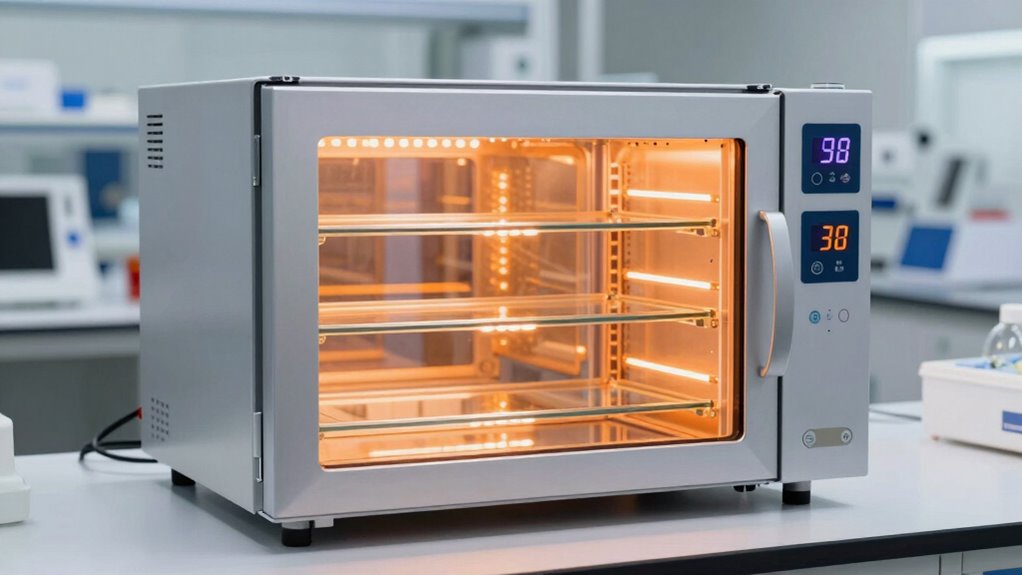
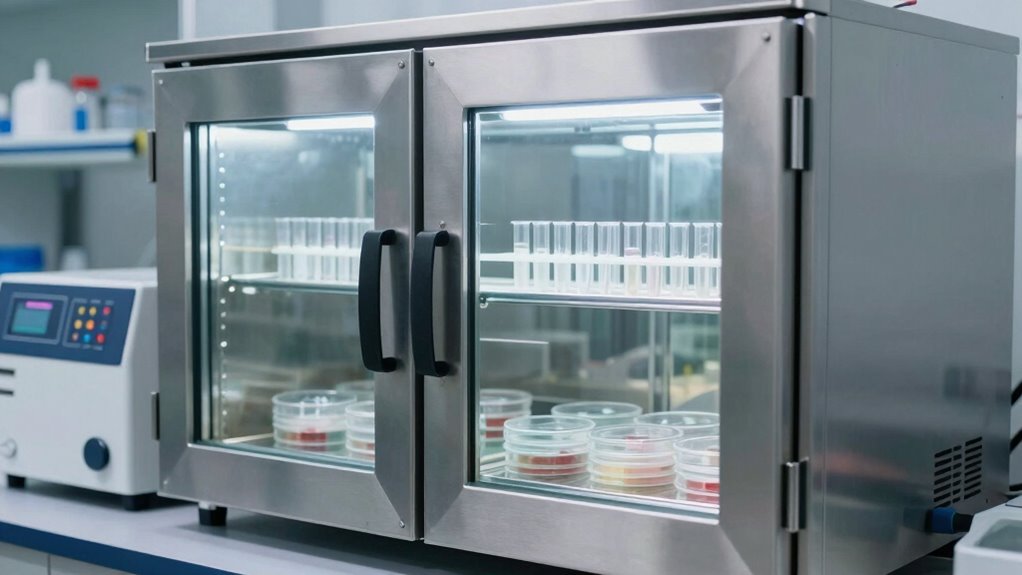
Laboratory incubators play an essential role in scientific research and diagnostics by providing a controlled environment for growing cultures, testing samples, or conducting experiments. When it comes to genetic research and cell culture techniques, maintaining a consistent temperature inside the incubator is absolutely necessary. Fluctuations, even minor ones, can disrupt the delicate processes involved in cell growth and genetic expression, leading to unreliable results. You need to trust that your incubator offers stable conditions so your experiments can proceed smoothly and produce accurate data.
In genetic research, where precision matters more than anything, temperature stability influences gene expression and mutation rates. If the temperature drifts too high or too low, it can stress the cells or alter their behavior, skewing your results. This is especially true when working with sensitive samples or conducting experiments that require strict control over environmental variables. When your incubator maintains a consistent temperature, you can be confident that the changes you observe are due to your experimental variables, not external fluctuations.
Cell culture techniques are equally dependent on a steady environment. Growing cells outside their natural habitat demands exact conditions to guarantee healthy proliferation and differentiation. Temperature instability can cause cell stress, reduce viability, or even kill cultures altogether. When your incubator provides a steady temperature, it supports ideal cell growth, which is essential for obtaining reliable, reproducible results. Whether you’re expanding cell populations or preparing samples for analysis, you need a device that keeps temperature fluctuations to a minimum. Proper temperature regulation is crucial to prevent unintended variability in your experiments. Investing in an incubator with advanced temperature control features can further ensure consistent results, especially during long-term studies. Additionally, humidity control can also contribute to maintaining optimal conditions for sensitive biological samples.
Aside from influencing biological processes, temperature stability also impacts the reproducibility of your experiments. Consistent conditions mean your results are repeatable, a core principle of scientific research. If your incubator’s temperature varies, it becomes difficult to determine whether changes in your data stem from experimental variables or environmental inconsistencies. This can compromise the integrity of your research and lead to flawed conclusions.
Additionally, temperature control features such as precise sensors and reliable thermostats are critical for maintaining stable conditions over time. Investing in an incubator with these capabilities can significantly enhance the quality of your research outcomes. It reduces the need for constant monitoring and adjustments, letting you focus on your research rather than troubleshooting environmental issues. When you understand why temperature stability matters, you’ll appreciate the importance of choosing the right incubator to support your genetic research and cell culture techniques. It’s the foundation for producing trustworthy, high-quality scientific results.

IVYX Scientific 5L Incubator – Precise Temperature Control from 0°C to +55°C, 12V DC / 110V AC
VERSATILE: Can be set as a refrigerator or warm incubator for a variety of science projects. Especially well…
As an affiliate, we earn on qualifying purchases.
As an affiliate, we earn on qualifying purchases.
Frequently Asked Questions
How Often Should Laboratory Incubators Be Calibrated?
You should calibrate your laboratory incubator at least once every six months, though more frequent calibration may be necessary if you notice temperature fluctuations. Regular calibration guarantees accurate temperature monitoring, which is crucial for consistent results. Keep an eye on device performance, and consider calibration if you modify settings or after repairs. Consistent calibration helps maintain temperature stability and upholds the integrity of your experiments.
What Are the Common Causes of Temperature Fluctuations?
A stitch in time saves nine, and preventing temperature issues is no different. You’ll find that sensor accuracy and power fluctuations are common causes of temperature fluctuations. Faulty sensors can give inaccurate readings, while power fluctuations disrupt the incubator’s consistent environment. Regular maintenance, proper calibration, and stable power sources help keep temperature fluctuations in check, ensuring reliable results and ideal conditions for your experiments.
How Does Ambient Room Temperature Affect Incubator Performance?
Your incubator’s performance is directly affected by ambient room temperature; fluctuations can cause internal temperature instability. When the room temperature varies, the incubator works harder to maintain consistent conditions, risking uneven results. Humidity control also plays a role, as unstable room humidity can impact internal humidity levels, affecting sample growth. To guarantee peak performance, keep the room temperature steady and maintain proper humidity control around your incubator.
Are There Safety Features to Prevent Temperature Malfunctions?
Yes, laboratory incubators often have safety mechanisms to prevent temperature malfunctions. These features include alarms that alert you if the temperature deviates from set parameters, automatic shut-off systems, and backup power supplies. They work together to guarantee malfunction prevention, safeguarding your samples and experiments. Regular maintenance and calibration further enhance safety, giving you peace of mind that the incubator will operate reliably and prevent temperature-related issues.
What Maintenance Is Required for Optimal Temperature Stability?
You need to regularly calibrate your incubator’s sensors to guarantee accuracy, which coincidentally maintains consistent temperature control. Keep an eye on power fluctuations, as they can cause instability, so consider using surge protectors. Clean the vents and interior to prevent dust buildup that can interfere with sensor readings. Periodic inspections and prompt repairs help maintain ideal temperature stability, ensuring your experiments stay reliable and precise.
IVYX Scientific 5L Incubator – Precise Temperature Control from 0°C to +55°C, 12V DC / 110V AC
VERSATILE: Can be set as a refrigerator or warm incubator for a variety of science projects. Especially well…
As an affiliate, we earn on qualifying purchases.
As an affiliate, we earn on qualifying purchases.
Conclusion
Just as the steady hand of a master chef guarantees a perfect dish, maintaining temperature stability in laboratory incubators assures reliable results. Remember, in the grand tapestry of scientific discovery, small details matter—like the quiet hum of a well-calibrated incubator. When you prioritize precise temperature control, you’re not just conducting experiments; you’re shaping the future, much like the steady rhythm of a heart that keeps the universe alive.

Onsju 18 Egg Incubators for Hatching Eggs, Automatic Egg Turning and Humidity Control Incubator for Hatch Chicken Duck Quail Pigeon Pheasant Partridge Home Classroom Lab-
🔔[Precision Temperature Control] – Our digital incubator maintains professional-grade temperature accuracy within optimal hatching ranges. An advanced airflow…
As an affiliate, we earn on qualifying purchases.
As an affiliate, we earn on qualifying purchases.
IVYX Scientific 5L Incubator – Precise Temperature Control from 0°C to +55°C, 12V DC / 110V AC
VERSATILE: Can be set as a refrigerator or warm incubator for a variety of science projects. Especially well…
As an affiliate, we earn on qualifying purchases.
As an affiliate, we earn on qualifying purchases.