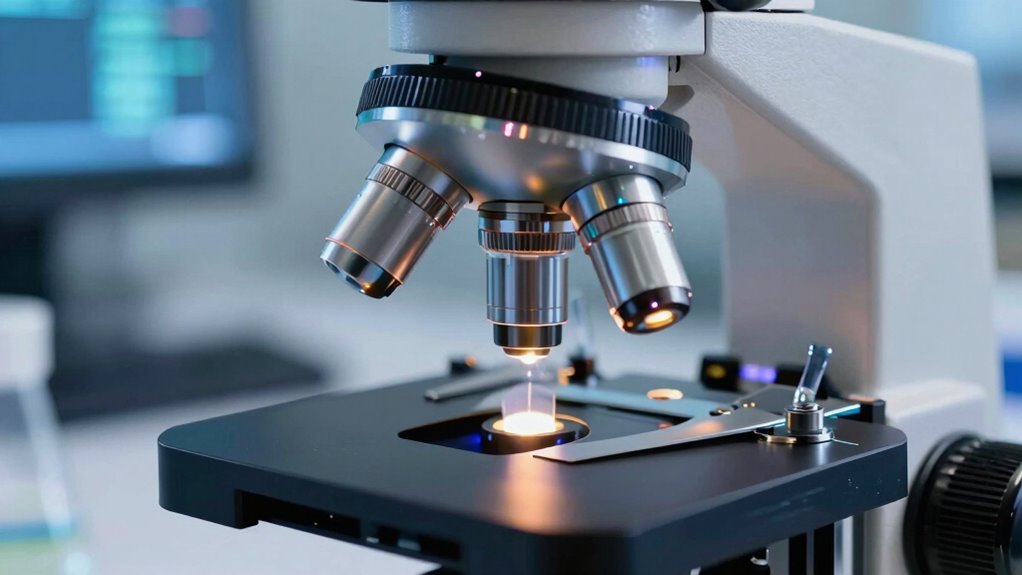

Modern microscopes are incredibly useful beyond biology because they let you examine materials, surfaces, and nanoscale structures in detail. They help identify defects, analyze composition, and study surface features essential for engineering and nanotechnology. By using digital imaging and data analysis, you can work faster and more accurately. These tools improve quality control and support innovation in various industries. If you want to discover how they’re shaping future technologies, keep exploring.

Prime made for students and young adults
- Fast, free delivery for dorm and study essentials
- Prime Video and Amazon Music included
- Member-only deals
Key Takeaways
- Enable detailed analysis of material surfaces, defects, and composition for engineering and manufacturing improvements.
- Facilitate nanotechnology by visualizing structures just a few nanometers in size.
- Support digital imaging and data analysis for faster, more accurate microscopic evaluation.
- Assist in quality control by detecting microscopic flaws in products like microchips and coatings.
- Drive innovation in materials science and research through high-resolution, atomic-level insights.
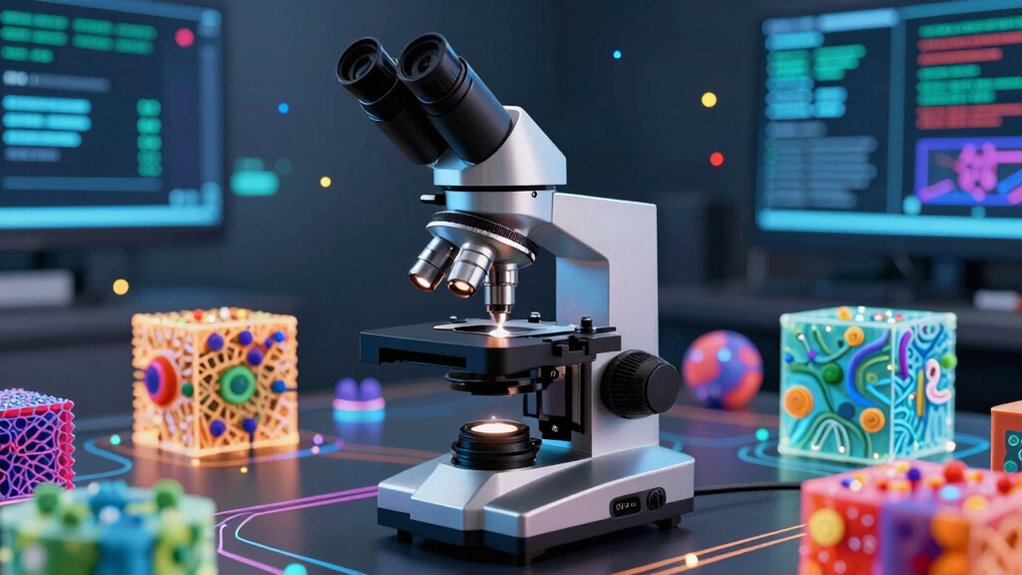
While microscopes are traditionally associated with biology, their applications have expanded far beyond that field. Today, modern microscopes have become essential tools in industries like material analysis and nanotechnology applications. Their ability to reveal details at the microscopic and even atomic levels makes them invaluable for scientific discovery and practical problem-solving. When you analyze materials, for instance, these microscopes allow you to examine surface structures, identify defects, and determine composition with remarkable precision. This level of detail helps you develop stronger, more reliable materials, whether you’re working on engineering components, electronic devices, or advanced coatings.
Modern microscopes reveal atomic details, enabling advanced material analysis and innovative technological breakthroughs.
In nanotechnology, microscopes are indispensable because they let you see structures just a few nanometers in size. You can manipulate atoms and molecules, observe nanoscale phenomena, and even design nanomaterials with specific properties. These capabilities are essential when you’re developing new materials with enhanced strength, flexibility, or conductivity. Modern tools like scanning electron microscopes (SEMs) and atomic force microscopes (AFMs) give you a detailed view of nanostructures that would be impossible to see with traditional optical microscopes. This high resolution allows you to understand how nanoscale features influence the overall behavior of materials, enabling you to innovate more effectively. The integration of digital imaging and data analysis has further enhanced these microscopes’ capabilities, making detailed analysis more accessible and efficient.
The usefulness of modern microscopes extends to quality control as well. In manufacturing, they help you detect tiny flaws or inconsistencies in products before they reach consumers. Whether you’re inspecting microchips, testing the integrity of thin films, or analyzing composite materials, these microscopes provide the clarity needed to guarantee reliability and safety. They also play a fundamental role in research and development, where understanding the minute details of a sample can lead to breakthroughs in technology and materials science. Advances in microscopy technology have made these tools faster, more accurate, and more user-friendly. You can now perform complex material analysis and nanotechnology applications with greater ease, often integrating digital imaging and data analysis to streamline your workflow. This means you can obtain detailed information quickly, make informed decisions, and accelerate your research or product development cycles. Modern microscopes have truly transformed how you explore and manipulate the microscopic world, opening up new possibilities across multiple scientific and industrial domains. Enhanced resolution capabilities are continually expanding the scope of what can be observed and manipulated at the nanoscale, making it possible to explore previously inaccessible atomic-level details.
scanning electron microscope for sale
As an affiliate, we earn on qualifying purchases.
As an affiliate, we earn on qualifying purchases.
Frequently Asked Questions
How Do Modern Microscopes Assist in Materials Science Research?
Modern microscopes assist in materials science research by providing optical enhancement, allowing you to see tiny details of materials at high resolution. They enable precise sample preparation, helping you analyze structural properties accurately. With advanced imaging techniques, you can study surface morphology, composition, and defects. These tools make it easier for you to develop new materials, improve existing ones, and understand properties at the microscopic level, advancing innovations across various industries.
Can Microscopes Be Used for Archaeological Artifact Analysis?
Yes, microscopes help analyze archaeological artifacts by revealing details like ancient residues and surface textures. You can examine tiny inscriptions or tool markings that aren’t visible to the naked eye, aiding in preservation efforts. Modern microscopes allow you to study artifacts without damaging them, ensuring long-term preservation. They provide vital insights into ancient cultures, helping you understand historical contexts through detailed surface and material analysis.
What Role Do Microscopes Play in Nanotechnology Development?
You play a vital role in nanotechnology development with microscopes, as they enable quantum imaging and nanoscale manipulation. These advanced tools let you observe and manipulate materials at atomic levels, leading to innovations in electronics, medicine, and materials science. By harnessing the precision of modern microscopes, you can push the boundaries of what’s possible in creating tiny, powerful devices and exploring quantum phenomena with unprecedented detail.
Are Microscopes Useful in Environmental Monitoring?
Sure, microscopes are practically indispensable for environmental monitoring. You can use them for microbial detection, catching tiny invaders before they cause chaos, or pollutant analysis, revealing hidden toxins lurking in water or air. Who needs a giant lab when your microscope can uncover the secrets of nature’s tiniest villains? They make it possible to monitor ecosystems accurately, ensuring you’re always one step ahead of environmental disasters—like a superhero for the planet.
How Do Microscopes Contribute to Quality Control in Manufacturing?
You use microscopes in manufacturing to guarantee quality control through precision imaging and defect detection. These advanced tools help you spot tiny flaws or inconsistencies that might go unnoticed otherwise. By providing detailed visuals at a microscopic level, microscopes allow you to verify the integrity of components, maintain high standards, and prevent defective products from reaching customers. This ensures your manufacturing process stays efficient and reliable.
As an affiliate, we earn on qualifying purchases.
Conclusion
Modern microscopes open doors to countless fields, from materials science to medicine, from electronics to forensics. They reveal details invisible to the naked eye, enabling you to innovate, analyze, and understand the world more deeply. Whether you’re examining tiny cracks or intricate circuits, their power lies in precision, clarity, and versatility. Embrace these tools not just for what they show you, but for how they expand your possibilities, your insights, and your understanding beyond the limits of sight.
digital microscopes for material analysis
As an affiliate, we earn on qualifying purchases.
As an affiliate, we earn on qualifying purchases.
As an affiliate, we earn on qualifying purchases.
Halloween Picks
halloween
As an affiliate, we earn on qualifying purchases.