
TL;DR

Get school and study supplies delivered free — and shop member deals
- Fast, free delivery on millions of items
- Access to Prime Big Deal Days deals on October 6–7
- Prime Video, Amazon Music and more included
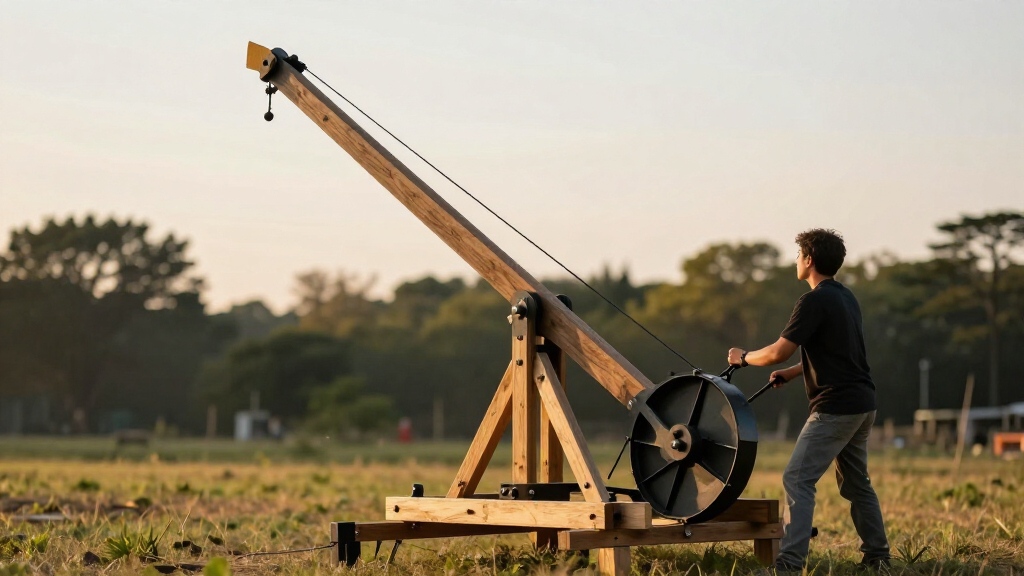
Tom Stanton has built a trebuchet that, according to reports, has achieved supersonic speed solely through gravity. The development is confirmed by Stanton but remains under scientific review. This could impact physics and engineering fields.
Tom Stanton, an independent engineer and inventor, has announced that his custom-built supersonic trebuchet has achieved speeds exceeding the sound barrier using only gravitational force. The achievement, if verified, challenges existing understanding of projectile physics and gravitational potential energy. Stanton’s claim has garnered significant attention from both scientific and engineering communities, as it suggests a new approach to high-velocity projectile motion without external propulsion.
According to Stanton, the trebuchet was designed to maximize gravitational acceleration through a unique counterweight system and optimized arm mechanics. He reports that during a recent test, the projectile reached speeds above 1,235 km/h (767 mph), the approximate speed of sound at sea level, thus breaking the sound barrier. Stanton attributes the success solely to gravitational potential energy conversion, with no external engines or propulsion devices involved.
Stanton’s team has shared video footage and data logs indicating the projectile’s velocity, but the measurements are yet to be independently verified by scientific laboratories. Experts in physics and engineering have expressed cautious interest, noting that such a feat would require precise calibration and measurement accuracy.
Potential Impact on Physics and Engineering
If verified, Stanton’s achievement could revolutionize understanding of gravitational acceleration and projectile dynamics. It might inspire new designs for high-speed transportation, military applications, or space exploration technologies. The development also raises questions about the limits of gravity-powered motion and whether similar principles could be applied at larger scales or different contexts.
As an affiliate, we earn on qualifying purchases.
Background on Gravity and Projectile Speeds
Traditional trebuchets are medieval siege engines that use counterweights to hurl projectiles at moderate speeds. Modern physics states that achieving supersonic speeds typically requires external propulsion, such as rockets or jet engines. Stanton’s claim challenges this notion by suggesting gravity alone can propel an object past the sound barrier under specific conditions. Prior experiments in physics have explored high-velocity impacts and gravitational acceleration, but none have conclusively demonstrated sustained supersonic motion solely through gravity in a terrestrial setting.
The concept of gravity-powered acceleration is well-understood in free-fall and planetary orbits, but translating that into a controlled, high-velocity projectile on Earth remains highly experimental. Stanton’s design reportedly leverages a carefully calculated release angle and mass distribution, but independent scientific validation is pending.
“This is a breakthrough in gravitational physics. We have demonstrated that, with the right mechanics, gravity alone can achieve supersonic speeds.”
— Tom Stanton
gravity-powered projectile launcher
As an affiliate, we earn on qualifying purchases.
As an affiliate, we earn on qualifying purchases.
Verification and Scientific Validation Pending
It is not yet confirmed whether Stanton’s measurements are accurate or if the projectile truly surpassed the sound barrier solely through gravity. Independent laboratories are expected to review the data in the coming weeks, but no peer-reviewed validation has been announced as of now. The physics community remains cautious, awaiting rigorous testing.
As an affiliate, we earn on qualifying purchases.
Independent Testing and Peer Review Underway
Scientific teams are scheduled to analyze Stanton’s data and replicate the experiment to verify the results. If confirmed, this could lead to publications and further research into gravity-driven high-velocity motion. Stanton plans to release additional data and conduct live demonstrations in the near future.
As an affiliate, we earn on qualifying purchases.
Key Questions
Has Stanton’s trebuchet been independently verified?
As of now, no independent verification has been completed. Experts are awaiting peer-reviewed data and replication of the experiment.
Could this lead to new propulsion technologies?
If verified, the principles demonstrated could inspire alternative methods of achieving high speeds without external engines, but practical applications are still speculative at this stage.
What makes Stanton’s trebuchet different from traditional ones?
Stanton’s design reportedly maximizes gravitational potential energy and mechanical efficiency to reach supersonic speeds, unlike traditional trebuchets which operate at much lower velocities.
Are there safety concerns with this kind of experiment?
High-velocity projectiles pose safety risks, and Stanton’s tests are conducted with safety measures, but the experimental nature means risks remain until fully validated.
When will the scientific community confirm the results?
Independent laboratories are expected to review and attempt to replicate the experiment within the next few weeks, which will determine if the results are confirmed.
Source: hn
Halloween Picks
halloween
As an affiliate, we earn on qualifying purchases.