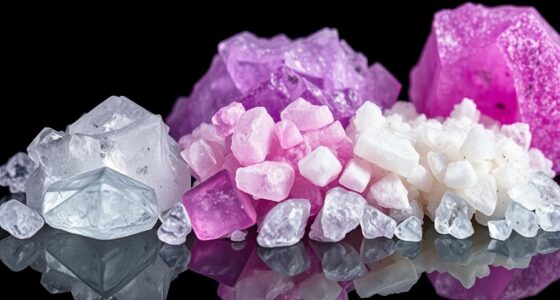
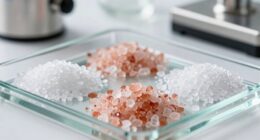
When you explore crystal hydrates in common salts, you’ll see that water molecules are embedded within their crystal structures, affecting their appearance, stability, and behavior. These water molecules fit into specific lattice sites during formation and are stabilized through hydrogen bonds and electrostatic interactions. Factors like temperature, humidity, and the strength of internal bonds influence whether a hydrate remains stable or turns into an anhydrous form. Understanding these interactions helps predict how salts will behave under different conditions, and there’s more to uncover as you go further.
Key Takeaways
- Crystal hydrates are salts with water molecules embedded in their crystal structure, affecting their properties and stability.
- Water incorporation depends on the salt’s chemistry, formation conditions, and lattice site compatibility.
- Stable hydrates maintain water through hydrogen bonds and electrostatic interactions, influenced by environmental factors.
- Temperature, humidity, and pressure significantly impact hydrate stability, causing dehydration or rehydration.
- Understanding hydrate stability is essential for predicting salt behavior and optimizing industrial handling and storage.

Crystal hydrates are compounds where water molecules are integrated into the crystal structure, often giving them unique properties. When you look at common salts, you’ll notice that some form these hydrates, which means water molecules are embedded within their crystalline lattice. This water isn’t just loosely attached; it’s an essential part of the structure, affecting the salt’s appearance, stability, and behavior. Understanding how water molecule incorporation occurs helps explain why some salts are stable as hydrates while others aren’t.
Crystal hydrates are salts with water molecules embedded in their crystal structure, influencing stability and properties.
The process of water molecule incorporation depends on the chemical nature of the salt and the conditions under which it forms. During crystallization, water molecules fit into specific sites within the crystal lattice, stabilized by hydrogen bonds and electrostatic interactions. These interactions help maintain the hydrate’s structure, but they also influence how easily the water can be lost or gained. When you consider hydrate stability factors, temperature, humidity, and pressure come into play. For example, increasing temperature can cause the water molecules to escape, transforming the hydrate into an anhydrate, which is a salt without water. Conversely, exposure to high humidity can lead to the formation of hydrates from anhydrous salts, as water molecules are absorbed into the crystal lattice. Understanding these stability factors is crucial for predicting salt behavior in different environments.
Hydrate stability factors are critical because they determine whether a hydrate will persist under certain conditions or convert into another form. The strength of the bonds holding water molecules in place influences this stability. If these bonds are weak, even slight changes in environmental conditions can cause dehydration or rehydration. You might notice that some salts, like copper sulfate pentahydrate, readily lose water when heated, turning into a powder, while others, like sodium sulfate decahydrate, remain stable for longer periods. This difference lies in the specific interactions within their crystal structures, which are influenced by factors such as lattice energy, the size and shape of the crystal, and the packing efficiency of the molecules. Additionally, the chemical interactions within the crystal lattice play a pivotal role in determining the overall stability of hydrates. Moreover, the specific bond strengths between water molecules and the salt matrix also impact how easily dehydration occurs.
In practical terms, understanding water molecule incorporation and hydrate stability factors helps you predict how salts behave in different environments. It is also important to consider the effect of environmental conditions on hydrate stability, as they can significantly alter the physical properties of salts. Recognizing how environmental factors impact hydrate stability allows you to handle, store, and process salts more effectively, ensuring their desired properties are maintained. Ultimately, the interplay of water molecule incorporation and hydrate stability factors shapes the physical and chemical characteristics of crystal hydrates, making them fascinating and significant in many scientific and industrial contexts.

Celtic Sea Salt Light Grey Coarse – Unrefined Mineral Salt, 70+ Trace Minerals, Sustainably Harvested, GMP Certified – Cooking, Finishing, Hydration, Grinder Use – 1 lb Resealable Bag
Bursting with Naturally Occurring Minerals: Whole-crystal coarse sea salt with over 70 trace minerals that preserve the ocean’s…
As an affiliate, we earn on qualifying purchases.
As an affiliate, we earn on qualifying purchases.
Frequently Asked Questions
How Do Crystal Hydrates Affect Salt Solubility?
Crystal hydrates influence salt solubility through hydration effects, which can either increase or decrease solubility depending on the specific salt and hydrate form. When hydrates form, water molecules are incorporated into the crystal structure, affecting how easily the salt dissolves. This results in solubility variation, where some hydrates dissolve more readily, while others are less soluble than anhydrous salts, impacting your ability to predict and control salt solutions.
Are Crystal Hydrates Stable Under High Temperature?
Crystal hydrates aren’t very stable under high temperatures. When exposed to heat, they undergo thermal decomposition, breaking down and releasing water molecules. This process reduces hydrate stability, causing the salt to lose its water content and often changing its structure. If you’re working with hydrates at high temperatures, you should expect decomposition and possible conversion into anhydrous salts, which alters their properties and applications.
Can Crystal Hydrates Be Used in Industrial Applications?
Imagine you’re designing a process for industrial extraction, and hydrate formation becomes a key step. Crystal hydrates can indeed be used in industrial applications, like controlling moisture levels or purifying salts. For example, in salt production, hydrate formation helps separate impurities efficiently. These hydrates are valuable because they stabilize salts and facilitate specific reactions, making them versatile tools in various manufacturing and chemical processes.
What Are Common Methods to Identify Crystal Hydrates?
You identify crystal hydrates by examining hydrate formation and analyzing their crystal structure. You can use techniques like X-ray diffraction to observe the unique lattice arrangements that hydrate crystals have compared to anhydrous forms. Thermogravimetric analysis (TGA) helps detect water loss upon heating, confirming hydrate presence. Additionally, spectroscopy methods like IR can reveal characteristic water vibrational modes, making them essential tools for identifying crystal hydrates accurately.
Do Crystal Hydrates Influence the Taste of Salts?
Ever wondered if crystal hydrates affect your salt’s taste? They definitely can. These hydrates influence salt crystallization, altering how flavors are released. When hydrated salts dissolve, they may enhance or sometimes mask certain flavors, giving you a different experience with each sprinkle. So, yes, crystal hydrates do play a subtle role in flavor enhancement, making your culinary adventures more intriguing than you might have guessed.

Copper Sulfate Pentahydrate 99.9% Crystals – 10 Lbs.
Made in The USA
As an affiliate, we earn on qualifying purchases.
As an affiliate, we earn on qualifying purchases.
Conclusion
By now, you see how crystal hydrates influence the properties of common salts. Did you know that over 50% of salts in nature form hydrates? This statistic highlights how essential water molecules are in shaping mineral structures and their stability. Understanding these relationships helps in fields like medicine, food preservation, and industrial manufacturing. So, next time you encounter salt, remember it might be more than just a simple mineral—it’s part of a complex, hydrated world.
REDMOND Re-Lyte Kids Hydration Electrolyte Mix Powder, Sample Pack (6 Ct.)
ELECTROLYTES FOR KIDS – We partnered with pediatricians to develop Re-Lyte Kids with the specific hydration needs of…
As an affiliate, we earn on qualifying purchases.
As an affiliate, we earn on qualifying purchases.

All-New 2026 8-in-1 Pool Test Strips -150 CT Pool Salt Test Strips | Salt Water Pool Testing Kit for Salt Water Pools, in & Above-Ground Pools, Hot Tubs&Spas| Quick&Accurate Testing Chlorine,pH,Salt
Premium Quality 8-in-1 Pool Test Strips– Crafted with premium Nordic fiber paper, our Salt Water Pool Testing Kit…
As an affiliate, we earn on qualifying purchases.
As an affiliate, we earn on qualifying purchases.