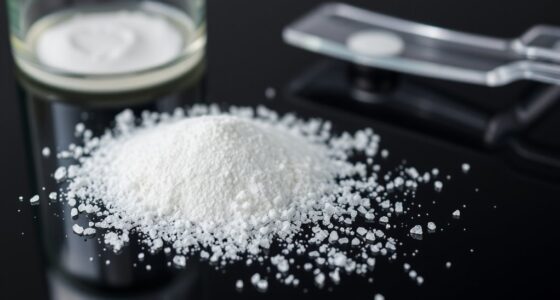
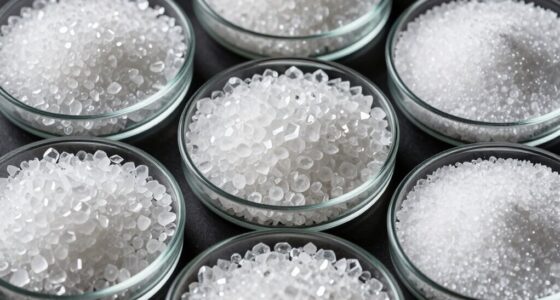
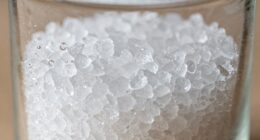
Potassium nitrate is crucial in various industries that directly impact your daily life. It’s widely used as a fertilizer to supply plants with potassium and nitrogen, boosting agricultural productivity. It also plays a key role in food preservation, preventing spoilage and extending shelf life for products like cured meats. Additionally, it’s indispensable in fireworks, providing the oxygen needed for vibrant colors and dazzling displays. Discover more about its versatile roles and how they shape everyday products.
Key Takeaways
- Potassium nitrate is a vital component in fertilizers, providing essential potassium and nitrogen to enhance crop growth.
- It is used in food preservation, especially for curing meats, by inhibiting bacterial growth and extending shelf life.
- In the fireworks industry, potassium nitrate acts as an oxidizer, enabling combustion and producing vibrant colors.
- Historically, it was used in gunpowder and continues to be crucial in pyrotechnic compositions for safety and visual effects.
- Its versatile chemical properties support multiple industries, including agriculture, food, and entertainment sectors worldwide.

Potassium nitrate, also known as saltpeter, plays an essential role in various industrial applications due to its unique chemical properties. Its history dates back centuries when it was used in traditional applications like preservation and medicine. Historically, potassium nitrate was crucial in the production of gunpowder, where it served as an oxidizer that fueled explosive reactions. During that era, its extraction often involved collecting naturally occurring deposits or producing it through complex methods involving plant materials and soil. These early uses laid the groundwork for its significance in different industries today.
In modern industrial processes, potassium nitrate’s role has expanded considerably, especially in agriculture, food production, and pyrotechnics. As a key component in fertilizers, it supplies plants with essential nutrients—potassium and nitrogen—that support healthy growth and improve crop yields. Farmers rely on this compound because it dissolves easily in water, making nutrient delivery efficient and quick. It’s particularly useful in soils deficient in potassium or nitrogen, helping to correct deficiencies and boost productivity. The application of potassium nitrate in fertilizers has become a standard practice globally, contributing to food security and sustainable agriculture.
Beyond its agricultural importance, potassium nitrate has a critical place in food preservation. Its ability to inhibit bacterial growth makes it ideal for curing meats like ham and sausages, where it prevents spoilage and extends shelf life. When added in controlled amounts, it also contributes to maintaining the desired color and flavor in preserved foods. This use dates back centuries, echoing its historical applications, yet it remains relevant today due to its effectiveness and safety when used properly.
Furthermore, potassium nitrate plays a key role in the fireworks industry. It acts as an oxidizer in pyrotechnic compositions, providing the oxygen needed to sustain combustion and produce vibrant colors and explosive effects. Its inclusion in fireworks is a direct evolution from its historical applications in gunpowder, but now, the focus is on entertainment and spectacle rather than weaponry. The precise formulation of fireworks relies heavily on potassium nitrate to guarantee safety, brightness, and the desired visual effects.

Potassium Nitrate Fertilizer – Liquid Nitrogen & Potassium Supplement to Support Plant Growth, 8 oz
High-quality potassium and nitrogen supplement for plants
As an affiliate, we earn on qualifying purchases.
As an affiliate, we earn on qualifying purchases.
Frequently Asked Questions
Is Potassium Nitrate Safe for Human Consumption?
Potassium nitrate can be safe for human consumption when used properly in food preservation and certain medical applications. However, you should be aware of health concerns and only consume it in regulated amounts. Excessive intake may lead to health risks like methemoglobinemia. Always follow safety guidelines and consult reliable sources to guarantee consumer safety. Never ingest potassium nitrate unless it’s approved for food or medical use.
How Is Potassium Nitrate Synthesized Industrially?
You’re asking how potassium nitrate is synthesized industrially. It’s created through an industrial synthesis process involving chemical reactions, primarily by reacting potassium chloride with sodium nitrate. This process produces potassium nitrate and sodium chloride as byproducts. The chemical reactions are carefully controlled to guarantee purity and efficiency. By understanding these reactions, you can see how raw materials are transformed into this essential compound used in various industries.
What Are the Environmental Impacts of Potassium Nitrate Production?
Sure, producing potassium nitrate is a shining example of environmental pollution and resource depletion. You might think you’re just making fertilizer, but you’re also risking soil and water contamination, not to mention draining natural resources. The process often releases hazardous waste and consumes significant energy, which adds to environmental strain. So, while you’re boosting crop yields, remember that your production method might be secretly chipping away at Earth’s health.
Can Potassium Nitrate Be Used in Medical Applications?
You can use potassium nitrate for certain medical applications, particularly in topical applications. It’s known to help treat conditions like psoriasis and can be included in ointments or creams to reduce skin thickening and inflammation. Medical uses of potassium nitrate are carefully controlled, ensuring safe application, and it’s essential to follow healthcare provider advice when using it topically. This helps maximize benefits and minimize potential side effects.
What Are Alternative Chemicals to Potassium Nitrate in Industry?
You can consider alternative chemicals like ammonium nitrate, urea, or ammonium sulfate as substitutes for potassium nitrate in industry. These chemical substitutes serve similar purposes in fertilizers, providing essential nutrients for plants. They’re often used in alternative fertilizers when potassium nitrate isn’t available or suitable. While they may differ in nutrient content and application, they effectively support agricultural needs, making them viable options for various industrial and farming uses.

Potassium Nitrate Technical Grade KNO3 4LBs 4 LBs (Granulated)
99.7% Pure or Higher
As an affiliate, we earn on qualifying purchases.
As an affiliate, we earn on qualifying purchases.
Conclusion
So, next time you see fireworks lighting up the night sky or enjoy perfectly preserved food, remember that potassium nitrate is the hidden hero making it all possible. Without it, your favorite snacks would spoil in a flash, and fireworks would be nothing more than dull sparks. It’s truly the miracle worker of the industry, turning ordinary ingredients into spectacular displays and life’s essentials into long-lasting delights. Talk about a tiny compound with a giant impact!
fireworks potassium nitrate kit
As an affiliate, we earn on qualifying purchases.
As an affiliate, we earn on qualifying purchases.

Innovating Science – Potassium Nitrate Lab Grade 500g – Versatile Oxidizing Agent for Scientific, Industrial, and Research Applications
LAB GRADE POTASSIUM NITRATE || Contains 500g of highly soluble potassium nitrate, suitable for laboratory, industrial, and chemical…
As an affiliate, we earn on qualifying purchases.
As an affiliate, we earn on qualifying purchases.