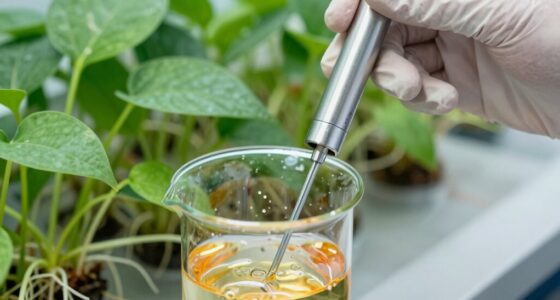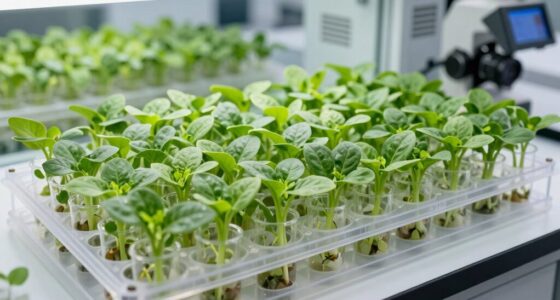
A PAR meter shows you the actual light intensity your grow lights produce, helping you determine if they support healthy plant growth through photosynthesis. It provides accurate data on PAR levels, ensuring your plants get enough light at each stage. You’ll also learn about the spectral quality, so you can adjust for the right wavelengths, and assess how energy-efficient your lights are. Keep exploring to discover how this tool can optimize your grow setup further.

Prime made for students and young adults
- Fast, free delivery for dorm and study essentials
- Prime Video and Amazon Music included
- Member-only deals
Key Takeaways
- It shows whether grow lights deliver adequate Photosynthetically Active Radiation (PAR) for healthy plant growth.
- It assesses the spectral quality to ensure the correct wavelengths support different growth stages.
- It measures energy efficiency by comparing PAR output relative to power consumption.
- It reveals light distribution uniformity, helping optimize placement and exposure for plants.
- It provides data to refine lighting conditions, enhancing overall plant health and productivity.

Understanding how your grow lights perform is essential for healthy plant development, and a PAR meter is the key tool to gauge their effectiveness. This device measures the Photosynthetically Active Radiation (PAR) that your plants receive, giving you concrete data about how well your lighting setup supports photosynthesis. When you use a PAR meter, you’re not just guessing whether your plants are getting enough light—you’re getting precise measurements that can help you optimize growth conditions. It reveals whether your grow lights deliver the right spectrum, ensuring spectral accuracy, which is vital because plants respond differently to various wavelengths. If your lights lack spectral accuracy, your plants might not be able to maximize their growth potential, even if the overall light intensity seems adequate. Additionally, a PAR meter can help you determine the spectral quality of your grow lights, ensuring they provide the wavelengths most beneficial for plant health. A PAR meter also helps you assess power efficiency. Instead of relying solely on wattage ratings, which can be misleading, you get real data on how much usable light your setup provides for plant growth. This means you can identify whether your grow lights are converting electrical power into effective PAR or if they’re wasting energy. If your measurements show low PAR values despite high power consumption, it indicates poor power efficiency. In such cases, you might consider switching to more efficient lighting options that provide better spectral quality and higher PAR output relative to energy used. This not only reduces electricity costs but also minimizes heat output, creating a healthier environment for your plants. Furthermore, understanding your light’s spectral distribution can help you tailor your lighting strategy to suit different stages of plant growth, ensuring optimal results throughout the lifecycle. Properly analyzing these factors with a PAR meter can also inform your decisions about lighting placement and the duration of light exposure, which are crucial for maximizing growth and yield.
As an affiliate, we earn on qualifying purchases.
Frequently Asked Questions
How Often Should I Calibrate My PAR Meter?
You should calibrate your PAR meter at least once every six months to maintain accurate readings. Regular calibration guarantees your meter’s light spectrum accuracy, which is essential for maximizing plant growth. If you frequently move it between different grow lights or environments, consider calibrating more often. Proper calibration helps you rely on precise measurements, so your plants get the right amount of light for healthy development.
Can a PAR Meter Measure UV or Infrared Light?
You can’t rely on a standard PAR meter to measure UV or infrared light, as it’s like comparing apples and oranges. While some advanced meters can handle UV measurement or infrared detection, most are designed specifically for photosynthetically active radiation. To get accurate readings, use specialized devices that focus on UV or IR. Don’t put all your eggs in one basket—use the right tools for the right job.
What Is the Ideal PAR Reading for Different Plant Stages?
For ideal plant growth, aim for a PAR reading between 400-600 µmol/m²/sec during vegetative stages, and increase to 600-900 µmol/m²/sec during flowering. Different plant stages require specific light spectrum and intensity to thrive. You should monitor PAR levels closely to guarantee your plants get the right amount of light spectrum at each stage, promoting healthy growth and maximizing yields. Adjust your grow lights accordingly for best results.
Do All PAR Meters Provide the Same Accuracy?
Did you know that not all PAR meters have the same accuracy? Some can vary by up to 20%, especially if they aren’t properly calibrated. While most measure the light spectrum effectively, device calibration is vital for reliable readings. You should always make sure your PAR meter is calibrated regularly, as this guarantees consistent, accurate measurements, helping you optimize your grow light setup and promote healthy plant growth.
How Does Distance From the Light Affect PAR Readings?
As you move closer or farther from the grow light, your PAR meter detects changes in light intensity, which directly impacts plant growth. When you’re closer, readings increase, providing higher light levels that promote robust growth. Conversely, moving away reduces the PAR readings, potentially limiting light exposure. Adjusting your distance guarantees your plants receive ideal light for healthy development, maximizing growth and ensuring your grow setup performs at its best.
plant grow light spectral analyzer
As an affiliate, we earn on qualifying purchases.
As an affiliate, we earn on qualifying purchases.
Conclusion
A PAR meter provides precise, practical, and powerful insights into your grow light’s performance. By measuring the moment-to-moment, meaningful, and measurable light levels, you can optimize your setup for lush, lively growth. Don’t doubt the data—dive into details, detect deficiencies, and drive your garden toward greatness. With this tool in hand, you turn uncertainty into understanding, releasing your plants’ full potential and ensuring every inch is illuminated with inspiration.
photosynthetically active radiation meter
As an affiliate, we earn on qualifying purchases.
As an affiliate, we earn on qualifying purchases.
grow light energy efficiency tester
As an affiliate, we earn on qualifying purchases.
As an affiliate, we earn on qualifying purchases.
Halloween Picks
halloween
As an affiliate, we earn on qualifying purchases.