For most homes, I’d start with the AcuRite Iris 01512MCB: its color display and outdoor readings offer a useful balance of at-a-glance information and weather monitoring. The Sainlogic 12-in-1 stands out for buyers who want rain and wind data, while the Newentor with two sensors suits households tracking more than one indoor or outdoor location. The main tradeoff is between simple temperature-and-humidity monitoring and a larger sensor setup that takes more space and effort to place. Wi-Fi features can add remote access, but they may not matter if you mainly check conditions from the kitchen or living room. Read on for my full comparison and help matching a station to your home.

Prime made for students and young adults
- Fast, free delivery for dorm and study essentials
- Prime Video and Amazon Music included
- Member-only deals
Key Takeaways
- The AcuRite Iris 01512MCB is my best overall pick for balancing a color display with outdoor readings; it offers a more rounded home setup than the simpler temperature-and-humidity stations.
- Rain and wind data are the clearest reason to choose a Sainlogic 12-in-1 or Wi-Fi station. If you only need indoor and outdoor temperature, that extra sensor coverage may add complexity without changing your daily decisions.
- Sensor count changes how useful a station is around the house. Newentor’s two-sensor option is better suited to comparing locations than one-sensor models, though it takes more thought to place and monitor sensors.
- Wi-Fi is most useful when you want readings away from the console. For a station checked at home, a straightforward display such as the La Crosse or DreamSky may be easier to live with.
- The roundup spans very different levels of weather tracking. A vertical forecaster or basic wireless display serves everyday temperature checks, while multi-sensor models are better for people who will use wind, rainfall, or app-based readings.
| AcuRite Iris 01512MCB Indoor/Outdoor Wireless Weather Station with Color Screen |  | Best for Full Outdoor Weather Tracking | Display: Color LCD | Connectivity: 433 MHz radio frequency | Measurements: Indoor and outdoor temperature and humidity, wind speed and direction, rainfall, and barometric pressure | VIEW LATEST PRICE | See Our Full Breakdown |
| La Crosse Technology Advanced Weather Station with Full-Color LCD and Atomic Time |  | Best for Everyday Comfort Readings | Display: Full-color LCD with adjustable backlight | Measurements: Indoor and outdoor temperature, humidity, heat index, and dew point | Wireless sensor range: Up to 330 ft (100 m) in open air | VIEW LATEST PRICE | See Our Full Breakdown |
| Newentor Wireless Weather Station with Indoor/Outdoor Thermometer and 2 Sensors |  | Best for Multi-Room Monitoring | Model: Q3 | Display: Color LCD | Sensor support: Up to 3 remote sensors; 1 included | VIEW LATEST PRICE | See Our Full Breakdown |
| Grinza Wireless Weather Station with Indoor/Outdoor Thermometer and Atomic Clock |  | Best for Sunrise, Sunset, and Tide Details | Model: SB003 | Display: 7.5-inch LCD with 5 brightness levels | Measurements and display information: Temperature, humidity, forecast, moon phase, tide, sunrise and sunset, time, and date | VIEW LATEST PRICE | See Our Full Breakdown |
| Sainlogic 12-in-1 Wireless Weather Station with Rain Gauge |  | Best for Solar-Powered Outdoor Readings | Weather functions: Rainfall, temperature, humidity, wind speed and direction, barometric pressure, dew point, and perceived temperature | Display: 6.5-inch LCD with 3 adjustable backlight levels | Rainfall accuracy: ±1 mm in light rain; ±7% in heavy rain | VIEW LATEST PRICE | See Our Full Breakdown |
| DreamSky Wireless Indoor/Outdoor Weather Station with Atomic Clock |  | Best for Multi-Room Temperature Monitoring | Measurements: Indoor and outdoor temperature and humidity | Display: Large color LCD with five adjustable backlight levels | Wireless sensor support: Up to 3 sensors; 1 included | VIEW LATEST PRICE | See Our Full Breakdown |
| Sainlogic 12-in-1 Wireless Weather Station with Rain Gauge |  | Best for Local Outdoor Weather Tracking | Measurements: Temperature, humidity, wind speed and direction, rainfall, barometric pressure, dew point, and perceived temperature | Display: 6.5-inch LCD with 3 adjustable backlight levels | Temperature range and accuracy: -40°F to 140°F; up to ±2°F (1°C) | VIEW LATEST PRICE | See Our Full Breakdown |
| AcuRite Wireless Home Weather Station with Color Display and Outdoor Sensor (02077M) |  | Best for Straightforward Forecasts | Model: 02077M | Measurements: Indoor and outdoor temperature, humidity, and barometric pressure trends | Forecast: Self-calibrating 12-hour forecast | VIEW LATEST PRICE | See Our Full Breakdown |
| Grillum Wireless Indoor/Outdoor Weather Station with 7.5″ Color Display |  | Best for a Large, Easy-to-Read Display | Model: EM3378UC-WWVB | Display: 7.5-inch HD color display | Measurements: Indoor/outdoor temperature and humidity, plus barometric pressure | VIEW LATEST PRICE | See Our Full Breakdown |
| Wi-Fi Weather Station with Rain Gauge, Wind Speed, and Smart App Control |  | Best for App-Based Weather Monitoring | Display: 7.5-inch HD VA LCD | Connectivity: 2.4 GHz Wi-Fi | Measured data: Temperature, humidity, wind speed, rainfall, barometric pressure, UV index, and feels-like temperature | VIEW LATEST PRICE | See Our Full Breakdown |
| AcuRite Iris 5-in-1 Home Weather Station with Wi-Fi, Black |  | Best for Full Outdoor Weather Tracking | Model: 01540M | Sensors: Anemometer, wind vane, barometer, hygrometer, rain gauge, and thermometer | Connectivity: Wi-Fi and 433 MHz | VIEW LATEST PRICE | See Our Full Breakdown |
| Sainlogic Smart Wi-Fi Weather Station with Indoor and Outdoor Monitoring |  | Best for Long-Term Data Logging | Model: SA68 Plus | Connectivity: 2.4GHz and 5GHz Wi-Fi; Bluetooth | Monitored conditions: Temperature, humidity, wind, rainfall, and barometric pressure | VIEW LATEST PRICE | See Our Full Breakdown |
| La Crosse Technology Wireless Color Weather Station with Outdoor Sensor |  | Best for Simple Indoor and Outdoor Readings | Model: C85845-INT | Display: Color LED with adjustable brightness | Connectivity: Wireless RF | VIEW LATEST PRICE | See Our Full Breakdown |
| AcuRite Digital Vertical Weather Forecaster with Indoor/Outdoor Temperature and Humidity |  | Best for Wall or Table Placement | Model: 01121M | Display: LCD | Connectivity: 433 MHz wireless | VIEW LATEST PRICE | See Our Full Breakdown |
| Newentor Wireless Indoor/Outdoor Weather Station with 1 Sensor |  | Best for Multi-Room Monitoring | Model: Q3 | Display: Color LCD | Included sensors: 1 remote sensor | VIEW LATEST PRICE | See Our Full Breakdown |
| digital weather stations for home | Display | Power | Connectivity | Temperature accuracy |
|---|---|---|---|---|
| AcuRite Iris 01512MCB Indoor/O | Color LCD | Corded electric; requires 10 AA batteries | 433 MHz radio frequency | ±1.11 °C |
| La Crosse Technology Advanced | Full-color LCD with adjustable backlight | 5V adapter included; optional backup requires 3 AAA alkaline batteries | — | — |
| Newentor Wireless Weather Stat | Color LCD | DC adapter or 2 AA batteries; batteries not included | — | — |
| Grinza Wireless Weather Statio | 7.5-inch LCD with 5 brightness levels | AC adapter or batteries; batteries not included | Wi-Fi | ±1°F |
| Sainlogic 12-in-1 Wireless Wea | 6.5-inch LCD with 3 adjustable backlight levels | Solar-powered with battery backup; requires 3 AA batteries, not included | Radio frequency wireless transmission; no Wi-Fi | — |
| DreamSky Wireless Indoor/Outdo | Large color LCD with five adjustable backlight levels | AC adapter with battery backup; requires 3 AA batteries | — | ±1°C |
| Sainlogic 12-in-1 Wireless Wea | 6.5-inch LCD with 3 adjustable backlight levels | Solar power with battery backup; requires 3 AA batteries | Wireless; Wi-Fi not supported | — |
| AcuRite Wireless Home Weather | Backlit color LCD with adjustable dimmer | AC adapter; display supports 3 AA batteries for optional backup | Wireless, 433 MHz | ±1.11°C |
| Grillum Wireless Indoor/Outdoo | 7.5-inch HD color display | Plug-in adapter or battery | — | — |
| Wi-Fi Weather Station with Rai | 7.5-inch HD VA LCD | — | 2.4 GHz Wi-Fi | — |
| AcuRite Iris 5-in-1 Home Weath | Color LCD | Battery powered | Wi-Fi and 433 MHz | ±2°F |
| Sainlogic Smart Wi-Fi Weather | — | — | 2.4GHz and 5GHz Wi-Fi; Bluetooth | ±5°F |
| La Crosse Technology Wireless | Color LED with adjustable brightness | 5V adapter; optional backup requires 3 AA batteries | Wireless RF | ±2°F |
| AcuRite Digital Vertical Weath | LCD | 5V adapter; optional 3 AAA backup batteries | 433 MHz wireless | ±1°C |
| Newentor Wireless Indoor/Outdo | Color LCD | DC adapter or batteries (not included) | — | ±1.8°F |
More Details on Our Top Picks
AcuRite Iris 01512MCB Indoor/Outdoor Wireless Weather Station with Color Screen
The AcuRite Iris 01512MCB is the most weather-focused choice here: it tracks wind speed and direction, rainfall, barometric pressure, temperature, and humidity, then adds historical readings and a personalized 12-hour forecast. That breadth makes it a better fit for homeowners who want to follow changing conditions around the property than the La Crosse Technology Advanced Weather Station, which concentrates on temperature, humidity, and comfort readings such as heat index and dew point. The color display puts readings, date, and time together, with adjustable brightness for different rooms. The tradeoff is a more involved setup: it requires 10 AA batteries, and the forecast’s pressure-based accuracy improves over roughly 14 days. I would choose it for outdoor data, not for Wi-Fi or app-based monitoring.
Pros:- Measures rainfall, wind speed and direction, and barometric pressure in addition to temperature and humidity.
- Color LCD combines the clock, date, current readings, and a personalized 12-hour forecast.
- Historical weather data helps track conditions beyond the current reading.
- Wireless outdoor sensor includes a mounting bracket.
Cons:- Requires 10 AA batteries, which are not included.
- Forecast calibration takes time; pressure accuracy improves over about 14 days.
- No Wi-Fi or app connectivity is listed.
Best for: Homeowners who want local readings for wind, rainfall, and pressure alongside indoor and outdoor temperature and humidity.
Not ideal for: Buyers who want app access, minimal battery use, or a simple temperature-and-humidity display.
- Display:Color LCD
- Connectivity:433 MHz radio frequency
- Measurements:Indoor and outdoor temperature and humidity, wind speed and direction, rainfall, and barometric pressure
- Temperature accuracy:±1.11 °C
- Temperature range:32 °F to 120 °F
- Power:Corded electric; requires 10 AA batteries
- Outdoor sensor:Wireless; mounting bracket included
- Features:Adjustable brightness, clock, historical data, and personalized 12-hour forecast
Our verdict“Choose the AcuRite Iris if detailed local wind and rainfall readings matter more than app access or a low-battery setup.”
La Crosse Technology Advanced Weather Station with Full-Color LCD and Atomic Time
The La Crosse Technology Advanced Weather Station suits households that want useful indoor and outdoor conditions without a rain gauge or wind sensors. Its heat index and dew point add context to temperature and humidity, helping explain how warm or damp a room or outdoor area may feel. Custom temperature alerts and minimum/maximum records are practical for tracking a nursery, greenhouse, or seasonal room. Compared with the AcuRite Iris 01512MCB, it gives up rainfall, wind, and barometric-pressure monitoring, but offers atomic time with automatic daylight-saving updates and a simpler set of weather readings to follow. The included adapter supports regular display use; on batteries, the backlight is on-demand rather than continuously lit. Its outdoor sensor also needs a shaded, sheltered location.
Pros:- Shows heat index and dew point alongside indoor and outdoor temperature and humidity.
- Atomic timekeeping updates the clock and daylight-saving time automatically.
- Customizable temperature alerts and minimum/maximum records help track changing conditions.
- Wireless sensor has an open-air range of up to 330 feet.
Cons:- Does not list rainfall, wind, or barometric-pressure measurements.
- Battery-powered backlight is on-demand and illuminates temporarily.
- Outdoor sensor placement should be shaded and protected from standing rain or snow.
Best for: Households that prioritize indoor comfort, temperature alerts, and automatic clock updates over wind and rainfall data.
Not ideal for: Home weather watchers seeking rain totals, wind direction, barometric pressure, or a continuously lit battery-powered screen.
- Display:Full-color LCD with adjustable backlight
- Measurements:Indoor and outdoor temperature, humidity, heat index, and dew point
- Wireless sensor range:Up to 330 ft (100 m) in open air
- Timekeeping:Atomic self-setting time and calendar with automatic daylight-saving updates
- Records and alerts:Minimum and maximum readings; customizable temperature alerts
- Power:5V adapter included; optional backup requires 3 AAA alkaline batteries
- Time format:12-hour or 24-hour
- Additional features:Time alarm with 10-minute snooze
Our verdict“Pick this La Crosse model for comfort-focused readings and automatic timekeeping, but choose the AcuRite Iris for broader outdoor measurements.”
Newentor Wireless Weather Station with Indoor/Outdoor Thermometer and 2 Sensors
The Newentor Q3 makes the most sense for homes where readings from several rooms matter. It supports up to three remote sensors, so a buyer can add coverage for a bedroom, greenhouse, or garage, though only one sensor comes in the box. Its color LCD also shows humidity, high and low records, barometric pressure, a 12–24-hour forecast, and moon phase, giving it more context than the La Crosse Technology Advanced Weather Station but less outdoor detail than the wind-and-rain-equipped AcuRite Iris 01512MCB. The included adapter keeps the display on; battery mode is better treated as a quick-glance backup because the screen lights for just 15 seconds. I would choose this for expandable room monitoring, not for a complete outdoor sensor array.
Pros:- Supports up to three remote sensor locations.
- Color LCD combines temperature, humidity, pressure, forecast, moon phase, and clock information.
- Included power adapter supports an always-on display.
- Atomic timekeeping, dual alarms, and customizable alerts add household utility.
Cons:- Only one remote sensor is included; additional sensors are needed for other locations.
- Battery mode provides only a 15-second quick-glance display.
- Does not list wind-speed, wind-direction, or rainfall monitoring.
Best for: Families or home gardeners who want to monitor several indoor or outdoor locations by adding remote sensors over time.
Not ideal for: Buyers who need multiple sensors included, a continuously illuminated battery display, or wind and rainfall measurements.
- Model:Q3
- Display:Color LCD
- Sensor support:Up to 3 remote sensors; 1 included
- Measurements:Indoor and outdoor temperature and humidity, high/low records, and barometric pressure
- Forecast:12–24-hour forecast
- Temperature accuracy and range:±1°F; 14°F to 122°F
- Power:DC adapter or 2 AA batteries; batteries not included
- Battery display mode:15-second quick-glance display
- Additional features:Atomic clock, moon phase, customizable alerts, dual alarms, and snooze
Our verdict“Choose the Newentor Q3 if expandable multi-room readings matter more than included sensor count or detailed wind and rain tracking.”
Grinza Wireless Weather Station with Indoor/Outdoor Thermometer and Atomic Clock
The Grinza SB003 distinguishes itself through the information around the weather: its 7.5-inch screen adds tide, sunrise and sunset, and moon phase to indoor and outdoor temperature, humidity, and forecasts. That makes it a more specialized home display than the Newentor Q3, which offers pressure readings and a 12–24-hour forecast but does not list tide or sunrise/sunset information. Grinza supports up to three sensor channels and includes one outdoor sensor, so more locations can be added later. Five brightness levels and adapter power help tailor the display to a room, while battery power offers an alternative when needed. The listed connectivity is Wi-Fi, but the product details do not describe app functions; buyers wanting rain and wind measurements should look to the AcuRite Iris 01512MCB instead.
Pros:- Large 7.5-inch screen includes tide, sunrise and sunset, and moon phase.
- Supports up to three sensor channels with one wireless outdoor sensor included.
- Five brightness levels offer more display adjustment than the Newentor Q3’s described battery quick-glance mode.
- Includes an adapter, dual alarms, and USB output.
Cons:- Only one outdoor sensor is included; additional sensors are sold separately.
- Batteries are not included, and the display dims on battery power.
- Rainfall and wind measurements are not listed, and app functions for the stated Wi-Fi connectivity are unspecified.
Best for: Households near the coast or buyers who want a large display that combines basic weather readings with tide and daylight information.
Not ideal for: Buyers who need documented app features, rainfall or wind measurements, or several sensors included.
- Model:SB003
- Display:7.5-inch LCD with 5 brightness levels
- Measurements and display information:Temperature, humidity, forecast, moon phase, tide, sunrise and sunset, time, and date
- Sensor channels:Up to 3; 1 wireless outdoor sensor included
- Temperature accuracy:±1°F
- Connectivity:Wi-Fi
- Power:AC adapter or batteries; batteries not included
- Additional features:Dual alarms and USB output
Our verdict“Choose the Grinza for its large screen and tide and daylight details, but pick the AcuRite Iris for practical wind and rainfall tracking.”
Sainlogic 12-in-1 Wireless Weather Station with Rain Gauge
The Sainlogic 12-in-1 is built for buyers who want several outdoor measurements without running a wired connection to the sensor. Its solar-powered outdoor unit tracks rainfall, wind speed and direction, temperature, humidity, pressure, and dew point, making it a close alternative to the AcuRite Iris 01512MCB. Sainlogic adds solar power and a stated rainfall accuracy, while the AcuRite provides a personalized 12-hour forecast and historical data. The 6.5-inch LCD has three backlight levels, and rainfall can be manually calibrated. The tradeoff is that this model has no Wi-Fi, so it is a local-display system rather than an app-connected one. Its temperature accuracy is listed as up to ±2°F, which is less precise than the Newentor Q3’s stated ±1°F.
Pros:- Tracks rainfall, wind speed and direction, temperature, humidity, pressure, and dew point.
- Solar-powered outdoor sensor with battery backup reduces reliance on a wired sensor connection.
- 6.5-inch LCD offers three adjustable backlight levels.
- Rainfall readings can be manually calibrated.
Cons:- No Wi-Fi connectivity or app access is listed.
- Requires 3 AA batteries, which are not included.
- Temperature accuracy is listed as up to ±2°F, less precise than the Newentor Q3’s ±1°F specification.
Best for: Homeowners who want solar-powered outdoor monitoring of rain, wind, and other conditions on a local display.
Not ideal for: Buyers who need Wi-Fi or app access, or who prioritize the tighter stated temperature accuracy of the Newentor Q3.
- Weather functions:Rainfall, temperature, humidity, wind speed and direction, barometric pressure, dew point, and perceived temperature
- Display:6.5-inch LCD with 3 adjustable backlight levels
- Rainfall accuracy:±1 mm in light rain; ±7% in heavy rain
- Temperature range and accuracy:-40°F to 140°F; up to ±2°F (±1°C)
- Humidity range:10% to 99%
- Barometric pressure range:300–1100 hPa
- Power:Solar-powered with battery backup; requires 3 AA batteries, not included
- Connectivity:Radio frequency wireless transmission; no Wi-Fi
Our verdict“Pick the Sainlogic for solar-powered rain and wind monitoring, but choose a connected station if remote app access is a requirement.”
DreamSky Wireless Indoor/Outdoor Weather Station with Atomic Clock
The DreamSky is a strong fit for households that want an easy-to-read home display and the option to track more than one outdoor area. Its large color screen, adjustable backlight, and customizable temperature alerts make it more useful for quick checks than a basic thermometer, while atomic timekeeping removes the need to reset the clock for daylight saving time. It supports up to three sensors, though only one is included, so monitoring a garage or second side of the house means buying extras. Compared with the AcuRite 02077M, DreamSky offers more sensor capacity and explicit alerts; AcuRite adds moon-phase information. One tradeoff is that battery power does not keep the display brightly lit: the backlight dims after 10 seconds. I’d choose it for a fixed indoor spot near an outlet.
Pros:- Large color display with five backlight levels is easy to read across a room.
- Supports up to three wireless sensors for monitoring separate locations.
- Customizable high- and low-temperature alerts help flag changing conditions.
- WWVB atomic clock adjusts automatically for daylight saving time.
Cons:- Only one outdoor sensor is included, so multi-location monitoring requires additional purchases.
- On battery power, the display backlight dims after 10 seconds.
- Three AA backup batteries are required and are not included.
Best for: Households that want a readable central display, temperature alerts, and the option to monitor multiple rooms or outdoor locations with extra sensors.
Not ideal for: Buyers who need a continuously illuminated display away from an outlet or want several remote sensors included in the box.
- Measurements:Indoor and outdoor temperature and humidity
- Display:Large color LCD with five adjustable backlight levels
- Wireless sensor support:Up to 3 sensors; 1 included
- Temperature accuracy:±1°C
- Forecast:12–24-hour forecast with 7-day calibration
- Clock:WWVB atomic clock with automatic daylight saving adjustment
- Alerts and records:Customizable high/low temperature alerts; maximum/minimum temperature and humidity records
- Power:AC adapter with battery backup; requires 3 AA batteries
- Dimensions:7.9 × 4.9 × 1.3 in
Our verdict“Choose DreamSky if you want a readable, alert-enabled home station with room to add sensors, and plan to keep it plugged in.”
Sainlogic 12-in-1 Wireless Weather Station with Rain Gauge
The Sainlogic 12-in-1 makes the most sense for someone who wants more than temperature and humidity from a home weather station. Its outdoor unit tracks rainfall, wind speed and direction, pressure, dew point, and perceived temperature, giving gardeners and weather watchers useful context that the temperature-focused DreamSky and AcuRite 02077M do not provide. The 6.5-inch screen keeps those readings together, and the wireless sensor can mount on a pole, roof, or fence. The tradeoff is that this is a local display rather than a connected system: Wi-Fi and app access are not supported. Rainfall accuracy also varies with conditions, with a wider stated tolerance in heavy rain. I’d pick it over the simpler stations for outdoor measurement breadth, but not for remote monitoring or smart-home access.
Pros:- Tracks rainfall, wind speed and direction, pressure, dew point, and perceived temperature in addition to temperature and humidity.
- Wireless outdoor sensor can be mounted on a pole, rooftop, or fence.
- 6.5-inch LCD has three adjustable backlight levels.
- Solar power with battery backup reduces reliance on a wired outdoor sensor.
Cons:- Does not support Wi-Fi or app-based remote monitoring.
- Three AA batteries are required and are not included.
- Rainfall accuracy has a broader stated tolerance in heavy rain.
Best for: Gardeners and weather hobbyists who want rainfall, wind direction, and other outdoor measurements displayed at home without relying on an app.
Not ideal for: Buyers who want Wi-Fi, phone alerts, or access to their weather history while away from the station.
- Measurements:Temperature, humidity, wind speed and direction, rainfall, barometric pressure, dew point, and perceived temperature
- Display:6.5-inch LCD with 3 adjustable backlight levels
- Temperature range and accuracy:-40°F to 140°F; up to ±2°F (1°C)
- Humidity range:10% to 99%
- Rainfall accuracy:±1 mm in light rain; ±7% in heavy rain
- Barometric pressure range:300–1100 hPa
- Power:Solar power with battery backup; requires 3 AA batteries
- Connectivity:Wireless; Wi-Fi not supported
- Weight:2.3 lb
Our verdict“Pick this Sainlogic if detailed local wind and rainfall readings matter more to you than Wi-Fi or app access.”
AcuRite Wireless Home Weather Station with Color Display and Outdoor Sensor (02077M)
The AcuRite 02077M suits buyers who want a familiar set of home readings without the added complexity of wind and rain sensors. It combines indoor and outdoor temperature and humidity with barometric pressure trends, forecast icons, and daily highs and lows; its self-calibrating forecast is designed to adapt to local conditions over time. Compared with the Sainlogic 12-in-1, it gives up rainfall and wind measurements but takes up less attention and fits a simpler indoor setup. The moon-phase display adds a small extra for users who like that information, while the adjustable dimmer helps manage the screen in different rooms. Its main limitation is expansion: the provided data does not specify multi-sensor support. The outdoor sensor and optional display backup also need separately supplied AA batteries.
Pros:- Combines indoor and outdoor temperature and humidity with barometric pressure trends.
- Self-calibrating 12-hour forecast adds a local outlook without a Wi-Fi connection.
- Color display includes forecast icons, trend arrows, daily highs and lows, and moon phase.
- Included AC adapter and adjustable dimmer support convenient indoor placement.
Cons:- Does not provide rainfall or wind measurements like the Sainlogic 12-in-1.
- Outdoor sensor requires two AA batteries that are not included.
- Display battery backup requires three additional AA batteries, also not included.
Best for: Homeowners who want indoor/outdoor readings, pressure trends, and a locally calibrated forecast in a relatively compact display.
Not ideal for: Weather enthusiasts who need wind or rainfall data, or households that want to monitor several remote locations from one station.
- Model:02077M
- Measurements:Indoor and outdoor temperature, humidity, and barometric pressure trends
- Forecast:Self-calibrating 12-hour forecast
- Display:Backlit color LCD with adjustable dimmer
- Connectivity:Wireless, 433 MHz
- Temperature accuracy:±1.11°C
- Power:AC adapter; display supports 3 AA batteries for optional backup
- Outdoor sensor batteries:2 AA batteries, not included
- Dimensions:1.6 × 4.5 × 6.6 in
Our verdict“Choose the AcuRite 02077M for an uncomplicated forecast-and-temperature setup, but look elsewhere for wind, rain, or multi-location tracking.”
Grillum Wireless Indoor/Outdoor Weather Station with 7.5″ Color Display
The Grillum EM3378UC-WWVB is geared toward buyers who want the station’s readings to be visible at a glance. Its 7.5-inch HD color display is larger than the DreamSky’s, and it pairs indoor and outdoor temperature and humidity with barometric-pressure-based local forecasts. Atomic timekeeping and automatic daylight saving adjustment add convenience for a station kept on a kitchen counter or desk. It supports up to three wireless sensors, but only one remote sensor is supplied, much like DreamSky; its listed feature set is less specific about alerts and historical records. The forecast also needs 7–10 days to calibrate, so it is not the best choice for immediate localized predictions. I’d favor it for screen size and timekeeping, while choosing the AcuRite 02077M for a more clearly specified forecast and trend display.
Pros:- 7.5-inch HD color display offers a large viewing area.
- WWVB atomic clock supports automatic daylight saving adjustment and seven North American time zones.
- Supports up to three wireless sensors for monitoring multiple locations.
- Adjustable brightness and plug-in or battery power offer flexible placement.
Cons:- Forecast calibration takes 7–10 days, delaying localized forecast readings.
- Only one remote sensor is included; sensor batteries are not included.
- Backlight turns off during RCC signal searches when using the adapter.
Best for: People who want a large household display for quick checks of indoor/outdoor conditions and atomic time.
Not ideal for: Buyers who need a forecast to reflect local conditions immediately or want clearly specified temperature alerts and historical records.
- Model:EM3378UC-WWVB
- Display:7.5-inch HD color display
- Measurements:Indoor/outdoor temperature and humidity, plus barometric pressure
- Forecast:Local forecast based on barometric trends; 7–10 days to calibrate
- Clock:WWVB atomic clock with automatic daylight saving adjustment
- Wireless sensor support:Up to 3 sensors; 1 remote sensor included
- Power:Plug-in adapter or battery
- Sensor batteries:2 AA batteries, not included
- Time zones:7 major North American time zones
Our verdict“Choose Grillum if a large display and atomic clock are your priorities, and you can wait for its forecast calibration.”
Wi-Fi Weather Station with Rain Gauge, Wind Speed, and Smart App Control
This Wi-Fi weather station is the clearest choice here for people who want their home readings on a phone as well as on a display. Its multisensor covers wind, rainfall, UV, temperature, humidity, and pressure, while the app adds current and historical data access—features the offline Sainlogic 12-in-1 lacks. The 7.5-inch screen presents a broad set of readings locally, and the sensor can transmit from up to 328 feet under the listed specification. That connectivity comes with a firm power condition: the station must stay plugged in to use Wi-Fi, and its display stays off on battery power except briefly after a wake-button press. I’d choose this over the Grillum if remote access matters, but skip it if you want an always-lit, battery-powered display or a simple setup without a 2.4 GHz network.
Pros:- App provides remote access to current conditions and historical weather data.
- Multisensor measures wind, rainfall, UV, temperature, humidity, pressure, and feels-like temperature.
- 7.5-inch HD VA LCD has adjustable display settings.
- Supports up to three additional standard sensors for expanded monitoring.
Cons:- Wi-Fi requires a 2.4 GHz network and the station to remain plugged in.
- Display stays off on battery power except briefly after pressing the wake button.
- Three AA sensor batteries and additional sensors are not included.
Best for: Home weather enthusiasts who want wind, rainfall, and UV readings plus phone access to current and historical data.
Not ideal for: Buyers without a 2.4 GHz Wi-Fi network, or anyone who needs the display and app connection to remain active while the station runs on battery.
- Display:7.5-inch HD VA LCD
- Connectivity:2.4 GHz Wi-Fi
- Measured data:Temperature, humidity, wind speed, rainfall, barometric pressure, UV index, and feels-like temperature
- Forecast:12-hour forecast
- Included sensor:1 multifunction sensor
- Additional sensor support:Up to 3 additional standard sensors
- Maximum transmission range:328 ft
- Sensor power:Solar panel or 3 AA batteries, not included
- Power and Wi-Fi condition:AC/DC adapter, battery, or solar; Wi-Fi works only while the station is plugged in
Our verdict“Pick this model if app access and broad outdoor measurements matter more than battery-powered, always-on display use.”
AcuRite Iris 5-in-1 Home Weather Station with Wi-Fi, Black
The AcuRite Iris 5-in-1 is the strongest fit here for homeowners who want more than temperature and humidity: its outdoor unit tracks wind speed, wind direction, and rainfall, while the display adds pressure, forecasts, and readings such as dew point. Wi-Fi sharing with Weather Underground also lets you check data away from home, a capability the simpler La Crosse C85845-INT and AcuRite 01121M do not offer. The color screen’s adjustable brightness and threshold alarms make frequent checks easier to tailor. The tradeoff is a more involved setup and a temperature operating range that starts at 32°F, which may limit cold-weather readings. Its battery-powered display also needs power planning if you want it available continuously.
Pros:- Measures wind speed and direction, rainfall, pressure, temperature, and humidity.
- Wi-Fi supports remote monitoring and sharing through Weather Underground.
- Color LCD includes adjustable brightness, a clock, and a date display.
- Historical data, forecasts, and threshold alarms add context beyond current readings.
Cons:- The stated temperature range begins at 32°F, limiting its listed coverage in freezing conditions.
- The display is battery powered, so continuous availability depends on keeping its batteries charged or replaced.
- More outdoor measurements mean more setup and placement decisions than simpler stations such as the La Crosse C85845-INT.
Best for: Homeowners who want local wind and rainfall readings plus remote access to their weather data.
Not ideal for: Buyers who only need indoor and outdoor temperature and humidity, or who need readings below 32°F.
- Model:01540M
- Sensors:Anemometer, wind vane, barometer, hygrometer, rain gauge, and thermometer
- Connectivity:Wi-Fi and 433 MHz
- Display:Color LCD
- Temperature accuracy:±2°F
- Temperature range:32°F to 122°F
- Power:Battery powered
- Dimensions:0.6 × 7.6 × 5.5 in (D × W × H)
Our verdict“Choose the AcuRite Iris if you want wind and rain measurements with Wi-Fi sharing, and skip it if basic household readings are enough.”
Sainlogic Smart Wi-Fi Weather Station with Indoor and Outdoor Monitoring
The Sainlogic SA68 Plus is the data-focused choice in this group. It records temperature, humidity, wind, rainfall, and pressure, then keeps up to two years of history for Excel export without a subscription. That makes it a better match for people who want to compare seasons or keep their own records than the AcuRite Iris 5-in-1, whose appeal centers more on its color display and Weather Underground sharing. Sainlogic’s 2.4GHz and 5GHz Wi-Fi support can suit newer home networks, while Bluetooth pairing offers another setup route. The stated ±5°F temperature accuracy is looser than the ±2°F figures listed for the Iris and La Crosse C85845-INT. Its 443-foot wireless range applies to open conditions, and each spreadsheet export covers only 30 days.
Pros:- Logs up to two years of readings and supports Excel export without a subscription.
- Tracks temperature, humidity, wind, rainfall, and barometric pressure.
- Supports 2.4GHz and 5GHz Wi-Fi, plus Bluetooth pairing.
- Includes mounting hardware and a built-in bubble level for sensor placement.
Cons:- Listed temperature accuracy is ±5°F, looser than the ±2°F figures for the AcuRite Iris and La Crosse C85845-INT.
- The 443-foot wireless range is specified for open conditions and can shrink around obstacles.
- Excel exports are limited to 30-day segments.
Best for: Weather-minded homeowners who want multi-season records they can export and analyze in spreadsheets.
Not ideal for: Buyers who prioritize tighter stated temperature accuracy, a large at-a-glance color display, or easy sensor coverage through walls and trees.
- Model:SA68 Plus
- Connectivity:2.4GHz and 5GHz Wi-Fi; Bluetooth
- Monitored conditions:Temperature, humidity, wind, rainfall, and barometric pressure
- Temperature accuracy:±5°F
- Maximum wind speed measurement:50 m/s
- Wireless transmission range:Up to 443 ft in open conditions
- Data logging and export:Up to two years; Excel export in 30-day segments
- Power requirement:3 AA batteries
Our verdict“Pick the Sainlogic SA68 Plus if keeping and exporting long-term weather records matters more than tighter stated temperature accuracy.”
La Crosse Technology Wireless Color Weather Station with Outdoor Sensor
The La Crosse C85845-INT keeps the job straightforward: it shows indoor and outdoor temperature and humidity, adds dew point and heat index, and records daily highs and lows. Custom alerts help households keep tabs on comfort without stepping up to the wind and rain equipment in the AcuRite Iris 5-in-1 or the Sainlogic SA68 Plus. Its atomic clock handles time and daylight-saving changes automatically, while the powered color display can stay lit for easy room-side checks. Compared with the more feature-heavy Iris, this model is easier to read as a household conditions monitor, but it does not provide the same outdoor measurement range or Wi-Fi access. Forecast calibration can take 7–10 days, and the outdoor sensor batteries are not included.
Pros:- Shows indoor and outdoor temperature and humidity, plus dew point and heat index.
- Customizable high and low alerts help flag uncomfortable conditions.
- Atomic clock automatically sets the time and adjusts for daylight saving time.
- AC adapter supports a constant-backlight display with adjustable brightness.
Cons:- Does not measure wind or rainfall, unlike the AcuRite Iris 5-in-1 and Sainlogic SA68 Plus.
- Forecast calibration may take 7–10 days.
- Outdoor sensor batteries are not included, and battery-only display lighting is on demand.
Best for: Households that want clear temperature and humidity readings, comfort alerts, and an always-lit display when plugged in.
Not ideal for: Buyers who want wind or rainfall measurements, app access, or a station that operates without a power adapter for continuous backlighting.
- Model:C85845-INT
- Display:Color LED with adjustable brightness
- Connectivity:Wireless RF
- Temperature accuracy:±2°F
- Upper temperature range:140°F
- Humidity range:10% to 99% RH
- Clock:Atomic self-setting; 12- or 24-hour format; 7 time zones
- Power:5V adapter; optional backup requires 3 AA batteries
Our verdict“Choose the La Crosse C85845-INT for convenient household temperature and humidity monitoring, not for full outdoor weather tracking.”
AcuRite Digital Vertical Weather Forecaster with Indoor/Outdoor Temperature and Humidity
The AcuRite 01121M is a practical fit when you want a broad set of household readings in a display that can sit on a tabletop or mount on a wall. It covers indoor and outdoor temperature and humidity, daily highs and lows, barometric pressure, and a 12-hour forecast, with added readings such as wind chill, dew point, or heat index. Its 330-foot sensor range offers placement flexibility, while the atomic clock takes care of time changes. Compared with the La Crosse C85845-INT, it adds barometric pressure and a longer stated sensor range; unlike the AcuRite Iris 5-in-1, it does not measure wind or rainfall or connect to Wi-Fi. The vertical form is useful for a wall, though buyers wanting richer outdoor data should look elsewhere.
Pros:- Combines indoor and outdoor temperature and humidity with pressure, daily highs and lows, and a 12-hour forecast.
- Wireless sensor has a stated range of up to 330 feet.
- Atomic clock adjusts automatically for daylight saving time.
- Supports tabletop or wall-mounted placement.
Cons:- Does not measure wind speed, wind direction, or rainfall like the AcuRite Iris 5-in-1.
- The display is an LCD rather than a color screen.
- Outdoor sensor and optional display backup batteries are not included.
Best for: Households that want a wall-mountable or tabletop station with forecasts, pressure, and everyday indoor/outdoor readings.
Not ideal for: Weather hobbyists who need wind or rain measurements, remote app access, or a color display.
- Model:01121M
- Display:LCD
- Connectivity:433 MHz wireless
- Wireless sensor range:Up to 330 ft (100 m)
- Temperature accuracy:±1°C
- Power:5V adapter; optional 3 AAA backup batteries
- Placement:Tabletop kickstand or wall-mounted
- Dimensions:1 × 5.5 × 9.5 in
Our verdict“Pick the AcuRite 01121M if flexible placement and pressure-based forecasts matter more than Wi-Fi or wind and rain data.”
Newentor Wireless Indoor/Outdoor Weather Station with 1 Sensor
The Newentor Q3 makes the most sense for households planning to monitor more than one indoor or outdoor location: it includes one remote sensor and supports up to three. Its color LCD combines temperature and humidity with daily highs and lows, pressure, moon phase, and a 12–24-hour forecast, while dual alarms and customizable alerts add household utility. Compared with the AcuRite 01121M, it offers sensor expansion and a color screen; compared with the La Crosse C85845-INT, it adds moon phase and a longer forecast window. It remains a temperature-and-humidity station, not a wind or rainfall monitor like the AcuRite Iris 5-in-1. Adapter power keeps the display illuminated, but battery mode only lights it briefly before saving energy.
Pros:- Supports up to three remote sensors, with one included.
- Color LCD displays temperature, humidity, pressure, moon phase, and a 12–24-hour forecast.
- Adapter power allows the display to stay illuminated.
- Atomic clock, dual alarms, snooze, and customizable alerts suit everyday household use.
Cons:- Does not measure wind or rainfall like the AcuRite Iris 5-in-1.
- Battery mode illuminates the screen for only 15 seconds before it enters energy-saving mode.
- Batteries are not included.
Best for: Families who want to add sensors for separate rooms or locations and prefer a color display with household alarms.
Not ideal for: Buyers who need wind or rainfall readings, or who expect an always-lit screen while running the station on batteries.
- Model:Q3
- Display:Color LCD
- Included sensors:1 remote sensor
- Maximum sensor support:3 sensors
- Temperature accuracy:±1.8°F
- Temperature range:14°F to 122°F
- Power:DC adapter or batteries (not included)
- Dimensions:1.18 × 8.03 × 5.12 in
Our verdict“Choose the Newentor Q3 if adding sensors across rooms is your priority and you can use adapter power for a continuously lit display.”
How We Picked
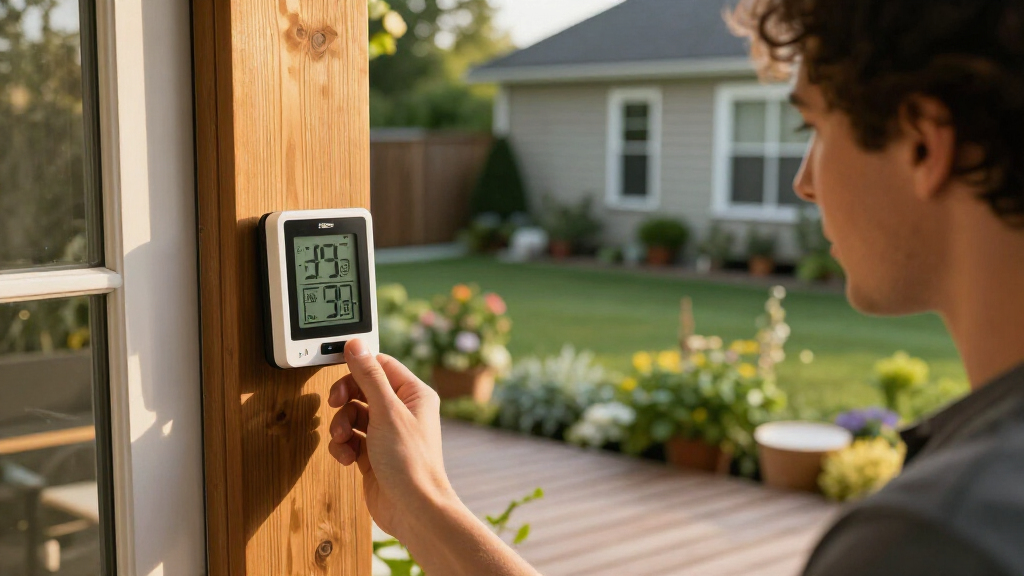
I compared these digital weather stations for home by the job they do, not by feature count alone. The main criteria were the usefulness of indoor and outdoor readings, sensor coverage, display readability, setup demands, and whether connected features such as Wi-Fi or atomic time add practical value. I also weighed how well each design fits ordinary home use, from checking a room’s humidity to monitoring wind and rain outside.
The ranking favors useful information with manageable setup. Models with broader weather data rank ahead when that extra information serves a clear use case, while simpler stations remain strong choices for buyers who want an easy local display. Similar or duplicate listings are treated as the same product rather than as separate advantages. Because the product list does not provide verified performance measurements or detailed specifications for every model, I avoid claiming accuracy levels or durability results that cannot be established from the available information.
Factors to Consider When Choosing Digital Weather Stations For Home
Before choosing a station, I’d decide what you want to know on an ordinary day and where you’ll check it. That answer can matter more than a long feature list: a desk-side temperature display and a full outdoor weather setup solve different problems.
Decide Which Readings Will Change Your Routine
Start with the readings you’ll actually use: indoor temperature, outdoor temperature, humidity, rainfall, or wind. A station that reports more variables is not automatically a better home choice if you rarely check them. Rain totals may help with gardening, while wind readings can be useful for outdoor plans or monitoring exposed areas. If you mostly want to know whether to open a window or take a coat, a simpler station may be easier to read and maintain. Avoid paying attention to the number of listed functions before deciding which decisions those functions will support. Match the station to your routine, not to the longest feature list.
Plan Sensor Locations Before You Buy
Outdoor readings depend on where the sensor can be placed, so think about mounting options and the distance between the sensor and display. A spot in direct sun, near a wall, or under an overhang can affect what a sensor records or whether it can collect rain. Multi-sensor models can help compare locations, but they also create more placement and battery tasks. Check the manufacturer’s stated transmission range and installation guidance rather than assuming a sensor will work through every wall. If you rent or lack a suitable outdoor mounting spot, a compact indoor-outdoor setup may fit better than a larger weather array. Choose a location that is both practical and representative of the conditions you want to track.
Choose a Display You Can Read Where You’ll Use It
A station is only convenient if its readings are easy to see from its intended spot. Think about viewing distance, screen size, lighting, and whether the console will sit on a counter, desk, or bedside table. Color screens can separate information visually, but a busy layout may make key readings harder to find at a glance. Atomic time can reduce clock-setting chores, yet it does not improve the weather data itself. If multiple people will check the display, prioritize clear labels and a layout that makes indoor and outdoor values easy to distinguish. For a station kept in a back room, screen visibility may matter less than sensor coverage.
Treat Wi-Fi as a Convenience With Setup Costs
Wi-Fi and app access are useful when you want to check conditions away from the console or review readings on a phone. They also add dependence on a compatible network, app support, and account or connection setup. Before choosing a connected model, confirm that its app supports the functions you care about and that your home network can reach the station’s location. If you only check weather at home, a standalone display avoids some setup and keeps the main task simple. Connected access should be a reason to choose a model, not a feature you assume you’ll use later. Consider whether remote readings would change a real decision in your day.
Account for Batteries, Mounting, and Ongoing Attention
Every separate sensor adds another item to install, position, and maintain. Find out what power sources the console and sensors use, whether mounting hardware is included, and how accessible the outdoor unit will be when it needs attention. Rain and wind sensors can provide useful local information, but their exposed placement may call for more care than a basic temperature sensor. A model that is easy to set up and check may be a better fit than a feature-rich station you do not want to maintain. Think through seasonal access, especially if the sensor will be mounted high or far from the house. The right level of upkeep is the one you will keep doing.
Spend More Only for Coverage You’ll Use
Paying for more sensors or connected monitoring makes sense when it fills a real gap, such as tracking rain for a garden or checking conditions from outside the home. It makes less sense if the console will show the same few readings you already get from a simpler model. Compare what the extra hardware measures, where it must be installed, and how you will use the information. A second sensor is valuable when you need a second location, not merely because the package includes one. If you are unsure, begin with the smallest setup that covers your everyday needs. You can prioritize added coverage when you have a clear reason for it.
Frequently Asked Questions
Do I need a Wi-Fi weather station, or is a local display enough?
A local display is enough if you mainly check conditions while you are at home and want readings without opening an app. Wi-Fi is a better fit when you want to see readings remotely or use connected features from a phone. Before choosing, check whether the model’s app supports the information you need and whether the station can connect from its planned location. A connected setup can require more configuration than a standalone console. I’d treat Wi-Fi as a practical benefit only when remote access will change how you use the station.
Is a multi-sensor weather station worth choosing over a one-sensor model?
It is worth it when you want to compare more than one location, such as different rooms or separate indoor and outdoor areas. A second sensor can answer a specific question that one sensor cannot, but it also adds placement and upkeep. If you only need a single outdoor reading and a console for indoor conditions, a one-sensor model may be simpler. Check how many locations the system can actually monitor and how readings appear on the display. Choose extra sensors for a defined use, not just for a larger package.
Should I choose a station with rain and wind readings for ordinary home use?
Rain and wind readings are most useful when you have a reason to monitor them, such as gardening, outdoor projects, or tracking conditions around an exposed property. They can make a station more informative, but they also require sensors to be placed appropriately outside. If your main concern is indoor comfort or basic outdoor temperature, those extra readings may not add much to your daily routine. Check the installation requirements before selecting a model with a broader sensor array. A simpler station can be the better home fit when weather detail is not a priority.
Where should I put the outdoor sensor for readings I can trust?
Use the manufacturer’s placement instructions as your starting point, then choose a location that is exposed enough to reflect local conditions but practical to reach. Direct sun, nearby walls, roof surfaces, and sheltered corners can affect readings, while poor placement can limit a rain sensor’s usefulness. Also check the stated communication range and account for walls or other obstructions between the sensor and console. A convenient mounting spot is more useful than an ideal spot that you cannot install or maintain safely. If you need readings for a specific area, place the sensor to represent that area rather than the easiest point on the property.
What is the best way to choose between a basic station and a full weather setup?
Write down the readings you expect to check each week and the decisions they will help you make. Basic stations suit everyday temperature and humidity checks, while broader systems make more sense when you will use rainfall, wind, extra sensor locations, or app access. Think about where the console will sit and whether you can install and maintain outdoor sensors. A long feature list can add setup work without improving the information you use most. Pick the simplest model that covers your real needs, then pay for added monitoring only when you have a clear use for it.
Conclusion
For most households, I recommend the AcuRite Iris 01512MCB as the best overall because it pairs a color screen with outdoor monitoring in a well-rounded home setup. The Sainlogic 12-in-1 is my best premium-style pick for broader weather tracking when rain and wind readings matter, while the Newentor with two sensors is the best choice for monitoring multiple locations. For a simpler start, I’d look at the DreamSky or a basic La Crosse model; they suit buyers who want a straightforward display rather than a larger sensor system. The best value depends on your needs: choose a one-sensor station if basic readings are enough, and avoid paying for connected or multi-sensor features you will not use. If you want remote checks, focus on the Wi-Fi options; if you want weather detail, prioritize rain and wind coverage.
Black Friday Picks

Vitamix 5200 Blender with 64 oz. Container, Black
As an affiliate, we earn on qualifying purchases.