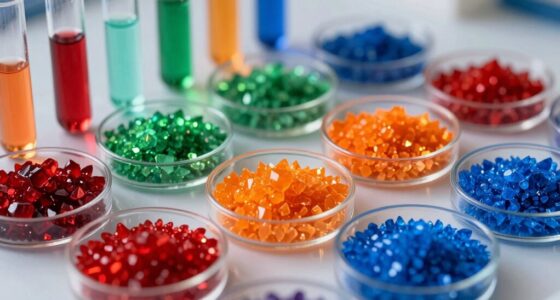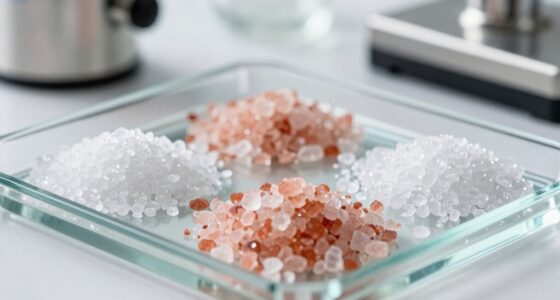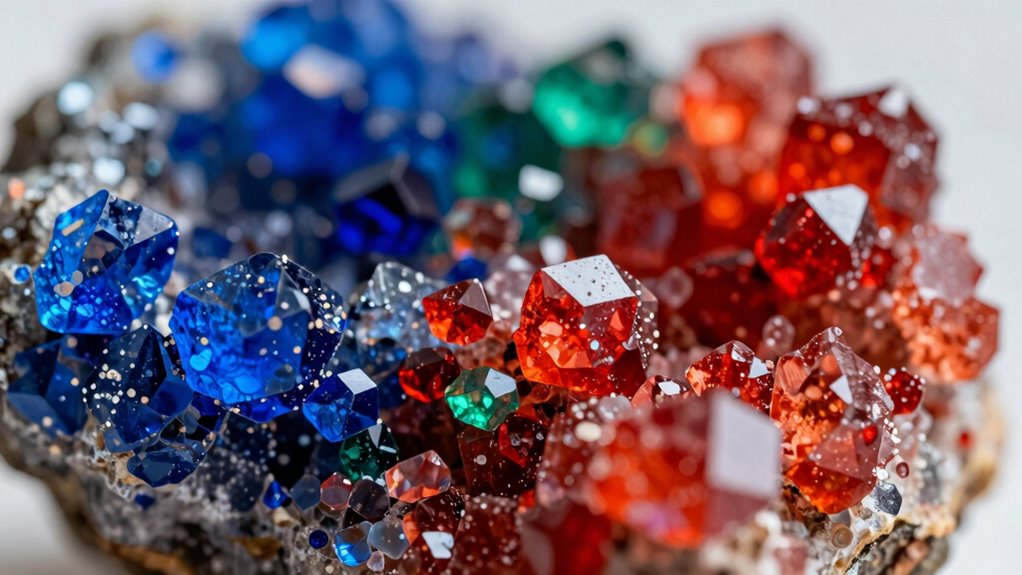

Inorganic salts change color because their metal ions’ electronic structures can shift depending on conditions like temperature, pressure, or chemical environment. When the electronic states of the metal ions alter, it affects how they absorb and transmit light, creating different colors. The crystal lattice’s arrangement plays a role too, as external factors can distort it, leading to changes in oxidation states and electronic interactions. To uncover how these factors blend to produce color shifts, keep exploring further.
Key Takeaways
- The electronic structure of metal ions determines their light absorption and resulting color.
- Changes in oxidation states of metal ions cause shifts in their electronic transitions, altering color.
- External factors like temperature, pressure, or chemical environment can distort the crystal lattice, affecting electronic states.
- Ionic interactions within the solution influence the electronic environment, leading to color variations.
- Lattice distortions and external stimuli modify the energy levels of electrons, causing observable color changes.
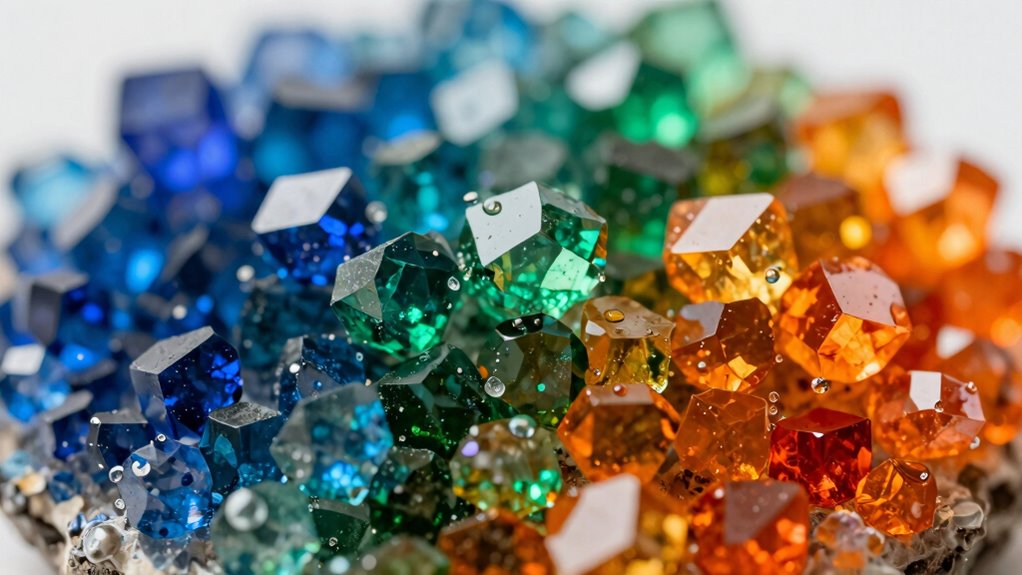
Inorganic salts often change color when they undergo chemical reactions or are exposed to different conditions, making them fascinating subjects of study. These color changes can be linked to their inherent properties, especially their electrolyte behavior and the structure of their crystal lattice. When you expose these salts to various environments, their ions interact with surrounding molecules or ions, leading to alterations in their electronic states. Such changes often manifest as visible shifts in color, which can be both intriguing and useful. The electronic structure of the metal ions plays a key role in determining how the color changes occur under different conditions. Electrolyte properties play a significant role in how inorganic salts behave under different conditions. As electrolytes, these salts dissociate into ions in solution, and the specific ions present determine the salt’s color. For example, transition metal salts like copper sulfate or potassium permanganate display vibrant hues because their metal ions have partially filled d-orbitals that absorb specific wavelengths of light. When conditions like pH, concentration, or temperature change, the ionic environment around these metal centers shifts, causing a change in their electronic structure and, consequently, their color. The ability of the salt to conduct electricity as an electrolyte also influences how it interacts with other ions or molecules in solution, contributing further to color variations. Additionally, the crystal lattice effects are influenced by external factors that can alter the stability of different oxidation states of the metal ions. The arrangement of ions within the crystal lattice creates a specific electronic environment around the metal ions. When external factors such as pressure, temperature, or chemical exposure alter the lattice structure, they can modify the field experienced by the metal ions. This, in turn, influences the energy levels of the electrons, resulting in a different absorption spectrum and a visible color change. In some cases, the crystal lattice can stabilize particular oxidation states of the metal ion, which are associated with distinctive colors. Changes in lattice parameters—like expansion or distortion—can induce transitions between these states, triggering a color shift. Furthermore, external stimuli such as pressure or temperature can induce lattice distortions that significantly influence the electronic transitions responsible for color changes. Understanding how crystal lattice structure interacts with external factors can help in designing materials with specific optical properties.

ESV Aquatics B-Ionic Calcium Buffer System, 2-part Calcium and Alkalinity Maintenance Kit for Salt Water Coral Reef Aquarium, 64 Ounce
- Simple Two-Component System: Easy-to-use liquid supplement
- Maintains Calcium and Alkalinity: Balances levels without powders or chemicals
- Restores Ionic Balance: Replenishes ions lost from skimming
As an affiliate, we earn on qualifying purchases.
As an affiliate, we earn on qualifying purchases.
Frequently Asked Questions
Do All Inorganic Salts Change Color Under the Same Conditions?
Not all inorganic salts change color under the same conditions. Spectral shifts depend on each salt’s crystal structures and how they interact with light. Some salts exhibit color changes when exposed to temperature, pressure, or different pH levels, while others remain unaffected. Your observations will vary because these factors influence how the salts absorb and reflect light, causing the distinct color changes seen in certain inorganic compounds.
Can Temperature Affect the Color Change in Inorganic Salts?
Yes, temperature can affect the color change in inorganic salts. When you heat a salt, its thermal stability influences whether its color remains stable or shifts. Higher temperatures may cause a change in the salt’s oxidation state or structure, leading to a different color. Conversely, some salts maintain their color due to their strong color stability, even under fluctuating temperatures. So, temperature plays a significant role in the visual appearance of inorganic salts.
Are Color Changes Reversible in Inorganic Salts?
Color changes in inorganic salts are often reversible, especially when driven by physical factors like temperature or light. You can confirm this through spectroscopic analysis, which shows consistent absorption patterns before and after the change. The reversibility depends on the crystal structures; if they remain stable, the color shift typically reverses. Consequently, understanding these structures helps predict whether a color change will last or revert.
How Does pH Influence the Color of Inorganic Salts?
pH influences the color of inorganic salts through acid-base reactions, which alter the salt’s structure and color. When you add pH indicators to a solution, they respond to changes in hydrogen ion concentration, signaling shifts in acidity or alkalinity. As a result, inorganic salts may change color depending on whether the environment is acidic or basic, making pH a vital factor in their color variations.
Can Impurities Cause Inorganic Salts to Change Color?
Impurity effects can definitely cause inorganic salts to change color, making you realize how sensitive these compounds are. When impurities are present, they can disrupt the salt’s color stability, leading to unexpected hues or fading over time. This can be surprising, but it highlights how even tiny contaminations influence chemical properties. So, always guarantee purity if you want consistent, vibrant colors in your inorganic salt samples.

BESTOYARD 20pcs Copper Electrode Strips for Saltwater and Potato Battery Experiments, Efficient Classroom Demonstrations with Stable Microcurrent Generation, for Science Team Projects
- Electrochemical Learning Tool: Explore saltwater battery concepts
- Real-Time Electricity Generation: Observe current with copper strips
- Beginner-Friendly Assembly: Includes instructions for easy setup
As an affiliate, we earn on qualifying purchases.
As an affiliate, we earn on qualifying purchases.
Conclusion
Think of inorganic salts as chameleons, changing their colors in response to their surroundings. When conditions like temperature, pH, or the presence of other chemicals shift, these salts adapt visually just like a chameleon blending into its environment. Understanding these color changes is like revealing a secret language of nature’s palette. So, next time you see a color shift in inorganic salts, remember—they’re just expressing their story through a vibrant, silent dialogue.

LotFancy Silica Gel Packets 0.5g 300 Pack, Color Indicating Desiccant Packs, Moisture Absorber for Spice Jars, Seed Storage, Jewelry, Electronics & Small Containers
- 300 Pack Small Desiccant Packets: Includes 300 resealable 0.5g packets
- Compact Size Fits Small Containers: 0.75×1.5 inch packets for tight spaces
- Effective Moisture Absorption: Absorbs up to 40% of weight in moisture
As an affiliate, we earn on qualifying purchases.
As an affiliate, we earn on qualifying purchases.
electrolyte salts for science experiments
As an affiliate, we earn on qualifying purchases.
As an affiliate, we earn on qualifying purchases.