TL;DR
A Harvard researcher has built a real-time, physically accurate black hole model for home use, simulating relativistic physics. The project is accessible via a browser, offering a new way to explore black hole phenomena.
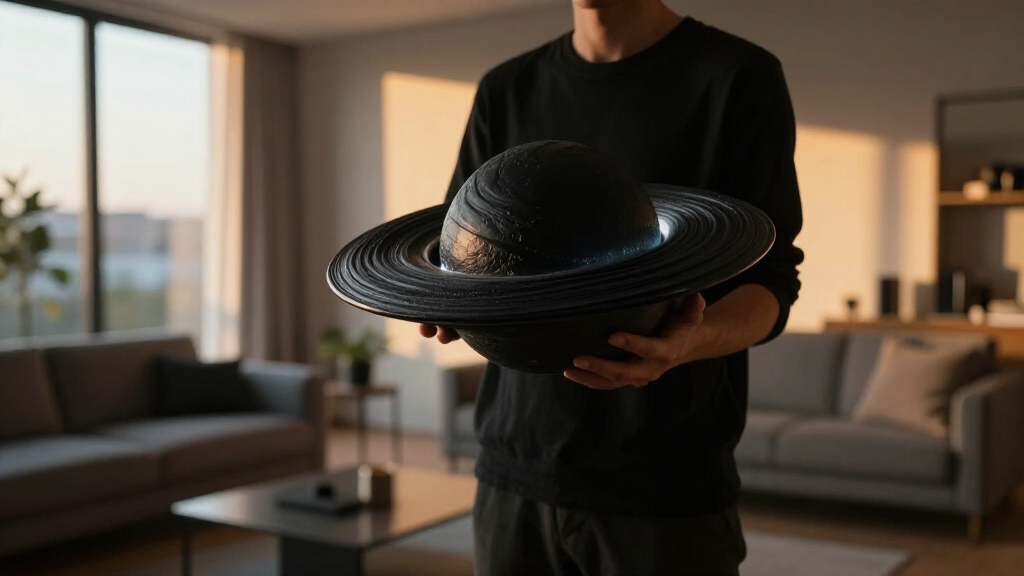
Harvard astrophysicist Alexander Plavin has unveiled a physically accurate black hole model that can be placed in a room and interacted with via a browser. This innovative project simulates relativistic physics in real time, allowing users to explore black hole phenomena firsthand, marking a significant advancement in scientific visualization and public engagement with astrophysics.
The project, shared on Show HN, is the result of Plavin’s work in modeling black holes with high fidelity to Einstein’s general relativity. It uses advanced algorithms to render the warping of spacetime, light bending, and accretion disk effects, all in a live browser environment. The model is designed to be physically accurate, based on current scientific understanding, and capable of demonstrating complex phenomena such as gravitational lensing and event horizon effects.
According to Plavin, the simulation runs at real-time speeds and can be manipulated to observe how matter and light behave near a black hole. The project aims to serve as an educational tool and a proof of concept for more accessible, realistic scientific visualizations. It is not a physical black hole but a detailed, computer-generated model that adheres closely to relativistic physics principles.
While the model is currently available for public testing via a web interface, details about its underlying algorithms and potential applications are still emerging. Plavin emphasized that this project is meant to inspire further research and public interest in astrophysics, especially in understanding extreme objects like black holes.
Potential Impact on Science Education and Visualization
This development could revolutionize how complex astrophysical phenomena are taught and understood. By providing a physically accurate, interactive model of a black hole accessible to the public, it opens new avenues for education, research, and outreach. It demonstrates that advanced scientific simulations can be made available outside specialized labs, fostering greater engagement with relativistic physics and astrophysics among students and enthusiasts.
Moreover, the project highlights the increasing role of browser-based simulations in scientific visualization, potentially leading to more immersive and accurate educational tools. However, it is important to note that this is a computer model and does not involve any physical black hole or experimental physics at this stage.

EISCO Molecular Model Atoms, Black, Pack of 10-2.2cm, 4 Holes – Spare Extra Parts for Molecular Model Kits
Pack of 10, Black Atoms
As an affiliate, we earn on qualifying purchases.
As an affiliate, we earn on qualifying purchases.
Advances in Black Hole Modeling and Public Engagement
Recent years have seen significant progress in simulating black hole physics through computer models and visualizations, driven by improved computational power and scientific understanding. Projects like the Event Horizon Telescope have provided real images of black holes, but interactive, real-time models accessible to the public have been limited.
Alexander Plavin’s work builds on this trend, combining scientific accuracy with user-friendly interfaces. The project is part of a broader movement to make complex astrophysical phenomena more accessible and understandable, especially as interest in black holes and relativistic physics continues to grow.
While the model is still in development, it reflects ongoing efforts to bridge the gap between advanced scientific research and public education, leveraging modern web technologies.
“This project demonstrates that we can create highly accurate, real-time models of black holes that are accessible to anyone with a browser. It’s a step toward making complex astrophysics understandable and engaging.”
— Alexander Plavin
interactive astrophysics display
As an affiliate, we earn on qualifying purchases.
As an affiliate, we earn on qualifying purchases.
Limitations and Future Development of the Black Hole Model
It is still unclear how precisely the simulation replicates all aspects of black hole physics, especially under extreme conditions or in dynamic scenarios. The algorithms are based on current models, but real-time rendering may involve approximations that limit accuracy. Details about the underlying computational methods and their validation against empirical data are still emerging.
Additionally, it remains uncertain whether this project will be expanded into more interactive educational platforms or integrated into formal curricula. The long-term stability and scalability of the simulation are also yet to be tested.

Teenii Physics & Optics Science Kit for Kids Ages 8-16, Light Experiment STEM Kit with Prism, Lenses & Mirrors, 15+ Optical Experiments Educational Lab Set
Explore the Science of Light: Discover the fascinating world of optics with 15+ hands-on light experiments and learn…
As an affiliate, we earn on qualifying purchases.
As an affiliate, we earn on qualifying purchases.
Upcoming Features and Broader Accessibility Plans
Plavin plans to refine the simulation, improving its accuracy and adding features such as dynamic accretion disks and particle interactions. He also intends to expand accessibility, potentially releasing a public API or educational modules for schools and universities.
Further collaboration with educational institutions and research groups is expected to enhance the model’s scientific fidelity and usability. The project’s future developments will likely focus on demonstrating more complex phenomena and integrating user feedback.

Space Science Toy for Kids Ages 8,9,10+, Birthday Gift, STEM Experiments
✅ Explore 50+ Space Experiments – Discover the wonders of space with over 50 hands-on science experiments, including…
As an affiliate, we earn on qualifying purchases.
As an affiliate, we earn on qualifying purchases.
Key Questions
Is this a real black hole?
No, this is a computer-generated model designed to simulate black hole physics accurately, but it is not a physical black hole.
Can I interact with the black hole model?
Yes, the simulation is designed to be interactive, allowing users to manipulate parameters and observe effects in real time via a web browser.
Does this project have scientific validation?
The model is based on current scientific theories, particularly general relativity, but its accuracy under extreme conditions is still being evaluated. It is primarily a visualization tool.
Will this be used in classrooms?
There are plans to adapt the model for educational purposes, but wider adoption will depend on further development and validation.
Is there a cost to access this simulation?
No, the current version is publicly accessible via a browser at no cost.
Source: hn