
Le Châtelier’s principle predicts how a chemical system at equilibrium responds to external changes by shifting in a way that minimizes those disturbances. If you increase the concentration of reactants or products, the system adjusts by shifting toward the side that consumes the added substances. Temperature and pressure changes also cause shifts, depending on whether the reactions are endothermic or exothermic and if gases are involved. Exploring further reveals how these principles apply broadly in real-world chemistry.
Key Takeaways
- Le Châtelier’s principle states that a system at equilibrium will adjust to counteract any external change.
- Changes in concentration, temperature, or pressure cause the system to shift toward the side that restores balance.
- Increasing reactant or product concentrations pushes the equilibrium to the opposite side to reduce the disturbance.
- Raising temperature favors the endothermic or shifts toward heat-absorbing products, depending on the reaction.
- Adjustments in pressure influence gas-phase equilibria by shifting toward fewer or more moles to re-establish equilibrium.

ALDON Innovating Science Science Kit – Equilibrium & Le Chatelier's Principle – for Teaching How Stress Effects Chemical Systems – Hands-On Lab Activity – Materials for 15 Setups
HANDS-ON LEARNING OF LE CHATELIER'S PRINCIPLE || Predict the behavior of a system due to changes in temperature,…
As an affiliate, we earn on qualifying purchases.
As an affiliate, we earn on qualifying purchases.
Understanding Chemical Equilibrium and Its Significance
Chemical equilibrium occurs when the rates of the forward and reverse reactions are equal, resulting in no net change in the concentrations of reactants and products. At this point, the system appears static, but reactions continue simultaneously in both directions. Phase changes can influence equilibrium, as shifts may occur when substances change states, affecting reaction rates and concentrations. Catalyst effects are vital because they speed up both the forward and reverse reactions equally, helping the system reach equilibrium faster without altering the positions of equilibrium. Understanding these factors helps you grasp how equilibrium remains sensitive to external influences, which is essential for predicting how the system responds to changes. Recognizing the role of phase changes and catalysts clarifies the dynamic yet balanced nature of chemical equilibrium. External conditions like temperature and pressure also significantly impact equilibrium positions, emphasizing the importance of reaction conditions in managing chemical processes. Additionally, understanding Le Châtelier’s principle allows chemists to predict how a system at equilibrium will respond to various disturbances, including the effects of concentration changes.
ALDON Innovating Science Science Kit – Equilibrium & Le Chatelier's Principle – for Teaching How Stress Effects Chemical Systems – Hands-On Lab Activity – Materials for 15 Setups
HANDS-ON LEARNING OF LE CHATELIER'S PRINCIPLE || Predict the behavior of a system due to changes in temperature,…
As an affiliate, we earn on qualifying purchases.
As an affiliate, we earn on qualifying purchases.
The Core Concept Behind Le Châtelier’s Principle
Le Châtelier’s Principle explains how a system at equilibrium responds to external changes. The core concept is that the system adjusts to minimize the effect of disturbances, balancing reaction kinetics and reaction rates. Catalytic effects speed up reactions without shifting equilibrium, emphasizing that changes in reaction speed don’t alter equilibrium positions. The system’s response depends on shifting either reactants or products to restore balance. Here’s a summary:
| Change | System Response | Effect on Equilibrium |
|---|---|---|
| Increase in temperature | Shifts to absorb heat (endothermic) | Moves toward products |
| Addition of a catalyst | Speeds reaction, no shift | No change in equilibrium |
| Increase in concentration | Reacts to reduce excess | Shifts away from added component |
| Decrease in pressure | Adjusts to restore pressure | Shifts to fewer moles |
This core idea guides how external factors influence equilibrium.

Allegro 2050-01 | Replacement Smoke Tubes for Qualitative Fit Testing | 6 Tubes with Caps | for Use with Allegro 2050 Smoke Test Kit | OSHA-Compliant Respirator Fit Test Refills
𝗥𝗘𝗣𝗟𝗔𝗖𝗘𝗠𝗘𝗡𝗧 𝗦𝗠𝗢𝗞𝗘 𝗧𝗨𝗕𝗘𝗦 𝗙𝗢𝗥 𝗙𝗜𝗧 𝗧𝗘𝗦𝗧𝗜𝗡𝗚 – Designed for use with the Allegro 2050 Standard Smoke Test Kit…
As an affiliate, we earn on qualifying purchases.
As an affiliate, we earn on qualifying purchases.
How Changes in Concentration Influence Reaction Direction

When you change the concentration of reactants or products in a system at equilibrium, the reaction responds by shifting to restore balance. Increasing reactant concentration pushes the reaction forward, raising reaction rates and producing more products. Conversely, adding more products shifts the equilibrium backward, favoring reactants. Removing reactants or products causes the system to adjust accordingly. Catalyst effects don’t change the position of equilibrium but speed up reaction rates in both directions, helping the system reach equilibrium faster. If you decrease concentration, the reaction shifts to produce more of that substance, restoring the original balance. These shifts follow Le Châtelier’s principle, ensuring the system responds predictably to concentration changes, maintaining equilibrium by adjusting reaction rates accordingly. Additionally, reaction dynamics can be influenced by various factors, including temperature and pressure, which also affect the equilibrium position. A thorough understanding of chemical equilibria helps predict how systems respond to different perturbations. Recognizing the role of reaction mechanisms is essential for understanding how these shifts occur at a molecular level.

MEANLIN MEASURE 0-35” WC Manifold Gas Pressure Test Kit, Pressure Gauge Kit for Natural Gas or LP Gas with 40" Feet Hose, 1/8” NPT Fitting with Barbed Connection and Hex Bushing
【Product Name】Manifold Gas Pressure Test Kit【Size】1/8" NPT fitting with barbed connection;2-1/4" DIAL FACE
As an affiliate, we earn on qualifying purchases.
As an affiliate, we earn on qualifying purchases.
The Role of Temperature Variations in Shifting Equilibria

Temperature changes can considerably shift chemical equilibria, depending on whether a reaction is endothermic or exothermic. When you increase the temperature, the system responds differently based on the reaction’s heat absorption or release. Understanding this helps you predict how equilibrium will move under varying thermal conditions. Additionally, climate change impacts in modern systems can be fine-tuned to monitor and adjust conditions to maintain optimal equilibrium.
Endothermic vs. Exothermic Reactions
Have you ever wondered how temperature changes influence chemical reactions? In endothermic reactions, heat absorbs into the system, often increasing the reaction rate and shifting equilibrium toward products when temperature rises. Conversely, exothermic reactions release heat, so an increase in temperature typically shifts the equilibrium toward reactants. Catalyst effects also play a role here, as they lower activation energy and speed up reaction rates without altering equilibrium positions. Understanding whether a reaction is endothermic or exothermic helps predict how temperature variations will shift equilibrium. When temperature increases, endothermic reactions tend to favor product formation, while exothermic reactions favor reactants. Recognizing this distinction allows you to manipulate conditions to optimize desired outcomes in industrial and laboratory processes. Additionally, knowing how to store essential oils properly can help maintain their effectiveness during use. Proper temperature control is crucial in chemical equilibrium management, as it directly influences the direction and extent of reactions. Being aware of the thermal properties of reactants can further assist in predicting and controlling shifts in equilibrium.
Temperature’s Effect on Equilibrium
Changes in temperature can considerably influence the position of equilibrium in a chemical reaction. When temperature shifts, it can cause phase changes, such as melting or vaporization, affecting the reaction’s dynamics. Increasing temperature generally favors endothermic reactions, pushing equilibrium toward products, while decreasing temperature favors exothermic reactions. Temperature adjustments can also impact catalyst effects, altering reaction rates but not the equilibrium position itself. However, catalysts can modify how quickly equilibrium is reached without changing its position. Understanding these influences helps you predict whether an equilibrium will shift to produce more reactants or products. By controlling temperature, you can effectively manipulate reaction conditions, ensuring ideal yields and efficiency in chemical processes. Additionally, awareness of credit card security measures is essential for protecting sensitive data during online transactions. The reaction conditions such as temperature are vital in optimizing chemical processes and achieving desired outcomes, as they directly affect the reaction equilibrium.
Effect of Pressure Changes on Gaseous Reactions
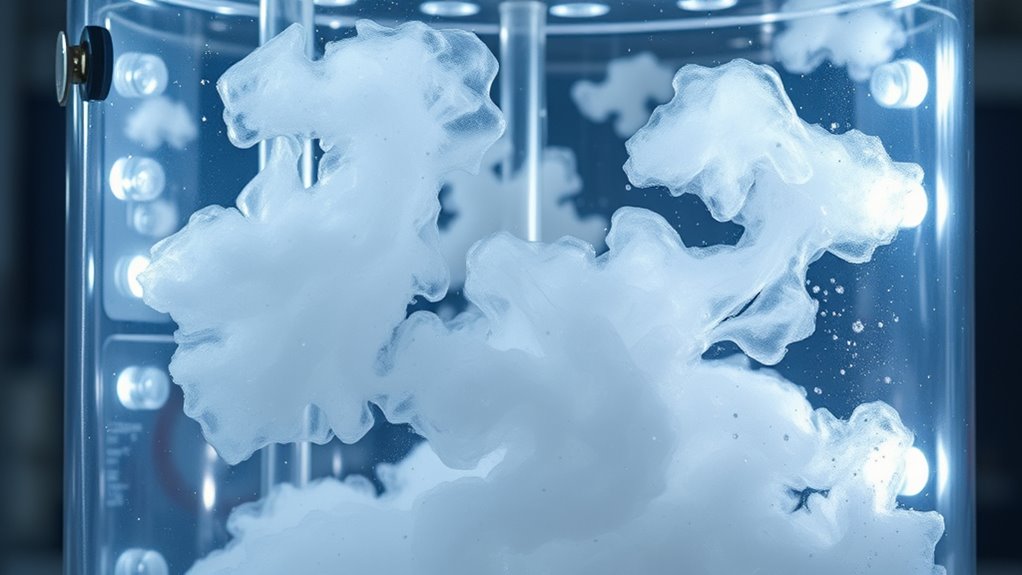
When pressure is altered in a gaseous reaction, Le Châtelier’s principle predicts that the system will shift to counteract the change. The pressure effects mainly depend on gas volume and the number of moles of gases involved. If you increase the pressure, the system shifts toward the side with fewer gas molecules to reduce pressure. Conversely, decreasing pressure causes a shift toward the side with more gas molecules, increasing the gas volume. This shift minimizes the change in pressure and helps restore equilibrium. Additionally, Kia Tuning modifications often involve adjusting gas flow and combustion processes to optimize engine performance under different conditions. Keep in mind, changes in pressure affect reactions involving gases more than those involving solids or liquids. Understanding how gas volume and the amount of gas molecules influence these shifts makes predicting equilibrium behavior under pressure changes much clearer, especially when considering the gas laws that govern these processes. Recognizing the role of reaction conditions is essential in applying Le Châtelier’s principle effectively to real-world systems.
Predicting the Shift for Endothermic and Exothermic Reactions

You can predict how reactions shift by considering whether they are endothermic or exothermic when temperature changes. Increasing the temperature favors the reaction that absorbs heat, while decreasing it favors the one that releases heat. Understanding this helps you determine the direction of equilibrium movement based on temperature adjustments. Additionally, recognizing the energy exchange involved in reactions can further clarify how shifts occur in response to temperature changes. As the market growth projected at over 40% CAGR in AI tech by 2025 indicates rapid technological advancements, understanding reaction shifts can also inform the development of more efficient processes in various industries.
Temperature Effects on Reactions
Temperature plays a pivotal role in determining the direction of equilibrium shifts according to Le Châtelier’s principle. When you increase temperature, endothermic reactions tend to shift right to absorb heat, while exothermic reactions shift left. Conversely, decreasing temperature favors the exothermic direction. Here’s what you need to know:
- Higher temperatures accelerate reaction rates but can reduce catalyst effects, impacting equilibrium.
- Endothermic reactions benefit from heat input, shifting equilibrium toward products.
- Exothermic reactions lose favor with added heat, shifting toward reactants.
- Temperature changes can alter reaction rates, influencing how quickly equilibrium is reached.
Shift Direction in Equilibrium
Have you ever wondered how to predict which way a reaction will shift when conditions change? The key lies in understanding whether a reaction is endothermic or exothermic. For endothermic reactions, adding heat shifts the equilibrium toward products, while removing heat favors reactants. Conversely, for exothermic reactions, increasing temperature pushes the shift toward reactants, and decreasing it favors products. Reaction kinetics also plays a role; faster reaction rates can influence how quickly equilibrium is re-established after a change. Additionally, catalysts impact the overall process by lowering activation energy, but they don’t alter the shift direction predicted by Le Châtelier’s principle. This understanding helps you anticipate the shift in equilibrium when temperature or other factors change, guiding effective control of chemical reactions. Understanding reaction types is essential for predicting these shifts accurately.
Examples Demonstrating Le Châtelier’s Principle in Action
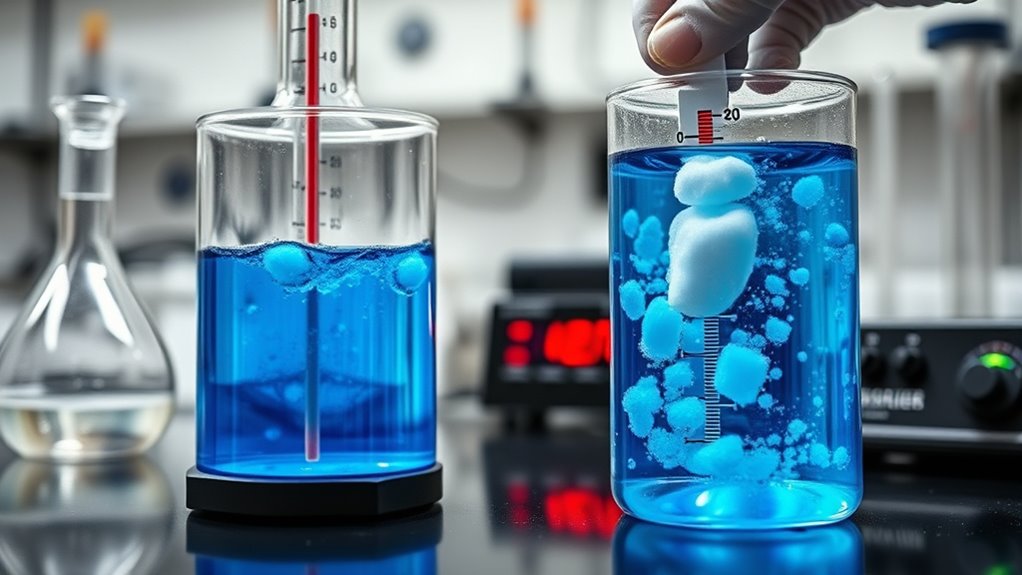
How does Le Châtelier’s Principle work in real-world scenarios? It helps explain how reaction mechanisms respond to changes, especially in industrial or biological systems. For example:
- Increasing temperature shifts equilibrium in exothermic reactions, affecting product yields.
- Adding a catalyst speeds up the reaction without shifting the equilibrium, demonstrating catalytic effects.
- Changing pressure in gaseous systems shifts equilibrium toward fewer moles of gas, aligning with Le Châtelier’s predictions.
- Altering concentration of reactants or products prompts the system to adjust accordingly, restoring balance.
- The development of robust safety measures in AI systems highlights the importance of monitoring AI behavior to prevent vulnerabilities. Additionally, understanding the reaction mechanism is essential for predicting how equilibrium responds to various changes.
These examples show how Le Châtelier’s Principle accurately predicts shifts in equilibrium. Observing these effects helps you understand reaction mechanisms and optimize conditions in chemical processes.
Practical Applications of Equilibrium Shift Predictions

Understanding how equilibrium shifts influence real-world applications is essential for optimizing chemical processes and ensuring safety. Catalyst effects can accelerate reactions without changing the equilibrium position, making processes more efficient, such as in industrial manufacturing. By selecting appropriate catalysts, you can shift the balance toward desired products or speed up reactions under specific conditions. Similarly, solvent influence plays a pivotal role; changing solvents can alter reaction rates and equilibrium positions by affecting solubility and interaction energies. For example, choosing the right solvent can favor product formation or suppress undesired side reactions. Recognizing these factors allows you to manipulate reaction conditions effectively, improving yields and safety in chemical production, pharmaceuticals, and environmental management. These practical applications highlight the importance of predicting equilibrium shifts accurately.
Frequently Asked Questions
How Does Le Châtelier’S Principle Apply to Real-World Industrial Processes?
You see, Le Châtelier’s principle helps you understand how a change in conditions affects an industrial process. It guides reaction optimization by predicting how shifts in temperature, pressure, or concentration can improve yields or efficiency. By applying this principle, you can better control processes, ensuring they stay at ideal equilibrium. This understanding allows you to fine-tune variables and maintain consistent product quality in real-world industrial applications.
Can Le Châtelier’S Principle Predict Equilibrium Shifts in Complex Reactions?
You might wonder if Le Châtelier’s principle can handle complex reactions. The answer is yes, but it’s more challenging. Reaction complexity and equilibrium dynamics make predicting shifts less straightforward because multiple factors influence the system. However, with careful analysis of each component and understanding how changes affect the whole, you can still use the principle to anticipate how equilibrium will respond, even in intricate reactions.
How Do Catalysts Affect Equilibrium Positions According to Le Châtelier’S Principle?
Imagine a busy marketplace where reactions dance between reactants and products at a delicate balance. Catalysts act like a helpful guide, increasing the reaction rate without shifting the dynamic equilibrium. They make reactions faster but don’t change the equilibrium position itself. According to Le Châtelier’s principle, catalysts don’t affect the balance point; they simply help reach equilibrium more quickly, keeping the system’s position unchanged even as the reaction rate soars.
Is Le Châtelier’S Principle Applicable to Biological Systems?
You’ll find that Le Châtelier’s principle applies to biological systems through biochemical feedback and enzyme regulation. When cells experience changes, they adjust reactions to restore balance, much like shifting equilibrium. For example, feedback inhibition controls enzyme activity, helping maintain stability. So, yes, this principle helps explain how living organisms respond to internal and external changes, ensuring proper function and homeostasis.
What Are Limitations of Le Châtelier’S Principle in Predicting Reaction Behavior?
You should recognize that Le Châtelier’s principle has limitations because it offers a reaction oversimplification. While it predicts how equilibrium shifts, real reactions can produce unpredictable outcomes due to factors like reaction kinetics, temperature fluctuations, or complex mechanisms. Relying solely on this principle can lead to inaccurate predictions, especially in complex systems where multiple variables influence the reaction’s behavior, making it important to reflect on other factors beyond simple equilibrium responses.
Conclusion
By understanding Le Châtelier’s principle, you hold the compass to navigate the shifting seas of chemical reactions. When conditions change, the equilibrium dances to find a new balance, like a tightrope walker adjusting with each step. With this knowledge, you can predict and even steer reactions, turning the unpredictable into a predictable rhythm. Think of it as mastering the art of balancing a delicate, ever-moving scale—you become the conductor of chemical harmony.