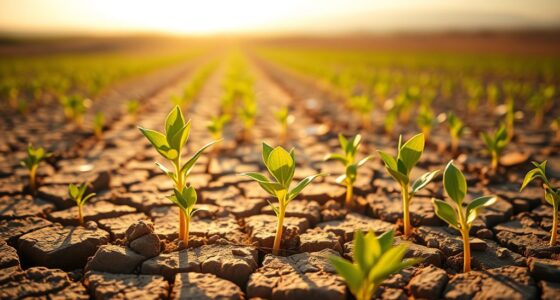
Startups in AgTech drive innovation by creating solutions that make farming more sustainable, efficient, and resilient. Incubators and innovation hubs support these startups with funding, mentorship, and access to networks, helping turn ideas into practical tools. They focus on technologies like IoT sensors, drone monitoring, and smart irrigation systems. As you explore further, you’ll discover how these hubs are shaping a more sustainable future for agriculture and the planet.
Key Takeaways
- Incubators and hubs provide essential resources like funding, mentorship, and networking to support early-stage AgTech startups.
- They foster collaboration among entrepreneurs, researchers, and industry leaders to accelerate innovative farming solutions.
- Startups develop technologies such as precision agriculture tools, IoT sensors, and smart irrigation systems through these ecosystems.
- Incubators facilitate the scaling and practical application of AgTech innovations to promote sustainable and efficient farming practices.
- They act as catalysts for advancing sustainable agriculture, enabling startups to address global food security and environmental challenges.

Agricultural technology startups are transforming the way we grow, harvest, and manage food production, driven by innovative solutions that address global challenges like climate change, resource scarcity, and population growth. These startups are at the forefront of developing tools and systems that promote sustainable farming, helping farmers reduce their environmental impact while increasing productivity. By integrating advanced technologies such as IoT sensors, data analytics, and automation, they enable precision agriculture—an approach that optimizes resource use, minimizes waste, and maximizes crop yields. As you explore the landscape of AgTech, you’ll see how startup incubators and innovation hubs play a crucial role in accelerating this transformation.
Incubators and innovation hubs serve as critical ecosystems where startups can flourish. They provide not only funding but also mentorship, technical expertise, and access to networks that are essential during the early stages of development. These environments foster collaboration between entrepreneurs, researchers, and industry leaders, creating a fertile ground for pioneering ideas to mature into scalable solutions. For you, engaging with these hubs means gaining exposure to cutting-edge technologies and best practices that can revolutionize traditional farming methods. They often host accelerators, workshops, and pilot programs that test new approaches to sustainable farming, emphasizing the importance of precision agriculture for resource efficiency and environmental health.
Incubators and hubs nurture startups with funding, mentorship, and networks, accelerating innovations in sustainable and precision agriculture.
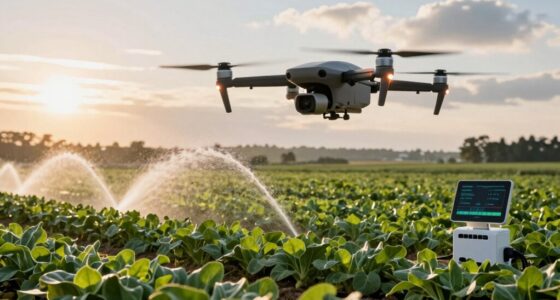
Startups within these hubs are actively developing tools that improve soil health, water management, and crop monitoring—key components of sustainable farming. For instance, some are designing smart irrigation systems that adjust water delivery based on real-time weather data and soil moisture levels, reducing water waste. Others focus on drone technology and remote sensing to gather detailed field data, enabling farmers to make precise decisions about fertilization and pest control. These innovations not only boost productivity but also lessen the ecological footprint of farming activities, aligning with global efforts to create a more resilient and sustainable food system. Additionally, many of these startups incorporate vetted home theatre projectors to enhance educational programs and training sessions for farmers and stakeholders.
As you look into the role of incubators and innovation hubs, you’ll notice how they serve as catalysts for innovation, nurturing startups that push the boundaries of what’s possible in agriculture. They help bridge the gap between research and application, ensuring that groundbreaking ideas reach the fields where they can make a real impact. By supporting startups that focus on sustainable farming and precision agriculture, these hubs are helping shape a future where food production is more efficient, environmentally friendly, and adaptable to changing global conditions. Ultimately, their work empowers farmers to adopt smarter, more sustainable practices that benefit both people and the planet.

MTDELE 10Pcs 3.3V Capacitive Soil Moisture Sensor Module
- Sensor Type: Capacitive Soil Moisture Sensor
- Compatibility: Compatible with Arduino and Raspberry Pi
- Size: 98 x 23 mm
As an affiliate, we earn on qualifying purchases.
As an affiliate, we earn on qualifying purchases.
Frequently Asked Questions
How Do Incubators Select Agtech Startups for Their Programs?
You should focus on how incubators conduct startup evaluation by reviewing your business model, innovation potential, and market impact. They also consider your team’s expertise and scalability. Mentors are vital, so they’ll look for strong mentor selection to guarantee your startup receives valuable guidance. Demonstrating a clear value proposition, growth plan, and a capable team increases your chances of being chosen for their program.
What Are the Common Challenges Faced by Agtech Startups?
You face common challenges like balancing sustainable practices with cost efficiency, maneuvering complex regulatory compliance, and securing adequate funding. You must adapt quickly to evolving technologies, overcome market uncertainties, and build trust with farmers and stakeholders. These hurdles test your resilience, demand innovation, and require strategic planning to succeed in the competitive AgTech landscape. Embracing sustainability and compliance is essential to overcoming these obstacles and driving long-term growth.
How Do Innovation Hubs Support Scaling Agtech Solutions Globally?
Innovation hubs support scaling your agtech solutions globally by fostering global collaboration and encouraging technological integration. They connect you with international partners, investors, and experts, helping you adapt your innovations across different markets. These hubs provide resources like mentorship, funding, and infrastructure, enabling you to refine your technology and expand efficiently. As a result, you can accelerate your growth and make a meaningful impact in agriculture worldwide.
What Funding Options Are Available for Early-Stage Agtech Startups?
They say “nothing ventured, nothing gained,” and for early-stage agtech startups, funding options like venture capital and grant funding are essential. Venture capital offers significant investment, while grant funding provides non-dilutive support for innovative projects. You can also explore government programs, angel investors, or agricultural grants. Combining these sources helps you secure the financial backing needed to grow and bring your agtech innovations to market.
How Can Startups Measure the Impact of Their Innovations in Agriculture?
You can measure the impact of your innovations in agriculture by utilizing sensor technology and data analytics. Deploy sensors to gather real-time data on crop health, soil conditions, and water usage. Analyze this data to track improvements like increased yields, reduced resource consumption, or better pest control. Regularly compare your metrics over time to assess progress, making adjustments based on insights to maximize your innovation’s effectiveness and sustainability.

Design And Operation Of Farm Irrigation Systems
- Condition: Used Book in Good Condition
As an affiliate, we earn on qualifying purchases.
As an affiliate, we earn on qualifying purchases.
Conclusion
As you navigate the fertile landscape of AgTech, startups act as the seeds of innovation, sprouting new ideas amid the rich soil of incubators and hubs. Your role in nurturing these sprouts can turn the winds of change into a sweeping harvest of progress. Embrace this journey, for your involvement transforms the seed of a concept into a flourishing future—where technology and agriculture grow together, intertwined like vines reaching toward a brighter, sustainable horizon.

DJI P4 Multispectral Agriculture Drone, 3-Axis Stabilized Camera, RGB + 5 Multispectral Sensors, RTK Module, 27-Min Flight Time, 4.4-Mile Range
- Multispectral Imaging: RGB plus 5 spectral sensors
- Precision Data Collection: TimeSync for centimeter accuracy
- Long Flight Time: Up to 27 minutes
As an affiliate, we earn on qualifying purchases.
As an affiliate, we earn on qualifying purchases.

AI & Sustainable Farming: How Artificial Intelligence is Revolutionizing Agriculture for a Greener Future (Tech and Innovations)
As an affiliate, we earn on qualifying purchases.
As an affiliate, we earn on qualifying purchases.