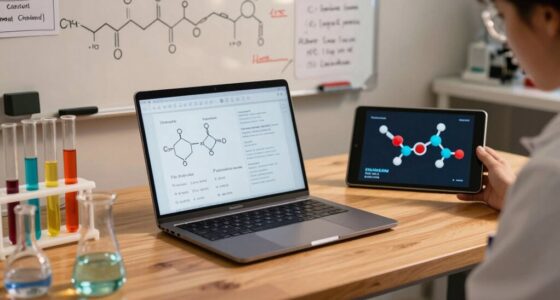
A compound microscope with a built-in camera connects your devices to display clear, detailed images of samples on screens in real time. This setup makes it easy to share observations instantly and encourages student participation. You can record videos, capture images, and organize your findings digitally, improving grasp and engagement. These features support remote learning and collaborative projects. To discover how this technology transforms teaching experiences, keep exploring how these microscopes can benefit your science classroom.

Prime made for students and young adults
- Fast, free delivery for dorm and study essentials
- Prime Video and Amazon Music included
- Member-only deals
Key Takeaways
- A compound microscope with a camera allows real-time imaging and sharing of specimens for enhanced group learning.
- It streamlines documentation of samples, enabling easy review, comparison, and digital record-keeping of experiments.
- Integration with digital devices improves student engagement by projecting detailed images onto screens for all to see.
- The camera supports remote learning by enabling virtual participation and live observation from anywhere.
- It facilitates sample preparation, analysis, and data collection, promoting hands-on, interactive science education.
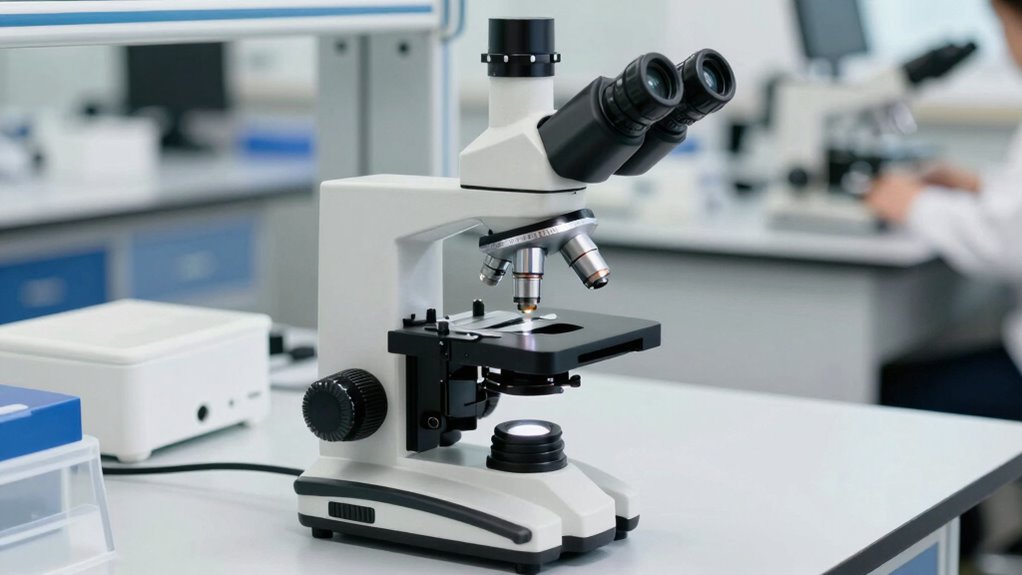
In modern teaching labs, a microscope with a camera has become an essential tool for engaging students and enhancing learning. This combination allows you to see microscopic details clearly while also capturing images and videos that can be shared instantly. Digital integration plays a key role here, enabling seamless connection between the microscope and computers or tablets. When you use a compound microscope with a camera, you can project what’s under the lens onto a screen, making it easier for everyone in the room to observe and discuss. This setup encourages active participation and helps students grasp complex concepts more effectively.
One of the biggest advantages of incorporating a camera is how it simplifies sample preparation. When you prepare samples for observation, the camera can document each step, providing visual records that are invaluable for analysis and review. You can take snapshots or record videos of your samples, which helps in identifying structures or abnormalities later. This capability promotes a more hands-on approach, where students can experiment with preparing slides, staining specimens, or adjusting focus, then immediately see the results on a larger display. It’s a powerful way to reinforce lessons and foster curiosity.
Furthermore, digital integration with a microscope camera streamlines the learning process by making it easier to compare samples. Instead of passing around a single slide or a small viewfinder, everyone can observe the same detailed image on their screens. This consistency ensures that each student has a clear understanding of what’s being studied, reducing confusion and increasing engagement. Plus, the ability to save images allows you to build a digital library of specimens, which can be used for future lessons or student projects. Additionally, integrating a camera with site management systems can help educators track and organize student work more efficiently. Incorporating digital imaging also facilitates the sharing of findings beyond the classroom, broadening students’ exposure to scientific communication. Using a camera with a microscope can also help in remote learning scenarios, allowing students to participate in experiments virtually and receive real-time feedback.
Another benefit is how the digital capabilities can support data analysis, enabling students to quantify and interpret their observations more effectively, which is crucial in scientific studies.
compound microscope with camera for teaching
As an affiliate, we earn on qualifying purchases.
As an affiliate, we earn on qualifying purchases.
Frequently Asked Questions
How Do I Connect the Camera to Different Computer Systems?
To connect your camera to different computer systems, you need to guarantee digital connectivity using compatible cables or wireless options. Check the camera’s compatibility standards, such as USB, HDMI, or Wi-Fi, for seamless integration. Install the appropriate drivers or software, and select the correct input source on each computer. This way, your camera will work smoothly across various systems, making teaching and sharing images more efficient.
What Software Is Compatible With the Microscope Camera?
You can use software like Micro-Manager, ImageJ, or proprietary applications from the camera manufacturer, which are compatible with most microscope cameras. These programs support microscope calibration and often include camera accessories to enhance image quality and analysis. Before choosing software, make sure it’s compatible with your computer system and camera model. Updating drivers and software regularly helps maintain smooth operation and peak image capture.
How Do I Troubleshoot Image Quality Issues?
To troubleshoot image quality issues, start by adjusting the lighting to guarantee proper illumination and contrast. Check the focus carefully using fine focusing techniques to sharpen the image. If the image remains blurry, clean the lenses and camera sensor, and verify the camera connection. Adjust the brightness and contrast settings within the software if available. These steps help you achieve clearer, more detailed images during your microscopy sessions.
Can the Camera Record Videos in High Definition?
Yes, the camera can record videos in high definition, thanks to its advanced image resolution and video capabilities. You’ll notice clear, sharp details in your recordings, making it ideal for teaching and analysis. Make sure your camera settings are optimized for HD recording, and use proper lighting to maximize quality. This way, you get detailed videos that enhance your understanding and presentations, providing a valuable tool for educational purposes.
What Is the Maximum Magnification Supported?
You can expect a maximum magnification support of around 1000x with most compound microscopes equipped with cameras, but it varies by model. This guarantees you get detailed images, maintaining optical clarity even at high levels of magnification. Keep in mind, magnification limits are essential for observing tiny details clearly. Choosing a microscope with high-quality optics guarantees sharp, crisp images, making your teaching or research more effective and engaging.
As an affiliate, we earn on qualifying purchases.
Conclusion
With a compound microscope with a camera, you’ll revolutionize your teaching labs, turning ordinary lessons into extraordinary journeys into the microscopic universe. Imagine students capturing crystal-clear images that could rival professional scientists’ work—it’s like having a window into a hidden world right at your fingertips. This powerful combo makes learning more engaging, interactive, and unforgettable. Equip your lab with this game-changing tool, and watch students’ curiosity and understanding skyrocket to astronomical heights!
educational microscope with image capture
As an affiliate, we earn on qualifying purchases.
As an affiliate, we earn on qualifying purchases.
compound microscope with live sharing
As an affiliate, we earn on qualifying purchases.
As an affiliate, we earn on qualifying purchases.
Fall Picks
fall essentials
As an affiliate, we earn on qualifying purchases.