
You should choose liquid nitrogen over dry forms when you need rapid, uniform cooling for biological samples or cryopreservation. It offers direct contact cooling and faster temperature reduction, ideal for minimizing handling and ensuring sample integrity. However, it requires careful safety measures and specialized storage. If quick, efficient cooling is your priority, liquid nitrogen is the better option, and you’ll discover more about its advantages and safety tips as you explore further.
Key Takeaways
- When rapid, uniform cooling of biological samples is essential for preservation or experiments.
- If direct contact cooling and minimal handling are required for biological or sensitive materials.
- When quick freezing times significantly improve sample quality or process efficiency.
- If the application demands precise temperature control and fast heat transfer.
- When safety protocols and proper storage infrastructure are in place to manage liquid nitrogen risks.
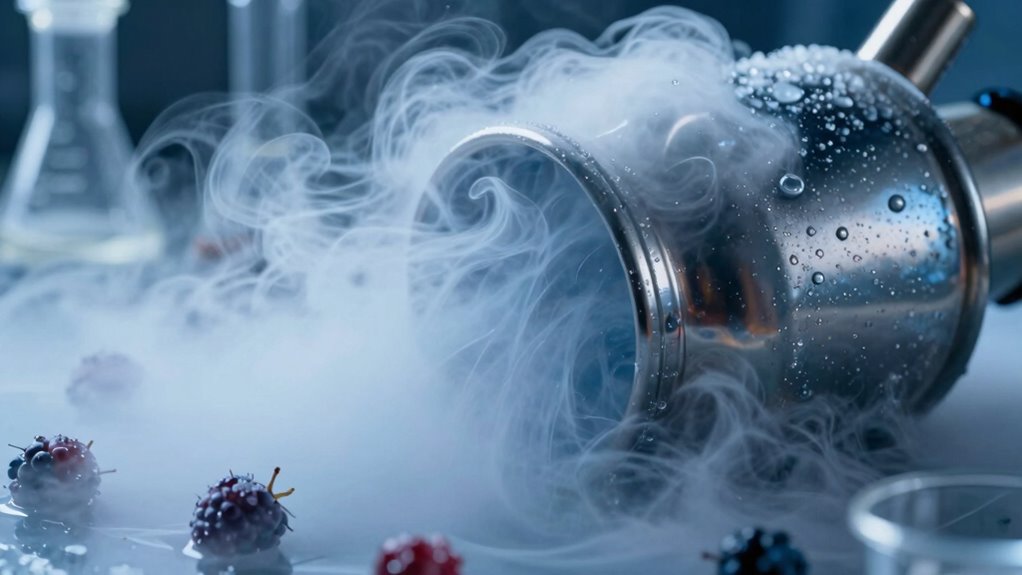
When choosing between liquid nitrogen and dry forms for your needs, it’s crucial to understand their differences in application, handling, and safety. Liquid nitrogen, with its extremely low temperature of -196°C, offers distinct advantages that make it the preferred choice in certain scenarios. You’ll find that its rapid cooling capabilities are unmatched, especially when working with biological samples, cryopreservation, or conducting experiments that require quick and uniform temperature reduction. Unlike dry forms, which often involve frozen or desiccated nitrogen compounds, liquid nitrogen provides direct contact cooling without intermediate steps, streamlining your processes.
Liquid nitrogen’s rapid cooling and direct contact make it ideal for biological samples and cryopreservation.
However, working with liquid nitrogen demands a keen focus on cryogenic safety. Because it’s a cryogenic liquid, mishandling can lead to severe cold burns or frostbite if you’re not cautious. You need proper protective gear—insulated gloves, face shields, and eye protection—to prevent injuries. Additionally, you should always guarantee good ventilation in your workspace. As liquid nitrogen vaporizes, it displaces oxygen, creating a risk of asphyxiation in poorly ventilated areas. So, safety protocols are critical, especially when handling larger quantities. You also need to be aware of the vaporization process, which can occur rapidly and unexpectedly if temperature or pressure is not carefully controlled. Proper training on cryogenic safety is essential to minimize risks during handling and storage.
Storage challenges also come into play with liquid nitrogen. Unlike dry nitrogen forms, which can often be stored in relatively simple, solid containers, liquid nitrogen requires specialized insulated containers called dewars. These are designed to minimize boil-off and maintain low temperatures, but they also come with limitations. You’ll need to monitor levels regularly and plan for frequent refilling, especially during high-volume use, to prevent running out unexpectedly. Additionally, the risk of pressure buildup inside storage vessels from vaporization means you must use vented containers and follow proper pressure management procedures. Failing to do so can compromise safety and lead to accidents. Proper storage techniques are essential to ensure safe and efficient use. Furthermore, understanding the pressure management involved in storing cryogenic liquids helps prevent dangerous incidents.
In contrast, dry nitrogen forms—such as nitrogen gas cylinders or frozen nitrogen pellets—are often easier to store and handle over longer periods. They tend to have fewer safety concerns related to vaporization and are more straightforward to transport and store. But, they don’t match the rapid cooling or direct contact advantages of liquid nitrogen. Moreover, understanding the storage limitations and safety requirements of each form is essential for effective usage. When your work demands quick, uniform cooling, or you need to preserve biological samples with minimal handling steps, liquid nitrogen makes more sense despite the storage challenges and safety precautions involved. It’s all about evaluating your specific needs and ensuring you’re prepared to handle the risks effectively.

Magula 10l Liquid Nitrogen Container, Ln2 Liquid Nitrogen Dewar,Aluminum Alloy Liquid Nitrogen Tank With 6 Canisters (10l)
- Compact 50mm Caliber: Allows longer storage and cycles
- Aerospace Aluminum Material: Strong, durable, and low evaporation rate
- Wide Application: Suitable for farms, labs, hospitals, and salons
As an affiliate, we earn on qualifying purchases.
As an affiliate, we earn on qualifying purchases.
Frequently Asked Questions
How Long Can Liquid Nitrogen Be Stored Safely?
You can typically store liquid nitrogen safely for several months to a year, depending on your storage conditions. The key is monitoring the storage duration and ensuring your container remains sealed and in good condition. Regularly check the tank’s pressure and safety valves, as improper container safety can lead to hazards. Properly maintained, liquid nitrogen stays effective and safe, but always follow manufacturer guidelines for ideal storage duration.
Are There Health Risks Associated With Liquid Nitrogen Exposure?
Yes, there are health risks associated with liquid nitrogen exposure. You risk cryogenic burns if it contacts your skin or tissues, causing severe frostbite. Inhaling vapor can lead to asphyxiation or vapor inhalation injuries, especially in enclosed spaces. Always handle liquid nitrogen with proper protective gear and guarantee good ventilation. If exposed, seek immediate medical attention to prevent serious damage or complications from cryogenic burns or vapor inhalation.
Is Liquid Nitrogen Environmentally Safer Than Dry Forms?
Think of liquid nitrogen as nature’s silent guardian—it’s generally safer for the environment than dry forms because it doesn’t produce harmful emissions or residues. Its environmental impact is minimal when handled properly, and safety considerations focus on avoiding rapid vaporization and frostbite. Unlike dry ice, liquid nitrogen quickly dissipates into the atmosphere, making it a cleaner choice overall. You just need to respect its potential hazards to keep everything safe.
Can Liquid Nitrogen Be Used at Home Safely?
You can use liquid nitrogen at home safely if you follow strict safety guidelines. Always wear protective gear like gloves and goggles, and handle it in well-ventilated areas to prevent asphyxiation. Store it in a proper, insulated container designed for cryogenic liquids, and keep it out of reach of children. Proper storage tips include labeling containers clearly and avoiding sealed, airtight containers to prevent pressure buildup.
How Does Temperature Stability Compare Between Liquid Nitrogen and Dry Forms?
Did you know liquid nitrogen maintains temperatures around -196°C, offering superior stability compared to dry forms? When it comes to temperature stability, liquid nitrogen excels because cryogenic insulation minimizes heat transfer, keeping temperatures consistent. Dry forms, however, are more prone to temperature fluctuations due to less effective insulation. If you need precise, stable cold temperatures, liquid nitrogen is the clear choice, especially in sensitive applications.

Bonvoisin Cryogenic Gloves 14.2"/36cm Long Mid-arm LN2 Protective Gloves for Liquid Nitrogen/Dry Ice/Cold Storage
- Temperature Resistance: Resists -260°C/-436°F cold
- Material: Made of durable cow leather
- Storage Tips: Store in dry, ventilated area
As an affiliate, we earn on qualifying purchases.
As an affiliate, we earn on qualifying purchases.
Conclusion
So, next time you’re faced with a choice, consider what liquid nitrogen could open for you. Its unique properties might just revolutionize your approach, offering possibilities dry forms can’t match. But beware—its power is as fascinating as it is unpredictable. Will you plunge into its depths, or stick with the familiar? The decision is yours, and the future of your projects could hinge on what you choose next. Are you ready to explore the unknown?

SmartSign "Caution – Liquid Nitrogen, Gloves And Face Shield Required" Sign | 10" x 14" Plastic
- Material: 55 mil HDPE plastic for durability
- Weather Resistance: Lasts up to 2 years outdoors
- Eco-Friendly: 100% recyclable base material
As an affiliate, we earn on qualifying purchases.
As an affiliate, we earn on qualifying purchases.

U.S.SOLID 30L Cryogenic Container Liquid Nitrogen LN2 Tank Dewar with Straps 6 Canisters
- Capacity: 30L liquid nitrogen storage
- Design: Vacuum flask for cold liquids
- Temperature Maintenance: Keeps temperatures below freezing
As an affiliate, we earn on qualifying purchases.
As an affiliate, we earn on qualifying purchases.