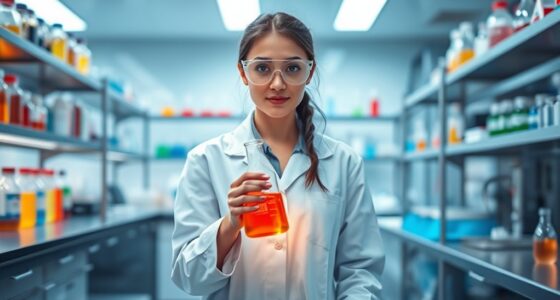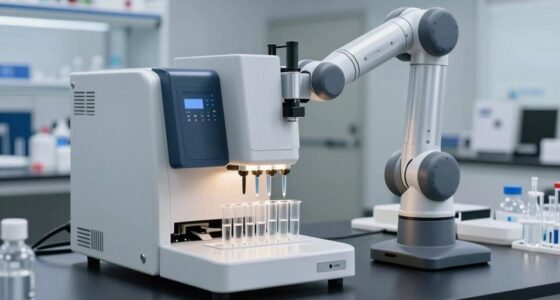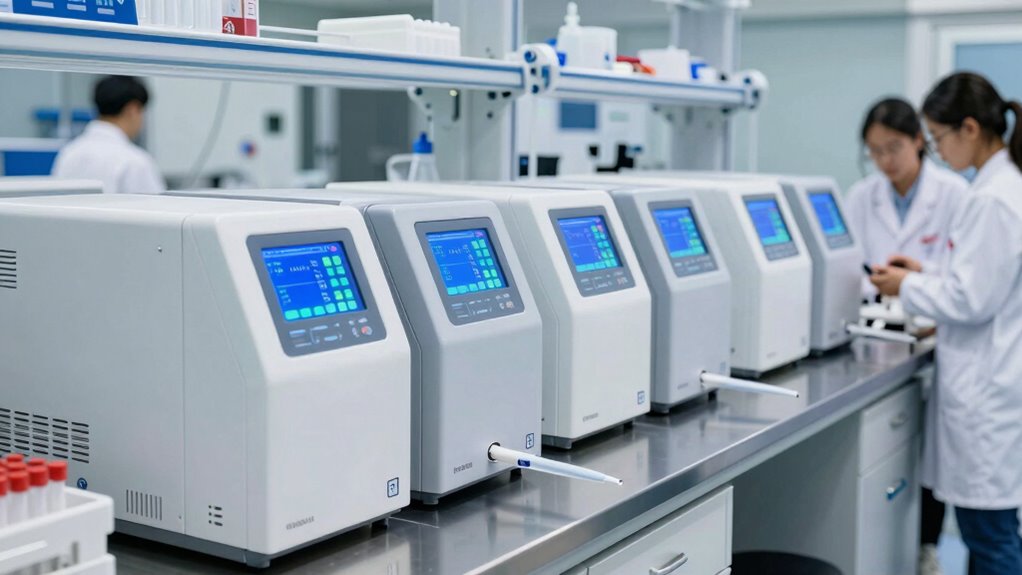

PCR machines play a essential role in modern lab education by providing hands-on experience in genetic analysis and molecular biology techniques. They help you understand genetic variation, inheritance, and mutations through real experiments. These machines also improve laboratory skills by automating DNA amplification, reducing errors, and teaching precise procedures. Their use highlights the importance of automation and technology in research. Keep exploring to discover how PCR technology can shape your scientific journey.

Prime made for students and young adults
- Fast, free delivery for dorm and study essentials
- Prime Video and Amazon Music included
- Member-only deals
Key Takeaways
- PCR machines provide hands-on experience, making complex genetic concepts more tangible for students.
- They automate DNA amplification, improving accuracy and reproducibility in laboratory exercises.
- PCR technology bridges classroom learning with real-world applications like disease diagnosis and forensic analysis.
- Incorporating PCR machines enhances technical skills essential for modern molecular biology research.
- Laboratory automation with PCR fosters efficient workflows and emphasizes the importance of precise experimental control.

Polymerase Chain Reaction (PCR) machines have revolutionized modern lab education by providing hands-on experience with essential molecular biology techniques. As a student or educator, you now have access to a powerful tool that brings theoretical concepts into practical application. PCR machines enable you to perform genetic analysis efficiently, allowing you to amplify specific DNA sequences with remarkable accuracy. This capability enhances your understanding of genetic variation, inheritance, and mutation, making complex biological processes more tangible and comprehensible. Instead of relying solely on textbooks or simulated exercises, you gain real-world experience by designing and executing PCR experiments, which deepens your grasp of genetic mechanisms.
In addition to advancing your understanding of genetics, PCR machines streamline laboratory automation, transforming how experiments are conducted. These devices automate the repetitive and meticulous process of DNA amplification, reducing the likelihood of human error and increasing reproducibility. As you operate a PCR machine, you become familiar with the principles of laboratory automation—learning to set precise thermal cycles, monitor reactions, and troubleshoot issues efficiently. This exposure prepares you for modern research environments, where automation plays an integral role in speeding up workflows and enhancing data accuracy. By integrating PCR into your curriculum, you not only acquire technical skills but also develop a mindset attuned to efficient, automated laboratory practices. Understanding the importance of laboratory automation further emphasizes how modern science benefits from technological advancements.
Moreover, PCR machines serve as a gateway to exploring advanced applications like genetic testing, disease diagnosis, and forensic analysis. When you perform PCR-based experiments, you witness firsthand how genetic analysis can be employed to identify genetic disorders or trace biological evidence. This practical experience bridges the gap between classroom theory and real-world impact, fostering a deeper appreciation for molecular biology’s role in medicine, agriculture, and environmental science. As you become proficient in using PCR machines, you also learn about the importance of precision and controls in scientific experiments, emphasizing the need for meticulous lab techniques and data interpretation. Recognizing the significance of laboratory automation in modern science further underscores the importance of PCR technology.
PCR machine for educational labs
As an affiliate, we earn on qualifying purchases.
As an affiliate, we earn on qualifying purchases.
Frequently Asked Questions
How Cost-Effective Are PCR Machines for Educational Institutions?
PCR machines can be quite cost-effective for educational institutions, especially when you consider the long-term benefits. Conducting a thorough cost analysis helps you weigh initial expenses against educational gains and potential research opportunities. While the upfront investment may seem high, budget considerations like grants or shared resources can make them affordable. Overall, if integrated properly, PCR machines enhance learning and research, providing valuable hands-on experience without straining your budget.
What Safety Precautions Are Necessary When Using PCR Machines?
Think of PCR machines as delicate musical instruments—you handle them with care. You should always follow laboratory safety protocols, wearing gloves and eye protection, to prevent contamination or accidents. Proper equipment handling includes checking for damages, avoiding spills, and keeping the workspace clean. Never bypass safety steps, even when you’re in a rush, because proper precautions protect you and ensure accurate results. Safety first keeps the science playing in harmony.
Can Students Operate PCR Machines Independently?
Yes, students can operate PCR machines independently, but only after proper student training. You’ll need to understand safety protocols, handle equipment calibration carefully, and follow detailed instructions. Supervisors should oversee initial operations to guarantee safety and accuracy. Once trained and familiar with the procedures, students can confidently run PCR tests, contributing to their learning and lab efficiency while maintaining safety standards.
How Long Does a Typical PCR Cycle Take in a Classroom Setting?
A typical PCR cycle in a classroom setting takes about 2 to 3 hours, perfect for a class period or a leisurely weekend. During this thermal cycling, your students will witness DNA amplification unfold like a magic trick, as the machine rapidly heats and cools. It’s like a rollercoaster ride for molecules, transforming tiny genetic snippets into abundant copies—proof that science can be both fun and efficient!
Are There Portable PCR Machines Suitable for Field Education?
Yes, there are portable PCR devices perfect for field applications. These compact, lightweight devices allow you to perform DNA amplification outside traditional labs, making them ideal for on-site testing, environmental studies, or educational demonstrations. With user-friendly interfaces and quick cycle times, you can get reliable results in real-time. These portable PCR machines empower you to bring molecular biology into the field, expanding educational and research possibilities beyond the classroom.
As an affiliate, we earn on qualifying purchases.
Conclusion
You might think PCR machines are too complex for students, but integrating them into modern lab education actually sparks curiosity and builds critical skills. These machines aren’t just about tech—they teach problem-solving, precision, and scientific thinking. Plus, early exposure to PCR prepares you for future innovations in biology and medicine. So don’t shy away from incorporating PCR technology; it’s an investment in your skills and your understanding of cutting-edge science.
As an affiliate, we earn on qualifying purchases.
As an affiliate, we earn on qualifying purchases.
Columbus Day / Indigenous Peoples' Day Picks
long weekend sales
As an affiliate, we earn on qualifying purchases.