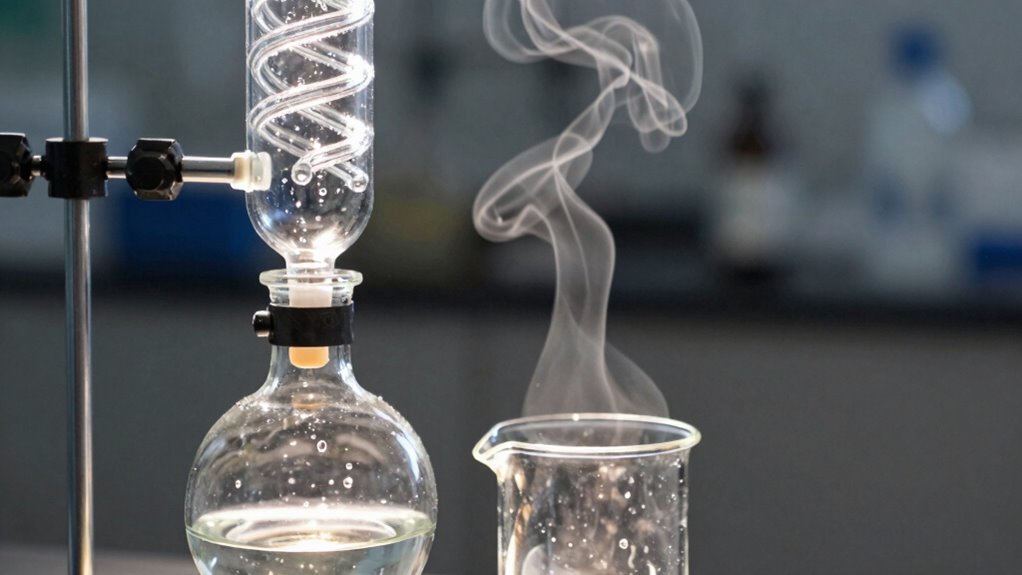
Distillation separates liquids by heating a mixture until the component with the lower boiling point turns into vapor. You then cool the vapor in a condenser so it reverts to a purified liquid. This process relies on temperature control to target specific substances, preventing impurities from co-vaporizing. If you want to understand how tools like fractional columns improve this separation or how temperature regulation works, there’s more to discover on this topic.

Prime made for students and young adults
- Fast, free delivery for dorm and study essentials
- Prime Video and Amazon Music included
- Member-only deals
Key Takeaways
- Distillation separates liquids based on differences in their boiling points.
- The liquid with the lower boiling point vaporizes first and is collected separately.
- Vapor passes through a condenser, cooling back into a liquid for collection.
- Fractional distillation enhances separation for liquids with close boiling points using a column with large surface area.
- Precise temperature control prevents impurities from co-vaporizing, ensuring purity of the separated liquids.
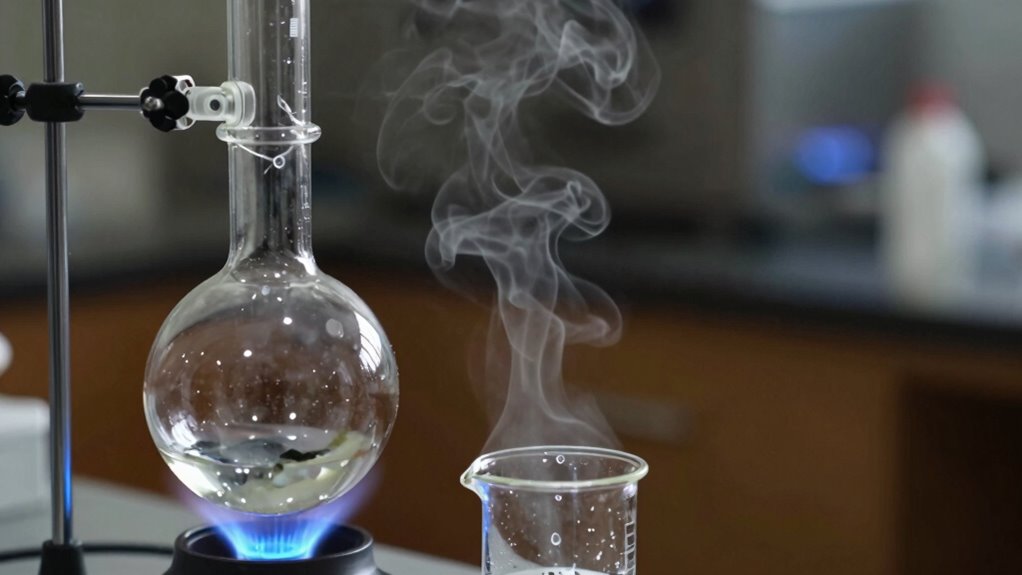
Have you ever wondered how scientists separate different liquids in a mixture? One of the most effective methods is distillation, which relies on differences in boiling points to separate components. When you set up a distillation process, you heat the mixture in a specialized apparatus called a distillation flask. As the mixture heats up, the liquid with the lower boiling point starts to vaporize first. This vapor rises through a condenser, where it cools and turns back into liquid form, then collects in a separate container. This way, you can effectively separate liquids that are mixed together.
During distillation, temperature control is essential. You need to carefully monitor the heat applied to prevent overheating, which could cause impurities to vaporize along with the target liquid. Precise temperature regulation guarantees that only the desired component vaporizes at its boiling point. This is where evaporative cooling plays a critical role. As the vapor forms, it undergoes evaporative cooling, which naturally lowers its temperature slightly compared to the boiling point. This cooling helps maintain a steady process, preventing sudden temperature spikes that could lead to impurities co-vaporizing or the mixture overheating. By managing evaporative cooling and temperature regulation, you guarantee that the separation is clean and efficient.
Effective distillation depends on careful temperature control and evaporative cooling to ensure pure separation.
The process can be repeated—called fractional distillation—if the liquids have close boiling points. In fractional distillation, a fractionating column is used, which provides a large surface area for repeated condensation and vaporization cycles. This enhances separation because the vapor becomes progressively enriched in the more volatile component as it moves up the column. Throughout this process, maintaining proper temperature regulation is fundamental; too high, and you risk losing purity, too low, and the vaporization might not occur efficiently. Additionally, understanding boiling points helps optimize the process for different mixtures. Effective heat management is crucial for achieving high purity in the separated liquids.
Furthermore, temperature regulation also plays a vital role in preventing the formation of azeotropes, which can complicate separation processes. Modern distillation techniques often employ advanced temperature control systems to improve efficiency and purity. Incorporating suitable equipment can make a significant difference in the success of the separation process. Ultimately, distillation is a precise technique that combines heat management, evaporative cooling, and vapor separation to isolate liquids. It’s widely used in industries like refining petroleum, producing spirits, and purifying chemicals. By understanding how temperature regulation and evaporative cooling work together, you can appreciate the science behind this age-old method. It’s fascinating how controlling heat and harnessing natural cooling effects allow scientists to separate complex mixtures into their pure components, making distillation a cornerstone of modern chemistry and industry.
Popular right now

Sony 65 Inch BRAVIA 3 LED 4K HDR Smart Google TV (K-65S30)

Bose QuietComfort Headphones (2nd Gen) Wireless Noise-Cancelling Headphones, Black

Vitamix Nano Personal Blender with SmoothiePilot, Black
As an affiliate, we earn on qualifying purchases.
Frequently Asked Questions
Can Distillation Separate Liquids With Similar Boiling Points?
Yes, distillation can separate liquids with similar boiling points, but it’s more challenging. When the boiling points are close, the mixture separation becomes less efficient because both liquids vaporize at nearly the same temperature. To improve separation, you might need to use fractional distillation, which involves a fractionating column that provides multiple vaporization-condensation cycles, allowing you to better distinguish between liquids with similar boiling points and achieve a more effective separation.
How Does Temperature Control Affect the Distillation Process?
Think of temperature control as the conductor of a symphony—keeping everything in perfect harmony. When you regulate temperature, you manage vapor pressure, ensuring that the right component vaporizes at the right time. Precise temperature regulation prevents mixing of vapors and improves separation. If the temperature gets too high, impurities can carry over; too low, and you won’t vaporize enough. Proper control is essential for an efficient, pure distillation process.
What Are Common Applications of Distillation in Industry?
You use distillation in industry mainly for solvent purification and refining crude oils. It helps you attain high solvent purity, essential for manufacturing processes, and separates complex mixtures into valuable components. In industrial refining, distillation guarantees products like gasoline, kerosene, and chemicals meet quality standards. Its efficiency and ability to isolate specific substances make it an indispensable method for maintaining product quality and safety across various industries.
Is Distillation Effective for Separating Complex Mixtures?
Distillation can be effective for separating complex mixtures, especially when high chemical purity is needed. It leverages differences in boiling points to isolate components, but its success depends on equipment efficiency. If your distillation setup is well-designed and properly maintained, you’ll get better separation results. However, for very similar boiling points, additional methods might be necessary to achieve the desired purity and separation quality.
What Safety Precautions Are Necessary During Distillation?
During distillation, you should wear protective gear like gloves, goggles, and a lab coat to prevent burns or chemical exposure. Make sure proper ventilation systems are in place to avoid inhaling vapors, which can be hazardous. Always operate equipment carefully, monitor temperatures closely, and never leave the process unattended. These precautions help you stay safe while effectively separating liquids through distillation.
Conclusion
So, now you see how distillation is like a magical superpower that can separate even the most stubborn liquids! With just heat and patience, you can turn a confusing mixture into pure, crystal-clear components—faster than you can blink! It’s the ultimate trick up any scientist’s sleeve, transforming chaos into clarity. Next time you hear “distillation,” remember—it’s not just a process, it’s a liquid-separating wizard that can do the impossible!