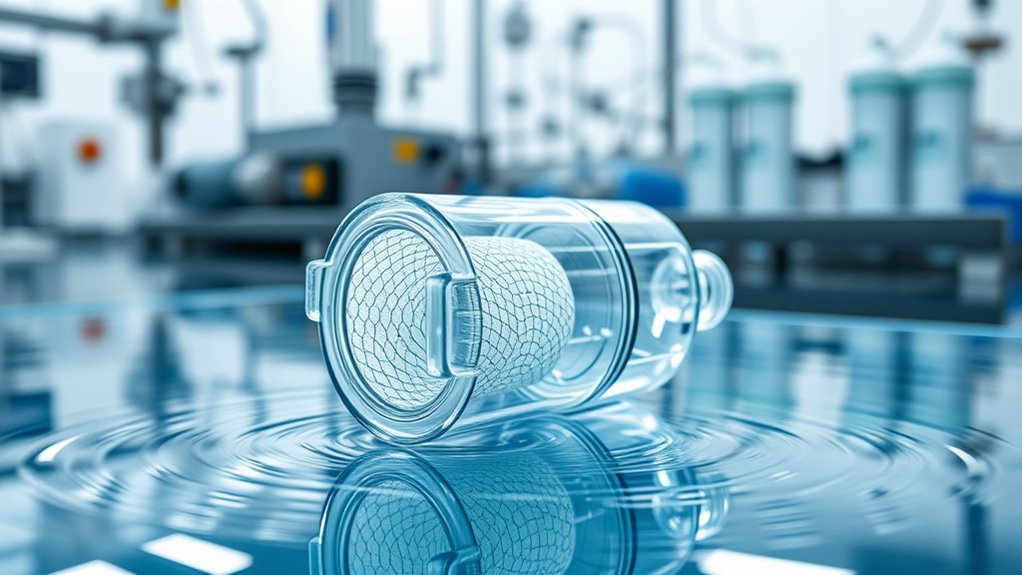

Membrane technologies play a vital role in modern desalination and water purification by efficiently removing salts, organic compounds, and contaminants from water sources. Techniques like reverse osmosis force water through semi-permeable membranes under high pressure to produce clean, high-quality drinking water. Nanofiltration offers a more energy-efficient option for removing specific pollutants. These systems are widely used across utilities, industries, and residential sectors, helping you understand how they bring safe water to communities and industries alike. Keep exploring how these technologies continue to evolve.
Key Takeaways
- Membrane technologies like reverse osmosis and nanofiltration effectively remove salts, bacteria, viruses, and organic contaminants from water sources.
- Reverse osmosis uses high-pressure semi-permeable membranes to convert seawater into potable water with minimal chemical treatment.
- Nanofiltration membranes selectively remove divalent salts, organic compounds, and bacteria, offering energy-efficient desalination options.
- Membrane materials are engineered for durability, high rejection, and fouling resistance, ensuring long-term system performance.
- These technologies provide scalable, sustainable solutions for drinking water, wastewater treatment, and addressing global water scarcity.

Membrane technologies play a essential role in modern desalination and water purification processes by providing efficient and reliable methods to remove contaminants. Among these technologies, reverse osmosis stands out as one of the most widely used and effective techniques. In reverse osmosis systems, water is forced through semi-permeable membranes under high pressure, allowing water molecules to pass while blocking salts, bacteria, viruses, and other impurities. This process is especially valuable in converting seawater into potable water, making it a cornerstone of large-scale desalination projects worldwide. Its ability to produce high-quality drinking water with minimal chemical treatment makes reverse osmosis a preferred choice for utilities, industries, and even residential applications.
Membrane technologies, especially reverse osmosis, are crucial for efficient, high-quality water purification and desalination worldwide.
In addition to reverse osmosis, nanofiltration has gained prominence due to its versatility and efficiency in removing specific contaminants. Nanofiltration membranes have slightly larger pores compared to reverse osmosis membranes, which allows them to selectively remove divalent and larger molecules like certain salts, organic compounds, and bacteria. This makes nanofiltration particularly useful for treating surface water, wastewater, and brackish water, where the goal is to reduce contaminants without completely desalinating the water. It’s a more energy-efficient process in some cases, offering a balance between purification and operational costs. For instance, nanofiltration can effectively remove pesticides, pharmaceuticals, and naturally occurring organic matter, improving water quality for various industrial and municipal purposes.
As you explore membrane technologies, you’ll notice that both reverse osmosis and nanofiltration rely on advanced membrane materials designed to withstand high pressures and chemical exposure. These membranes are often made from thin-film composites that provide durability, high rejection rates, and fouling resistance. Proper maintenance, including regular cleaning and pretreatment of feed water, is essential to guarantee optimal performance and longevity of the membranes. You’ll also find that advances in membrane design continue to enhance their selectivity, permeability, and resistance to fouling, making these systems more sustainable and cost-effective over time. Additionally, understanding the membrane material properties is crucial for optimizing system performance and longevity.
Ultimately, understanding the differences and applications of reverse osmosis and nanofiltration empowers you to select the right technology for your specific water treatment needs. Whether you’re aiming to produce drinking water, treat wastewater, or reduce specific contaminants, these membrane processes offer flexible, scalable solutions that can be tailored to meet diverse requirements. As you implement these technologies, you’ll contribute to addressing global water scarcity challenges while guaranteeing safe, clean water for communities and industries alike.

iSpring RCC7AK, NSF Certified, 75 GPD, Alkaline 6-Stage Reverse Osmosis System, pH+ Remineralization RO Water Filter System Under Sink, Patented Top-Mounted Faucet Design for Easy Installation
PATENTED DESIGN – The top-mounted fastener allows for easy countertop installation entirely from above, eliminating the hassle of…
As an affiliate, we earn on qualifying purchases.
As an affiliate, we earn on qualifying purchases.
Frequently Asked Questions
What Are the Latest Advancements in Membrane Material Durability?
You’ll find that recent advancements in membrane material durability include the use of advanced composites and nanomaterial enhancements. These innovations improve strength, resistance to fouling, and longevity of membranes. Researchers are incorporating nanomaterials like carbon nanotubes and graphene oxide into composite structures, which markedly enhance performance. These developments help you achieve more efficient, durable membranes that withstand harsh conditions, reducing maintenance costs and extending operational life.
How Do Membrane Technologies Compare in Energy Efficiency?
You’ll find that membrane technologies vary in energy efficiency, with some designs consuming less energy per unit of water treated. By comparing efficiency metrics, you can see that newer membranes often use less energy, making them more sustainable and cost-effective. Factors like membrane design and operational conditions influence energy consumption, so selecting the right technology can markedly reduce your operational costs and environmental impact while maintaining high water quality.
What Are the Cost Implications of Scalable Membrane Desalination?
You’ll find that scalable membrane desalination involves significant infrastructure costs, but its economic feasibility improves with larger plant sizes and technological advancements. While initial investments can be high, operational expenses decrease over time, making it a cost-effective solution for water-scarce regions. Careful planning and financing are essential to balance infrastructure costs and long-term benefits, ensuring the process remains financially viable and sustainable.
How Are Membrane Fouling Issues Being Mitigated?
Membrane fouling is a formidable obstacle, but you combat it effectively by implementing advanced biofouling prevention strategies. Regular cleaning protocols, including chemical and physical cleaning, keep membranes clear and functioning ideally. You also use anti-scalants and proper pretreatment to reduce fouling risks. Staying vigilant with monitoring ensures you catch issues early, maintaining efficiency and extending membrane lifespan, making your water purification process resilient and sustainable.
What Are Future Trends in Membrane-Based Water Purification?
You’ll see future trends focus on smart membrane development, which enhances selectivity and antifouling properties, making purification more efficient. Additionally, integrating renewable energy sources like solar or wind will reduce operational costs and environmental impact. These innovations aim to create sustainable, energy-efficient water purification systems, addressing global water scarcity. Embracing these trends could revolutionize how you access clean water, making solutions more affordable and eco-friendly.

Chanson Nano-Filtration Water Purifier System – Non-Electric, Long-Life Filter, Reduces Fluoride, Heavy Metals, VOCs & Hardness | Effective Home Filtration for Tap, Well, River, and Rain Water
Limite Lifetime Warranty
As an affiliate, we earn on qualifying purchases.
As an affiliate, we earn on qualifying purchases.
Conclusion
So, after all this talk about advanced membrane technologies, you might think they’re perfect. Yet, despite their promise of clean water, you’ll still find yourself battling fouling, energy costs, and plastic waste. Ironically, the very tools meant to save us from water scarcity could become part of the problem. But hey, with continued innovation, maybe someday these membranes will truly deliver on their promises—without creating new challenges along the way.

Waterdrop G3P600 Reverse Osmosis System, 8 Stage Tankless Reverse Osmosis Water Filter, NSF/ANSI 42 & 53 & 58 & 372 Certified, Under Sink RO System, 2:1 Pure to Drain, Smart LED Faucet
𝐓𝐫𝐮𝐬𝐭𝐞𝐝 𝐜𝐞𝐫𝐭𝐢𝐟𝐢𝐜𝐚𝐭𝐢𝐨𝐧𝐬: Waterdrop G3P600 reverse osmosis system is certified against NSF/ANSI 58 for TDS reduction and NSF/ANSI 372…
As an affiliate, we earn on qualifying purchases.
As an affiliate, we earn on qualifying purchases.

Max Water XLP-4040 Reverse Osmosis 4" x 40" RO Membrane, 2300 GPD | XLP 4040 For Water Purification Desalination Commercial, Industrial, Agricultural
Optimal Purity & Performance: Achieve exceptional water quality with our XLP-4040 4" x 40" RO Membrane capable of…
As an affiliate, we earn on qualifying purchases.
As an affiliate, we earn on qualifying purchases.