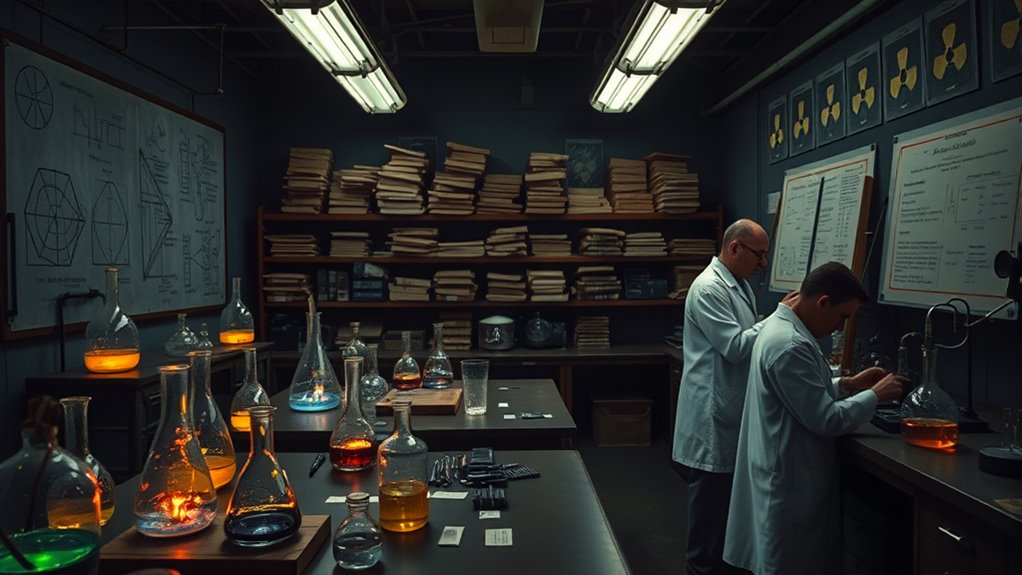

The chemistry behind the atomic bomb involves understanding nuclear fission, where splitting uranium-235 or plutonium-239 releases a massive amount of energy. This process requires creating a supercritical mass of fissile material to sustain a chain reaction. Scientists worked on optimizing moderators and reflectors to control the reaction efficiently. As you explore further, you’ll discover how these chemical and nuclear principles played a vital role in developing this powerful weapon.
Key Takeaways
- The project focused on enriching uranium-235 and producing plutonium-239, both key fissile materials for the bomb.
- Chemists developed methods to separate fissile isotopes from uranium ore and reactor byproducts.
- Chemical processes included gaseous diffusion and centrifugation for isotope separation.
- Plutonium was produced in reactors and then chemically extracted and purified for weapon use.
- Understanding chemical properties of fissile materials was essential for designing critical mass and implosion mechanisms.

Have you ever wondered how scientists developed the first atomic bomb? It all started with a groundbreaking discovery in nuclear physics—nuclear fission. This process involves splitting the nucleus of an atom, typically uranium-235 or plutonium-239, releasing an enormous amount of energy in the process. Scientists realized that if they could control this chain reaction, it could serve as a powerful explosive. During the early 1940s, as World War II intensified, the race to harness nuclear fission accelerated. The U.S. government launched the Manhattan Project, a secret wartime effort to develop an atomic weapon before Nazi Germany or Japan could do so. This project wasn’t just about building a bomb; it was about understanding and manipulating the fundamental forces of nature.
One of the most critical challenges was ensuring wartime secrecy. The project involved thousands of scientists, engineers, and military personnel working at multiple sites across the country. Keeping all this under wraps was essential to prevent enemy intelligence from discovering their progress and potentially sabotaging the effort. The secrecy was so strict that even many involved didn’t know the full scope of the project until later stages. This clandestine environment fostered an atmosphere of urgency and innovation, where breakthroughs had to be achieved without leaks or espionage. Secrecy also meant working in isolated facilities, like Los Alamos Laboratory in New Mexico, where the actual design and assembly of the bomb took place.
Throughout this process, scientists focused on understanding the nature of nuclear fission and how to sustain a chain reaction. They experimented with different isotopes, moderators, and reflectors to optimize the process. They also explored how to assemble a supercritical mass—a configuration where the chain reaction could grow exponentially and release its energy in a split second. The challenge wasn’t just scientific; it was logistical and strategic, requiring meticulous coordination and deception to keep the project’s details hidden from the outside world. The wartime secrecy was essential to maintain the element of surprise and to prevent the Nazis or Japanese from developing their own nuclear weapons. Ultimately, this combination of scientific ingenuity, strategic secrecy, and relentless effort led to the successful development of the atomic bomb, forever changing the course of history. Additionally, advancements in project management techniques played a crucial role in coordinating such a complex and secretive effort.

Discovery™ Super Reactions Science Kit – 66 Experiments STEM Lab for Kids| Includes Chemistry Tools, Volcano Mold, Slime, Reactions & Explosions|Educational Learning Toy|DIY Activity Set Gift| Ages 8+
✔ 66 ACTION-PACKED SCIENCE EXPERIMENTS – Includes 26 step-by-step guided activities and 40 bonus DIY ideas using household…
As an affiliate, we earn on qualifying purchases.
As an affiliate, we earn on qualifying purchases.
Frequently Asked Questions
What Were the Main Chemical Challenges in Uranium Enrichment?
You face significant chemical challenges in uranium enrichment, mainly in isotope separation. You need to differentiate uranium-235 from uranium-238, which are chemically identical, making separation tricky. You rely on specialized chemical reagents and methods like gaseous diffusion and centrifuges to achieve this. Managing these processes requires precise control and innovative techniques to efficiently isolate the desired isotope, all while ensuring safety and minimizing contamination.
How Did Plutonium Chemistry Influence Bomb Design?
Think of plutonium chemistry like solving a complex puzzle. You analyze plutonium purification to ensure purity and control chemical reaction pathways, which directly impacts bomb design. Precise purification prevents unwanted reactions, while understanding pathways helps optimize the implosion method for efficient detonation. This chemistry is vital, as it determines the reliability and effectiveness of the bomb, making the mastery of plutonium chemistry essential in the development process.
Were There Any Alternative Chemical Methods Considered?
You should know that alternative chemical methods were indeed considered during the development of the atomic bomb. Researchers explored different chemical syntheses to produce fissile materials efficiently. They examined various approaches like electromagnetic separation and gaseous diffusion, which served as alternatives to pure chemical synthesis. These methods aimed to optimize uranium and plutonium production, ultimately shaping the bomb’s design and ensuring a successful and feasible path to nuclear weapon development.
What Role Did Chemical Safety Protocols Play During Development?
You understand that chemical safety protocols played a vital role in hazard mitigation during development. These protocols guaranteed safe handling of radioactive materials and hazardous chemicals, reducing risks to personnel. Strict safety measures, such as protective gear and controlled environments, were implemented to prevent accidents. By prioritizing safety protocols, you help protect everyone involved, maintaining a secure environment while advancing sensitive research on atomic bomb chemistry.
How Did Chemical Research Impact Post-War Nuclear Policies?
You know what they say, “knowledge is power.” Chemical research during the Manhattan Project greatly influenced post-war nuclear policies by highlighting risks like chemical warfare and advancing isotopic separation techniques. This knowledge led to stricter international controls, non-proliferation treaties, and safety protocols to prevent misuse of nuclear technology. Your understanding of these chemical processes helped shape policies aimed at maintaining global security and preventing future nuclear conflicts.
uranium isotope separation kit
As an affiliate, we earn on qualifying purchases.
As an affiliate, we earn on qualifying purchases.
Conclusion
So, here you are, marveling at the brilliant minds who cracked the atom’s code—no big deal, right? Just a little project that changed history forever. It’s almost funny how a dash of science and some secretive labs could lead to such destruction. But hey, who needs peace when you’ve got the power of splitting atoms at your fingertips? Just another day in the life of humans playing god—what could possibly go wrong?

LINKTOR Chemistry Molecular Model Kit (444 Pieces), Student or Teacher Set for Organic and Inorganic Chemistry Learning, Motivate Enthusiasm for Learning and Raising Space Imagination, A Fullerene Set
FOR BASIC TEACHING TO ADVANCED SCIENCE: 444 pieces molecular model kit, including 136 atoms, 158 bonds and 150…
As an affiliate, we earn on qualifying purchases.
As an affiliate, we earn on qualifying purchases.

Atomic Bomb Nuke Plutonium Sphere Internal Model,Explosive Lens, Historical Nuclear Physics,Oppenheimer Era 3D Craft Assembly Kit,Adult Science Collectible for Military History Fans & Display Ornament
A premium display model for adult collectors and history enthusiasts, featuring high-precision 3D printing with metallic luster material….
As an affiliate, we earn on qualifying purchases.
As an affiliate, we earn on qualifying purchases.