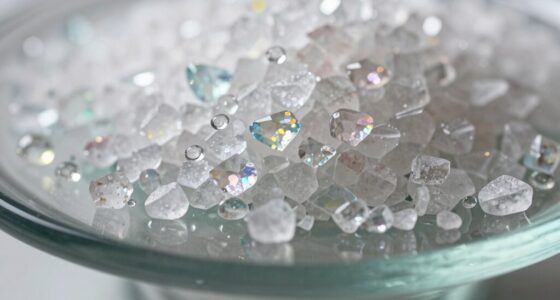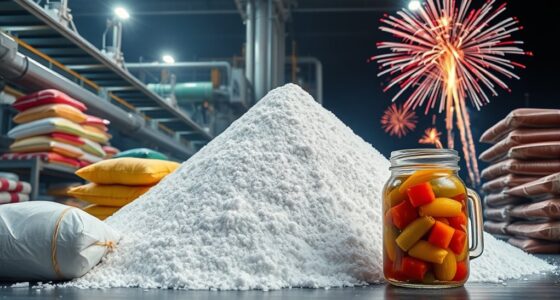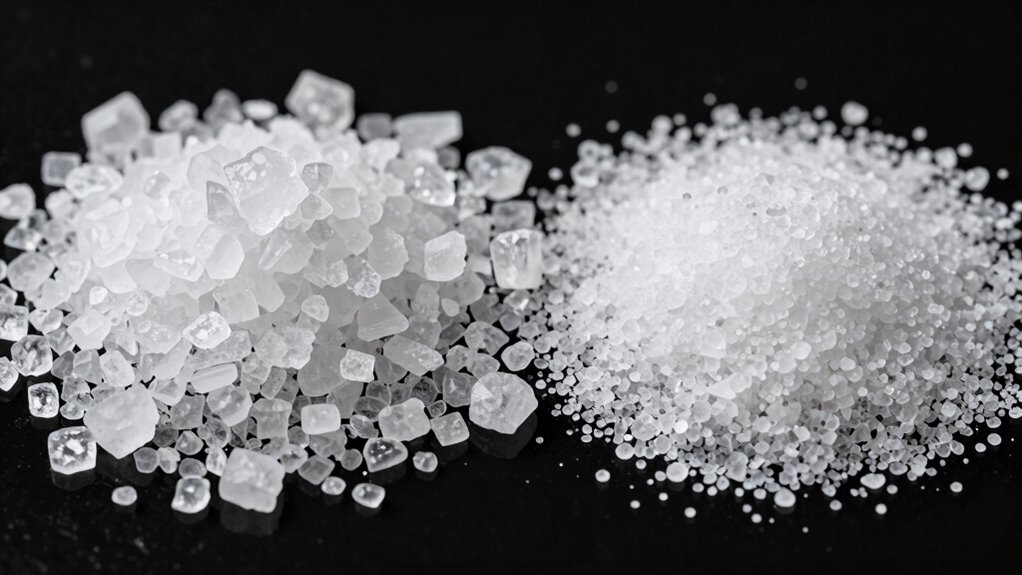

If you’re choosing between technical and lab grade salts, know that technical grade salts have lower purity, often containing impurities, and are mainly used in industrial applications. Lab grade salts, on the other hand, undergo strict purification, ensuring ≥99.9% purity, making them ideal for precise experiments and sensitive reactions. Cost and quality control also differ. To understand these distinctions in more detail and find the best fit for your needs, keep exploring further.
Key Takeaways
- Technical grade salts have lower purity and may contain impurities, suitable for industrial applications; lab grade salts are highly purified for precise experiments.
- Lab grade salts typically have ≥99.9% purity, while technical grade salts meet basic standards with potential contaminants.
- Lab grade salts undergo strict quality control and testing, whereas technical grade salts have minimal testing.
- Cost is lower for technical grade salts, making them more accessible for large-scale industrial use; lab grade salts are more expensive.
- Visual quality and impurity levels influence application suitability, with lab grade salts preferred for sensitive laboratory procedures.
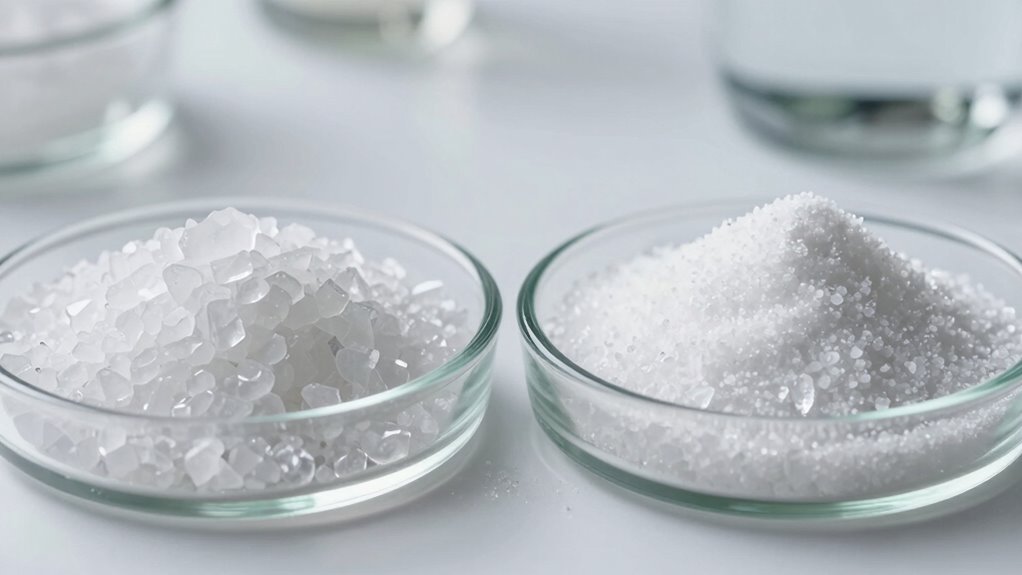
Ever wondered what sets technical grade salts apart from lab grade salts? The key differences mainly revolve around purity standards and application suitability. When you choose a salt for a specific purpose, understanding these factors guarantees you get the right product for your needs. Technical grade salts are typically produced for industrial applications, where they meet certain purity standards but are not as refined as lab grade salts. These salts often contain impurities or trace elements that aren’t harmful in large-scale manufacturing but wouldn’t be acceptable in laboratory settings. Because of this, they’re often less expensive and more readily available for bulk use. Conversely, lab grade salts undergo rigorous purification and testing, often meeting specifications like 99.9% purity or higher. This high level of purity minimizes the risk of contamination, ensuring your experiments yield reliable and reproducible results. If your work involves precise chemical reactions, titrations, or analytical techniques, lab grade salts are the only choice. Additionally, color accuracy in salts can influence their visual inspection and suitability for specific applications.

Sodium Chloride ACS Grade – 99% High Purity Crystals, 500 Grams (1.1 lb)
ACS Grade Sodium Chloride
As an affiliate, we earn on qualifying purchases.
As an affiliate, we earn on qualifying purchases.
Frequently Asked Questions
How Do Technical and Lab Salts Affect Chemical Reactions?
Technical and lab salts can profoundly impact your chemical reactions due to differences in purity standards. Lab-grade salts are purer, reducing contamination risks and ensuring more consistent results. Technical salts may contain impurities, which can interfere with reactions or produce unwanted byproducts. When precision matters, using lab-grade salts helps you achieve accurate, reliable outcomes, while technical salts are suitable for less sensitive applications where purity isn’t as critical.
Are Lab-Grade Salts Suitable for Industrial Applications?
Lab-grade salts generally aren’t suitable for industrial applications because they often have higher purity standards and fewer contaminants, which can be vital in sensitive processes. While their salt purity makes them ideal for research and testing, they might not meet the application suitability requirements of large-scale manufacturing. For industrial use, technical grade salts are preferred due to their cost-effectiveness and adequate purity levels for most applications.
Can Technical Salts Be Used in Food or Pharmaceutical Products?
Technical salts typically aren’t suitable for food or pharmaceutical products because they often lack the purity required for food safety and regulatory compliance. Using them can compromise safety standards and lead to legal issues. To guarantee quality, safety, and compliance, always select salts specifically labeled for food or pharmaceutical use. Prioritizing purity and proper labeling protects consumers and adheres to strict safety standards.
What Safety Precautions Are Needed When Handling Each Salt Grade?
When handling each salt grade, you should follow safety precautions based on purity standards and packaging considerations. For technical salts, wear gloves and eye protection since impurities might cause irritation, and guarantee proper sealing to prevent contamination. For lab-grade salts, handle in a lab environment with appropriate PPE, and store in airtight containers to maintain purity. Always follow manufacturer instructions and safety data sheets for safe handling of both grades.
How Do Storage Requirements Differ Between Technical and Lab Salts?
You should store technical salts in durable, clearly labeled containers, ensuring they’re tightly sealed to prevent contamination. Lab-grade salts require more precise storage conditions, such as controlled humidity and temperature, often in airtight containers to maintain purity. Both need to be kept away from incompatible substances, but lab salts demand stricter environmental controls to preserve their quality, while technical salts are generally more tolerant of varied conditions.

Himalayan Secrets Pharmaceutical Grade Salt Approved for Halogenerators – Use in Salt Therapy Rooms and Caves 5 LB JAR
Pharmaceutical Grade Sodium Chloride 99.9%
As an affiliate, we earn on qualifying purchases.
As an affiliate, we earn on qualifying purchases.
Conclusion
So, next time you’re faced with choosing between technical and lab grade salts, remember: one’s perfect for your backyard chemistry experiments, and the other’s reserved for those high-stakes, Nobel-worthy research. Don’t be fooled by the fancy labels; after all, a pinch of salt is just a pinch—until it’s not. Whether you’re tinkering at home or conducting groundbreaking science, knowing the difference keeps your experiments from turning into salt-saturated chaos.

Sodium Chloride (Salt), High Purity Crystals, 500 Grams (1.1 lb.)
Product has an Indefinite Shelf Life
As an affiliate, we earn on qualifying purchases.
As an affiliate, we earn on qualifying purchases.

Morton Table Salt, Iodized, 25 Pound
Discontinued
As an affiliate, we earn on qualifying purchases.
As an affiliate, we earn on qualifying purchases.