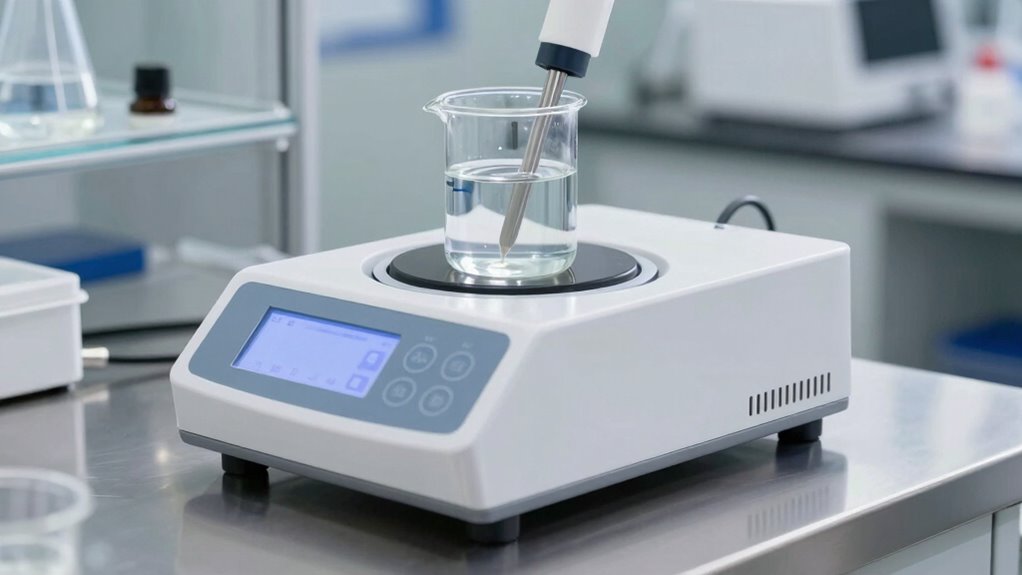

A laboratory sonicator is used for various tasks, including breaking down cells and tissues, creating stable emulsions, and removing dissolved gases from solutions. It also helps clean equipment by removing contaminants from tiny crevices and enhances chemical reactions through ultrasonic energy. Proper adjustment of ultrasonic parameters guarantees effective results without damaging samples. If you’d like to explore how these processes work and improve your experiments, there’s more to discover below.

Prime made for students and young adults
- Fast, free delivery for dorm and study essentials
- Prime Video and Amazon Music included
- Member-only deals
Key Takeaways
- Breaks down biological materials, cells, or tissues into manageable components for analysis or further experiments.
- Creates stable emulsions of immiscible liquids like oil and water for various applications.
- Removes dissolved gases from solutions to improve accuracy in spectroscopy and microscopy.
- Cleans laboratory equipment by removing contaminants from surfaces and tiny crevices.
- Optimizes ultrasonic parameters to enhance chemical reactions and ensure process efficiency.

Laboratory sonicators are versatile tools that play an essential role in modern scientific and medical research. You’ll find them commonly used in sample preparation, where they help break down complex biological materials, cells, or tissues into uniform, manageable components. This process guarantees that your samples are ready for analysis or further experimentation. Sonicators utilize high-frequency sound waves to disrupt cell walls, liberate intracellular contents, or homogenize mixtures, making your workflow more efficient and consistent. Additionally, sonicators are employed to enhance chemical reactions, increasing reaction rates or yields through ultrasonic energy.
One of the key applications of sonicators is in emulsification techniques. If you’re working with mixtures that need to be combined into stable emulsions—like oils and water or other immiscible liquids—sonicators are invaluable. Their ultrasonic waves generate intense shear forces that reduce droplet size, promoting the formation of fine, stable emulsions. This capability is especially vital in pharmaceutical research, cosmetics, and food science, where consistency in emulsions can greatly impact product quality and performance. With a sonicator, you gain precise control over droplet size and distribution, guaranteeing your emulsification processes meet strict specifications. The ultrasonic energy also helps in achieving a homogeneous mixture more rapidly than manual methods. Proper ultrasonic frequency settings are crucial for optimizing these processes and avoiding sample damage. The effectiveness of sonication can also depend on the power output of the device, which needs to be carefully calibrated for each application. Using the correct ultrasonic parameters ensures optimal results while protecting sensitive materials from overexposure.
In addition to sample preparation and emulsification, sonicators are often used for degassing solutions. When preparing samples or reagents, dissolved gases can lead to unwanted bubbles that interfere with analytical techniques like spectroscopy or microscopy. By applying ultrasonic energy, you can efficiently remove these gases, improving the accuracy and reliability of your results. This process is quick and effective, saving you time compared to traditional degassing methods. In some cases, ultrasonic degassing can also prevent the formation of gas bubbles during experimental procedures, ensuring consistent outcomes. Properly degassed samples are essential for obtaining precise and reproducible data in high-sensitivity experiments.
Sonicators also find their place in cleaning procedures. Ultrasonic cleaning, which involves immersing equipment or components in a cleaning solution and subjecting them to ultrasonic waves, removes contaminants and residues that are difficult to eliminate by manual cleaning. This application is especially useful in laboratories that require high levels of cleanliness, such as microbiology or analytical chemistry labs. The ultrasonic waves penetrate into tiny crevices, reaching areas that are otherwise hard to clean thoroughly. Regular cleaning with sonicators can extend the lifespan of laboratory tools and maintain strict hygiene standards. Proper maintenance and cleaning of the sonicator itself are important to ensure its optimal performance and longevity. Additionally, routine calibration and maintenance help prevent equipment malfunctions, ensuring consistent cleaning results over time.
laboratory sonicator for cell disruption
As an affiliate, we earn on qualifying purchases.
As an affiliate, we earn on qualifying purchases.
Frequently Asked Questions
How Does a Laboratory Sonicator Differ From Other Ultrasonic Devices?
You’ll find that a laboratory sonicator differs from other ultrasonic devices because it’s specifically designed for precise applications like ultrasonic cavitation and acoustic dispersion. Unlike general ultrasonic tools, it offers adjustable settings for frequency and amplitude, allowing you to target specific samples with accuracy. Its focused power guarantees effective cell disruption, emulsification, or cleaning, making it ideal for research and laboratory work where control and consistency are essential.
Can a Sonicator Be Used for Food Processing Applications?
Yes, you can use a sonicator for food processing applications. It helps improve food texture by breaking down cell walls and enhances ingredient extraction, making flavors and nutrients more accessible. You’ll find it useful for emulsifying, homogenizing, or tenderizing ingredients efficiently. By applying ultrasonic waves, you guarantee consistent results, reduce processing time, and preserve food quality, making it a valuable tool in modern food manufacturing.
What Precautions Should Be Taken When Operating a Sonicator?
You must take serious safety precautions when operating a sonicator—think of it as wielding a powerful sonic sword! Always prioritize sample safety by wearing gloves and goggles, and guarantee equipment calibration is perfect to prevent malfunctions. Never operate the device unattended, and keep the area clear of unnecessary personnel. Properly maintain and inspect the sonicator regularly to avoid accidents, because even small errors can lead to big safety risks.
How Long Should Samples Typically Be Sonicated?
You should typically sonicate samples for 5 to 15 minutes, depending on your sample type and desired outcome. During sample preparation, monitor acoustic cavitation carefully, as excessive sonication can cause overheating or degradation. Adjust the duration based on your specific needs, ensuring you balance effective disruption with sample integrity. Always stay attentive to temperature and energy levels to optimize results while protecting your samples.
Are There Specific Cleaning Protocols for Laboratory Sonicators?
Imagine your lab equipment as a trusted partner—cleanliness is its best armor. You should follow specific cleaning protocols for your sonicator, using gentle cleaning agents suitable for electronic components. Regular maintenance routines, including wiping down the tank and inspecting for residue or corrosion, help guarantee peak performance. Always turn off and unplug the device before cleaning, and consult the manufacturer’s guidelines for detailed instructions to keep it running smoothly.
ultrasonic emulsification device
As an affiliate, we earn on qualifying purchases.
As an affiliate, we earn on qualifying purchases.
Conclusion
A laboratory sonicator is your trusty compass in the vast ocean of scientific discovery. It whirls and dances, breaking barriers and uniting particles in harmony. With each pulse, it ignites the spark of innovation and reveals hidden secrets beneath the surface. Embrace this powerful tool, and let it be your guiding star—illuminating your path through the intricate maze of research, transforming chaos into clarity and curiosity into breakthrough moments.
As an affiliate, we earn on qualifying purchases.
As an affiliate, we earn on qualifying purchases.
Halloween Picks
halloween
As an affiliate, we earn on qualifying purchases.