Solubility matters in inorganic salt applications because it determines how effectively salts dissolve, control crystallization, and influence product quality. High solubility allows for easier manipulation in processes like purification and manufacturing, while low solubility can lead to unwanted crystal formation or buildup. Your choice of salt impacts environmental safety, process efficiency, and material quality. To explore how these factors shape various industries, keep exploring these essential concepts.
Key Takeaways
- Solubility determines crystallization control, affecting product purity and consistency in industrial processes.
- It influences environmental impact by affecting how salts dissolve and persist in ecosystems.
- Proper salt selection based on solubility optimizes process efficiency and system maintenance.
- Solubility impacts product quality, ensuring uniform crystal size and high material standards.
- Managing solubility is essential for sustainable salt use and minimizing ecological footprint.
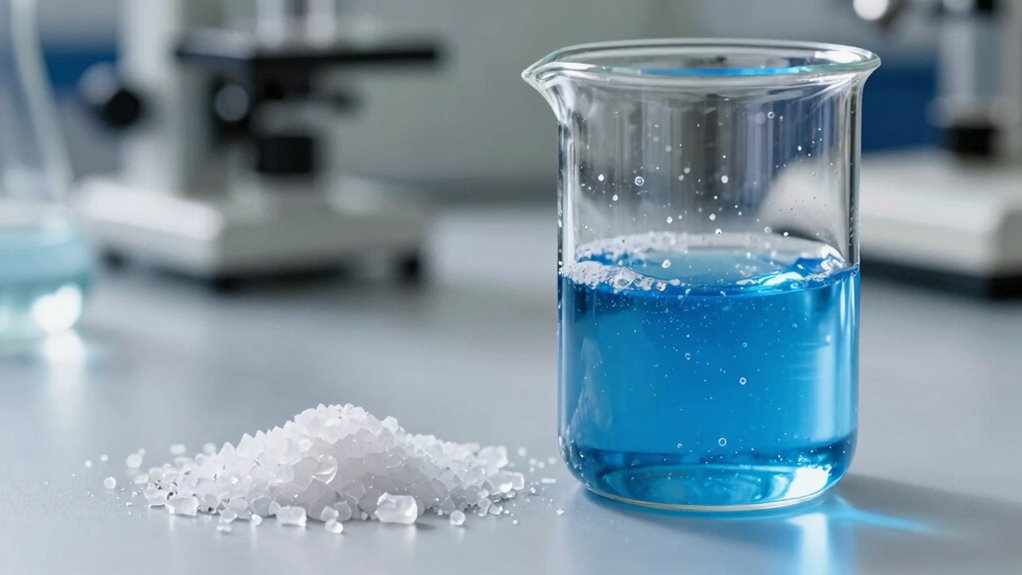
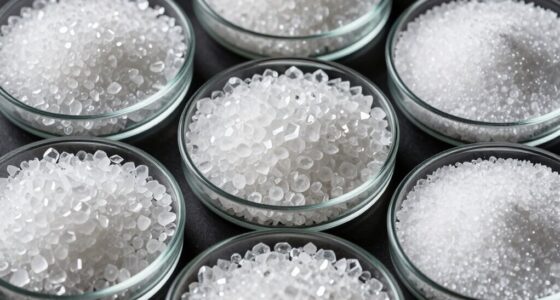
Have you ever wondered how the solubility of salts influences their effectiveness in various applications? When salts dissolve, their ability to either stay dissolved or crystallize out plays a pivotal role in many industries. For instance, in chemical manufacturing, controlling crystallization is key to obtaining pure, uniform crystals. If a salt’s solubility is too high, it may remain dissolved longer, making it easier to manipulate its crystallization process. Conversely, if it’s too low, crystals could form prematurely, leading to inconsistent product quality. Crystallization control becomes especially essential in pharmaceutical production, where precise crystal size and purity determine the efficacy and safety of medications.
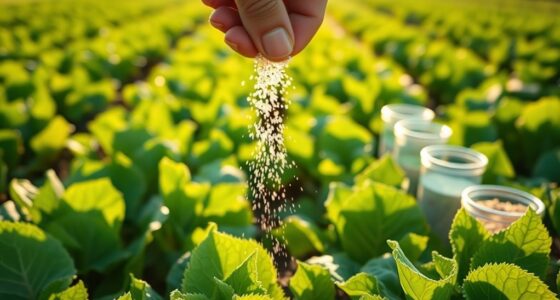
Beyond the manufacturing process, solubility also impacts the environmental footprint of salt use. When salts are employed in large-scale applications like de-icing roads or water treatment, their environmental impact depends heavily on how they dissolve and disperse. Soluble salts that easily dissolve can be washed away quickly, reducing surface residue and minimizing long-term environmental contamination. However, if salts are less soluble, they may linger in the environment, affecting soil and water quality over time. This persistence can harm plant life, aquatic ecosystems, and groundwater, emphasizing the importance of understanding salts’ behavior in the environment. Additionally, the crystallization process can be affected by environmental conditions, influencing how salts interact with surrounding ecosystems. Furthermore, selecting salts with appropriate solubility characteristics can help minimize environmental impact and promote sustainable practices.
Your choice of salt in any application hinges on its solubility properties because they dictate how the salt behaves in different settings. For example, in water softening, highly soluble salts like sodium carbonate dissolve readily to remove calcium and magnesium ions, improving water quality. In contrast, in cooling systems, less soluble salts might be preferred to prevent excessive buildup and scaling. The goal is to find a balance where the salt dissolves efficiently but doesn’t cause adverse environmental effects or operational issues.
Ultimately, understanding solubility isn’t just about how well a salt dissolves; it’s about how that dissolution influences the entire process and its environmental footprint. Proper crystallization control ensures high-quality products, while awareness of environmental impact guides responsible salt selection. By considering these factors, you can optimize salt applications for efficiency, safety, and sustainability, making sure that the benefits outweigh any potential risks associated with solubility and crystallization behavior. Additionally, the role of solubility in controlling crystal growth highlights its importance in producing consistent, high-quality materials across various industries.

All-New 2026 8-in-1 Pool Test Strips -150 CT Pool Salt Test Strips | Salt Water Pool Testing Kit for Salt Water Pools, in & Above-Ground Pools, Hot Tubs&Spas| Quick&Accurate Testing Chlorine,pH,Salt
Premium Quality 8-in-1 Pool Test Strips– Crafted with premium Nordic fiber paper, our Salt Water Pool Testing Kit…
As an affiliate, we earn on qualifying purchases.
As an affiliate, we earn on qualifying purchases.
Frequently Asked Questions
How Does Temperature Affect Salt Solubility?
You’ll notice that temperature dependence greatly affects salt solubility. As temperature increases, many salts become more soluble because the solubility equilibrium shifts, allowing more salt to dissolve. Conversely, some salts may become less soluble with rising temperature. Understanding this relationship helps you control processes like crystallization or dissolution, ensuring maximum efficiency. So, adjusting temperature can be a powerful tool in manipulating salt solubility for your specific applications.
Can Solubility Differences Influence Salt Purity?
Yes, solubility differences can influence salt purity. When you use impurity separation and crystallization techniques, you rely on varying solubility levels to isolate pure salt. By carefully controlling temperature and solvent conditions, you encourage impurities to stay dissolved while pure salt crystallizes out. This process helps you achieve higher purity, as impurities are separated efficiently during the crystallization, resulting in a cleaner, more refined inorganic salt.
What Role Does Pressure Play in Solubility?
Pressure effects markedly influence solubility dynamics, especially in gases and certain solids. When you increase pressure, you generally boost solubility because more molecules are forced into solution. Conversely, lowering pressure can cause salts to precipitate out. Understanding these pressure effects helps you control salt dissolution and crystallization processes, optimizing applications like crystal growth or salt recovery. So, adjusting pressure allows you to manipulate solubility for better efficiency and purity.
Are There Environmental Impacts of Salt Solubility?
You should know that salt solubility affects the environment by contributing to issues like saltwater intrusion and soil salinization. When salts dissolve easily, they can contaminate freshwater sources, harming ecosystems and agriculture. Increased solubility from human activities, like irrigation, worsens soil salinization, reducing crop yields. Managing salt solubility helps prevent these environmental impacts, protecting water quality and maintaining healthy soils.
How Is Solubility Measured in Labs?
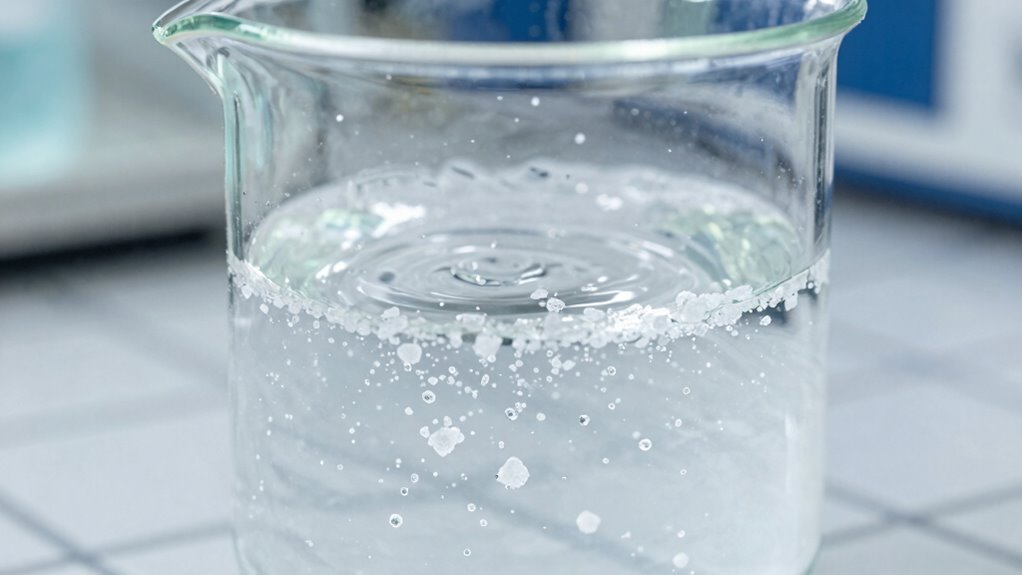
Think of lab measurements as tuning a musical instrument. To measure solubility, you first prepare a saturated solution at a known temperature. Then, you determine the concentration of dissolved salt, often using titration or spectrophotometry. This process reveals the solubility equilibrium—when no more salt dissolves at the saturation point—helping you understand how much salt can be dissolved before it starts to crystallize out.

WBM Salt Lamp – USB Himalayan Salt Lamp with Touch Dimmer Control, Natural Pink Crystal, 5-7 lbs, Wooden Base, LED Bulb, Room Decor, Home Decor, Relaxation, Ambiance, Gift
Authentic Himalayan Salt Lamp: Crafted from 100% natural Himalayan salt crystals, delivering the genuine glow and air-purifying benefits…
As an affiliate, we earn on qualifying purchases.
As an affiliate, we earn on qualifying purchases.
Conclusion
Understanding solubility is essential because it determines how effectively inorganic salts perform in real-world applications. For example, in water treatment, choosing a salt with the right solubility guarantees efficient removal of contaminants. If a salt isn’t soluble enough, it won’t dissolve fully, reducing its effectiveness. So, by selecting salts with appropriate solubility levels, you can optimize processes, save costs, and achieve better results—making it a critical factor in inorganic salt applications.

(4 Pack) Water Softener Salt Crystals – Natural High-Purity Salt for Softer Skin, Reduced Buildup, Easy Cleaning – 40 lb Each Bag with Handle, 160 lb Total
This product is Sodium Chloride
As an affiliate, we earn on qualifying purchases.
As an affiliate, we earn on qualifying purchases.

National Blue Ice Melt and Snow Salt 35lb Bucket – Fast Acting Ice Melter – Pet, Plant and Concrete Friendly, Environmentally Safe – Free of Magnesium Chloride – Melts to -15°F
PREMIUM ICE MELT: Melts to -15°F The faster an ice melter works, the less chance there is for…
As an affiliate, we earn on qualifying purchases.
As an affiliate, we earn on qualifying purchases.