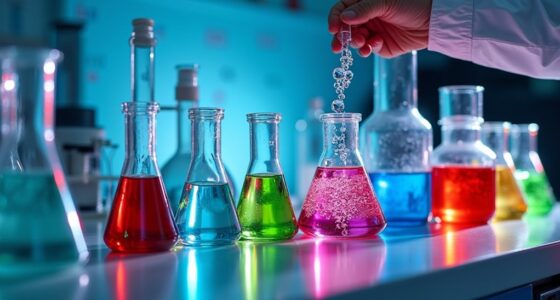

Water is such a powerful solvent because of its unique molecular structure. Its polarity allows water to interact with various substances, breaking them apart by attracting positive and negative charges. Hydrogen bonds help water dissolve ionic compounds and polar molecules effectively. These properties enable water to surround and separate different particles, making it essential for biological and industrial processes. If you want to understand more about how water’s structure and bonds work, keep exploring this fascinating topic.
Key Takeaways
- Water’s molecular polarity allows it to interact with and separate charged and polar molecules.
- Hydrogen bonding creates a cohesive environment that stabilizes dissolved substances.
- The partial positive and negative charges attract ions, facilitating dissociation of salts.
- Water’s bent shape enhances its ability to surround and dissolve various solutes.
- Its high surface tension and boiling point support effective interaction with different substances.
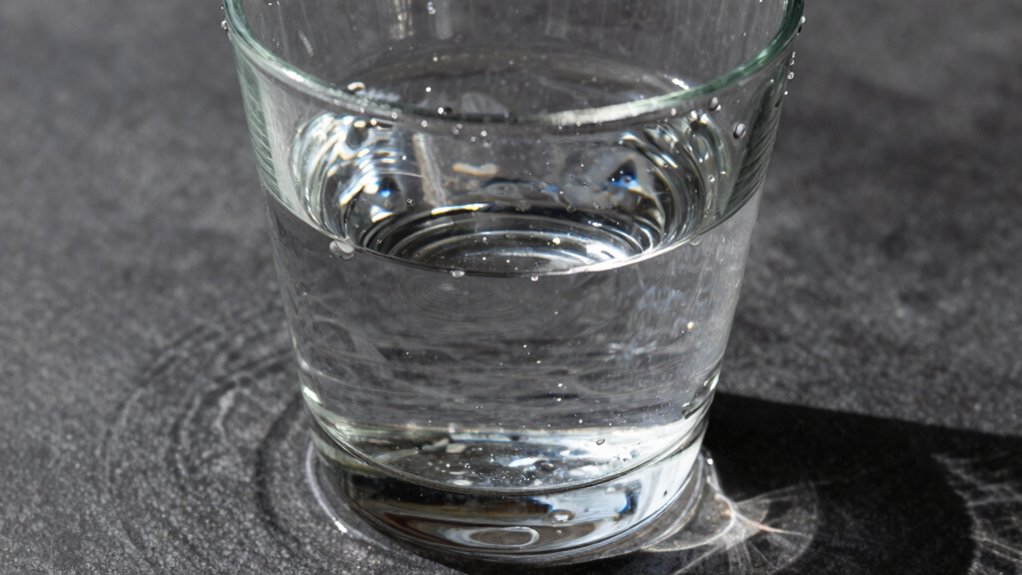
Have you ever wondered why water is known as the “universal solvent”? The answer lies in its unique molecular structure and the way its molecules interact with other substances. Water molecules are polar, meaning they have a partial positive charge on one side and a partial negative charge on the other. This molecular polarity is a key factor that allows water to dissolve many substances. When a substance is introduced into water, the positive end of water molecules is attracted to negatively charged parts of the solute, while the negative end is attracted to positively charged parts. This process helps break apart the solute’s particles, effectively dissolving them. Because of this molecular polarity, water can interact with a wide range of substances, making it incredibly versatile as a solvent. Hydrogen bonding plays an essential role in water’s ability to dissolve substances effectively. In water molecules, the hydrogen atoms are covalently bonded to oxygen, creating a bent shape that facilitates Hydrogen bonding. These hydrogen bonds are weak attractions between the hydrogen atom of one water molecule and the oxygen atom of another. Although individually weak, collectively, hydrogen bonds give water many of its remarkable properties, including its high surface tension and boiling point. More importantly, these hydrogen bonds are responsible for water’s cohesive and adhesive properties, which help in dissolving various substances. When salts, sugars, or other polar molecules are added to water, their particles interact with the hydrogen bonds, disrupting the structure of the solute and allowing it to disperse evenly throughout the water. This molecular interaction is fundamental to understanding how water functions as a solvent. Additionally, the molecular polarity of water is crucial for its ability to dissolve ionic compounds and polar molecules alike. You can think of hydrogen bonding as a sort of molecular handshake that keeps water molecules connected while also enabling them to surround and separate other molecules. This dynamic interaction makes water an excellent solvent for ionic compounds like salt, which dissociate into their constituent ions when in contact with water. The positive sodium ions are attracted to the partial negative charges of water molecules, while the negative chloride ions are attracted to the partial positive charges. This process is facilitated by water’s molecular polarity and hydrogen bonding, which work together seamlessly to break down and stabilize dissolved substances. In essence, water’s unique combination of molecular polarity and hydrogen bonding creates a powerful environment for dissolving a multitude of compounds. These properties enable water to break apart complex molecules and ions, making it the universal solvent that it is. Whether you’re observing biological reactions or industrial processes, water’s ability to dissolve so many different substances is what makes it vital for life and countless applications across various fields.

Carolina Magnetic Water Kit Class Set – Interactive Model for Learning Molecular Interactions | Includes 6 Kits with Water, Ion, and Ethane Molecules
- Experience in Science Education: Over 95 years of trusted educational materials
- Interactive Learning Tool: Visualize and feel molecular forces
- Complete Class Set: Includes 6 kits with water, ions, and molecules
As an affiliate, we earn on qualifying purchases.
As an affiliate, we earn on qualifying purchases.
Frequently Asked Questions
How Does Water’s Polarity Influence Its Solvent Abilities?
Water’s polarity, driven by its molecular dipole and uneven charge distribution, directly influences its solvent abilities. You’ll notice that water molecules have a partial positive charge on hydrogen atoms and a partial negative charge on oxygen. This allows water to attract and surround other polar molecules or ions, breaking apart their bonds. The strong dipole interactions enable water to dissolve many substances, making it a highly effective and versatile solvent.
Can Water Dissolve All Types of Substances Equally?
Can water dissolve all substances equally? Not exactly. Water’s chemical reactions and physical properties make it a versatile solvent, but it struggles with non-polar substances like oils. Its polarity allows it to break down ionic and polar compounds effectively, yet hydrophobic materials resist dissolution. So, while water is incredibly useful, it isn’t a universal solvent for every substance, especially those lacking polarity.
What Role Do Hydrogen Bonds Play in Water’s Solvation Process?
Hydrogen bonds are key to water’s solvation process because they enable water molecules to surround and interact with various substances efficiently. These bonds create a dynamic network, known as solvation dynamics, which allows water to adapt quickly, breaking and forming bonds as it dissolves different molecules. Your understanding of hydrogen bonding reveals how water’s flexible structure makes it an exceptional solvent, capable of dissolving many substances.
How Does Temperature Affect Water’s Effectiveness as a Solvent?
Temperature trends tend to tip the scales, impacting water’s solvent efficiency. When you increase the temperature, water molecules move more vigorously, breaking bonds faster and boosting solubility for many substances. Conversely, cooling slows molecular motion, reducing solubility. So, temperature effects directly influence how well water dissolves compounds, making it a more or less effective solvent depending on the thermal conditions. This delicate balance determines water’s dissolving prowess.
Are There Substances That Water Cannot Dissolve?
Water cannot dissolve nonpolar compounds and insoluble minerals. Nonpolar molecules, like oils and fats, don’t interact well with water’s polarity, making them insoluble. Similarly, minerals such as quartz or calcite don’t dissolve because their chemical structures resist breaking apart in water. You’ll find that water’s ability to dissolve substances depends on their polarity and chemical composition, so these types of compounds remain undissolved in water.

Water Kit© 6-Cup Set
- Water Molecule Polarity Investigation: Explore water molecule polarity
- Bond Type Exploration: Learn about ionic, covalent, hydrogen bonds
- Surface Tension Experiments: Test adhesion, cohesion, capillary action
As an affiliate, we earn on qualifying purchases.
As an affiliate, we earn on qualifying purchases.
Conclusion
Water’s exceptional ability to dissolve substances isn’t just fascinating—it’s crucial for life. Did you know that over 80% of the substances in your body are dissolved in water, enabling essential biological processes? This powerful solvent’s unique polarity and hydrogen bonding make it indispensable for everything from nutrient transport to waste removal. So next time you see water, remember it’s not just a simple liquid; it’s a remarkable molecule that sustains life itself.
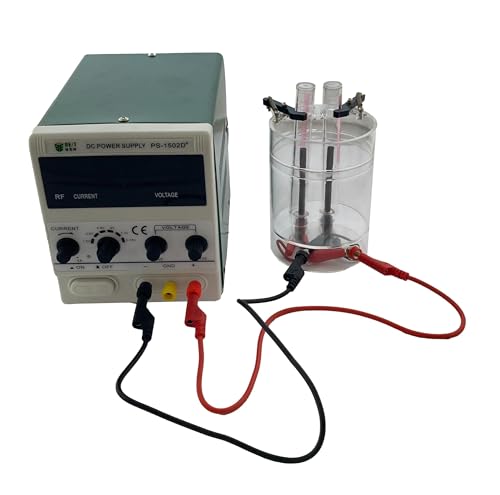
Sci-Supply Self-Contained Water Electrolysis Apparatus Kit – Hydrogen & Oxygen Gas Generation Demonstration with Power Supply & Banana Plug Leads – Chemistry & STEM Classroom Experiment
- Complete Water Electrolysis Kit: Demonstrates water electrolysis and gas separation
- Visual Gas Collection: Shows hydrogen and oxygen gas generation clearly
- Includes Power Supply & Leads: Ready for classroom use with power and wiring
As an affiliate, we earn on qualifying purchases.
As an affiliate, we earn on qualifying purchases.

Thames & Kosmos Chemistry Chem C500 Science Kit with 28 Guided Experiments 48 Page Science Guide Parents’ Choice Silver Award Winner, 13.1" L x 2.6" W x 8.9" H
- Number of Experiments: 28 guided experiments
- Educational Focus: Intro to chemistry concepts
- Colorful Reactions: Acids and bases effects
As an affiliate, we earn on qualifying purchases.
As an affiliate, we earn on qualifying purchases.