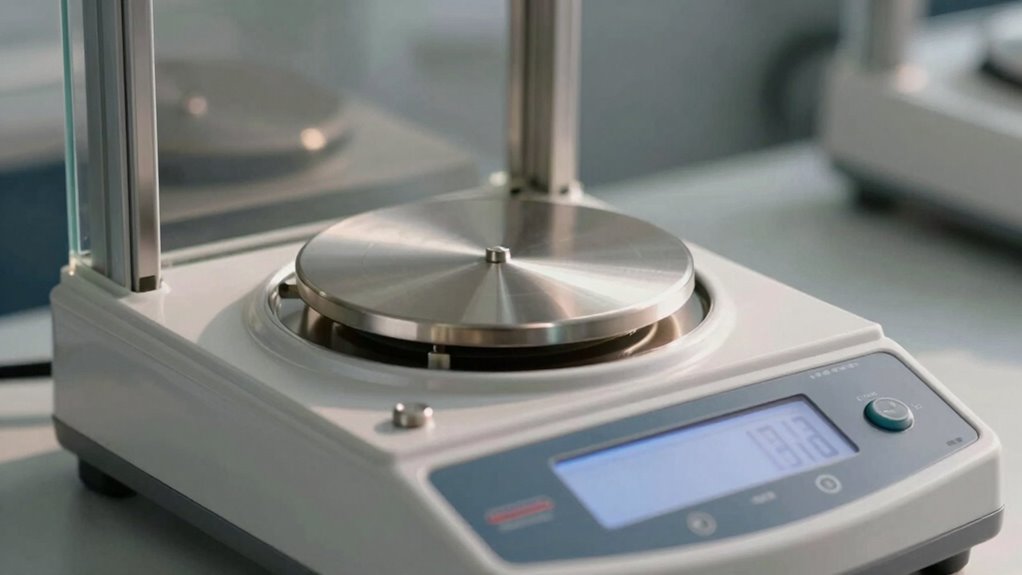

An analytical balance measures the tiny sample mass by detecting the force gravity exerts on it. You place your sample on the balance, which converts this force into a precise digital or analog reading. External factors like air currents, vibrations, and temperature can affect your measurements, so it’s important to calibrate regularly and control the environment. If you keep exploring, you’ll discover how these careful processes guarantee accurate, reliable results every time.
Key Takeaways
- An analytical balance measures the mass of small samples with high precision.
- It detects the gravitational force exerted by the sample’s mass.
- The device converts the force into digital or analog readings.
- It focuses on the sample’s mass, not its size or volume.
- External environmental factors can influence the measurement accuracy.
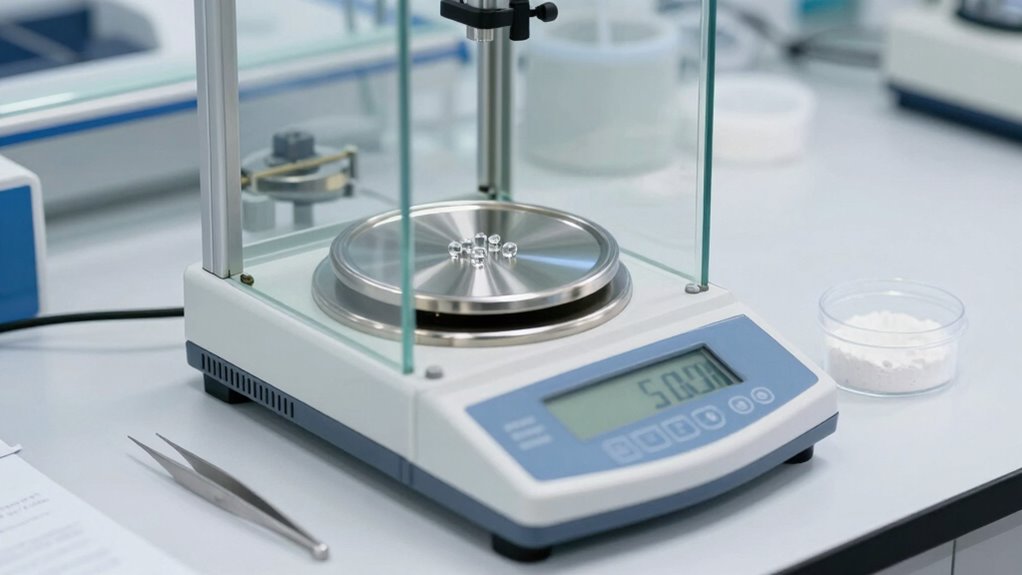
An analytical balance is an indispensable instrument in laboratories that require precise measurements of small quantities. When you use one, you’re not just weighing objects; you’re measuring the mass of tiny samples with incredible accuracy. To guarantee your measurements are reliable, you need to understand what an analytical balance actually measures and how calibration procedures play a vital role in meeting precision requirements. The balance detects the force exerted by the sample’s gravity, translating it into a digital or analog reading that indicates the mass. This process involves sophisticated sensors and mechanisms designed to minimize errors and provide consistent results.
An analytical balance measures tiny sample masses with high precision, relying on sensors to ensure accurate, consistent results.
However, to maintain that level of accuracy, you must regularly perform calibration procedures. Calibration adjusts the balance to make certain its readings correspond precisely to known standards. These procedures involve placing certified calibration weights on the balance and confirming that the displayed weight matches the weight of the standard. If there’s any discrepancy, you adjust the instrument until it aligns with the standard. Calibration isn’t a one-time task; it must be performed routinely, especially when you’re working with measurements that demand high precision. Proper calibration guarantees that your balance meets the specific precision requirements for your experiments or quality control processes. Routine calibration is essential for ensuring ongoing measurement accuracy.
When you think about what an analytical balance measures, it’s important to realize that it’s not just about the object’s size or volume but its mass. Unlike volume measurements, which depend on the object’s shape and density, mass is a fundamental property that remains constant regardless of location. This makes analytical balances invaluable in scientific and industrial settings where exact quantities are critical, whether you’re preparing chemical solutions, analyzing materials, or verifying product specifications. The balance’s sensitivity allows it to detect minuscule differences in mass, often down to the microgram level, making it essential for tasks that demand meticulous precision. Additionally, proper environmental conditions are crucial to prevent external influences from compromising measurement accuracy. Maintaining a stable environment helps reduce the impact of external vibrations or temperature fluctuations that can interfere with the balance’s readings.
Furthermore, understanding the importance of the balance’s environment is key. External factors such as air currents, vibrations, or temperature fluctuations can influence readings. That’s why balances are often placed in draft-free, vibration-isolated environments. When you’re measuring small quantities, even tiny disturbances can lead to errors. Regular calibration, coupled with controlled conditions, ensures that the balance maintains its precision requirements over time. Additionally, awareness of the environmental factors that can affect measurements helps users take proactive steps to protect the accuracy of their readings. Small environmental fluctuations, if unaccounted for, can significantly impact sensitive measurements, underscoring the need for vigilant environmental control. By paying close attention to these details, you can trust that your measurements truly reflect the sample’s mass, enabling accurate data collection and analysis.

RESHY Lab Scale 5000g x 0.01g, High Precision Digital Analytical Balance with Calibration Weights, 0.01g Accuracy Scientific Gram Scale for Jewelry, Kitchen, Food, Powder, Chemical Use
High Precision Lab Scale with 0.01g Accuracy:This digital lab scale provides up to 5000g capacity with 0.01g readability….
As an affiliate, we earn on qualifying purchases.
As an affiliate, we earn on qualifying purchases.
Frequently Asked Questions
How Often Should I Calibrate an Analytical Balance?
You should calibrate your analytical balance at least once a week, as studies show consistent calibration improves accuracy by up to 99%. Follow proper calibration procedures regularly, especially if you move the balance or change environmental conditions. For critical measurements, more frequent calibration is advised. Always check calibration frequency guidelines provided by the manufacturer, and conduct calibration procedures before each major use to guarantee precise and reliable results.
Can Environmental Factors Affect Measurement Accuracy?
Yes, environmental factors can affect your measurement accuracy. Air currents can cause fluctuations in the balance’s readings by disturbing the sensitive sensor, while temperature fluctuations can affect the balance’s internal components, leading to inconsistent results. To guarantee precise measurements, keep the balance in a draft-free, temperature-controlled environment. Regular calibration and minimizing environmental disturbances help maintain the accuracy you need for reliable analytical work.
What Types of Samples Are Unsuitable for Weighing?
Samples that are too volatile, hygroscopic, or prone to contamination are unsuitable for weighing. You should avoid handling procedures that cause sample contamination or loss of moisture, as these can lead to inaccurate results. For delicate samples, use proper techniques to prevent contamination, such as handling with clean tools and working in controlled environments. Unsuitable samples can compromise the balance’s accuracy and the integrity of your measurements.
How Do I Clean and Maintain My Analytical Balance?
You might think cleaning your analytical balance is straightforward, but missed steps can lead to inaccuracies. Start with gentle cleaning procedures—use a soft brush or lint-free cloth and avoid harsh chemicals. Regular maintenance tips include calibrating frequently and keeping the balance in a stable, vibration-free environment. Remember, a well-maintained balance guarantees precise measurements; neglect it, and your results could be compromised. Stay vigilant and keep it spotless!
What Is the Maximum Weight Capacity of an Analytical Balance?
Your analytical balance typically has a maximum weight capacity between 120 grams and 220 grams, depending on the model. To guarantee accuracy, you should calibrate it regularly, usually daily or weekly, especially considering environmental impacts like temperature and vibrations. Proper calibration helps maintain precision, even when weighing close to its capacity. Keep the balance level and in a stable environment to avoid measurement errors and extend its lifespan.

Bonvoisin Lab Analytical Balance 500g x 0.001g Precision Digital Scale .001 Gram Accuracy Laboratory Scientific Milligram Scale 17 Units Selectable
New Features-1. customize-units setup. The scale has 17 units in total. Some of them that is useless for…
As an affiliate, we earn on qualifying purchases.
As an affiliate, we earn on qualifying purchases.
Conclusion
As you step back from the analytical balance, it’s almost as if the tiny particles themselves whisper their secrets, revealing their weight with quiet precision. You realize that in this delicate dance of science, every tiny fraction counted becomes a story told through mere milligrams. It’s a reminder that even the smallest things hold immense significance, and in this silent moment, you’re reminded how the balance captures not just mass, but the essence of meticulous discovery.

LACHOI Analytical Balance 500g×0.001g Lab Scale 0.001g Accuracy High Precision Laboratory Scale with Windshield RS232 Interface Laboratory Balance (500g,1mg)
【0.001g ACCURACY MEASUREMENT】Max Capacity 500g; Accuracy 0.001g; Tolerance ±0.005g.This lab scale uses a highly stable sensor and a…
As an affiliate, we earn on qualifying purchases.
As an affiliate, we earn on qualifying purchases.

Toprime Digital Gram Scale 500g 0.01g Food Scale High Precision Kitchen Scale Multifunctional Stainless Steel Pocket Scale with Back-Lit LCD Display Tare PCS Features Silver
Meticulous Accuracy: Equipped with 4 high precision sensors to provide the most accurate weight readings. Refined accuracy 0.01…
As an affiliate, we earn on qualifying purchases.
As an affiliate, we earn on qualifying purchases.