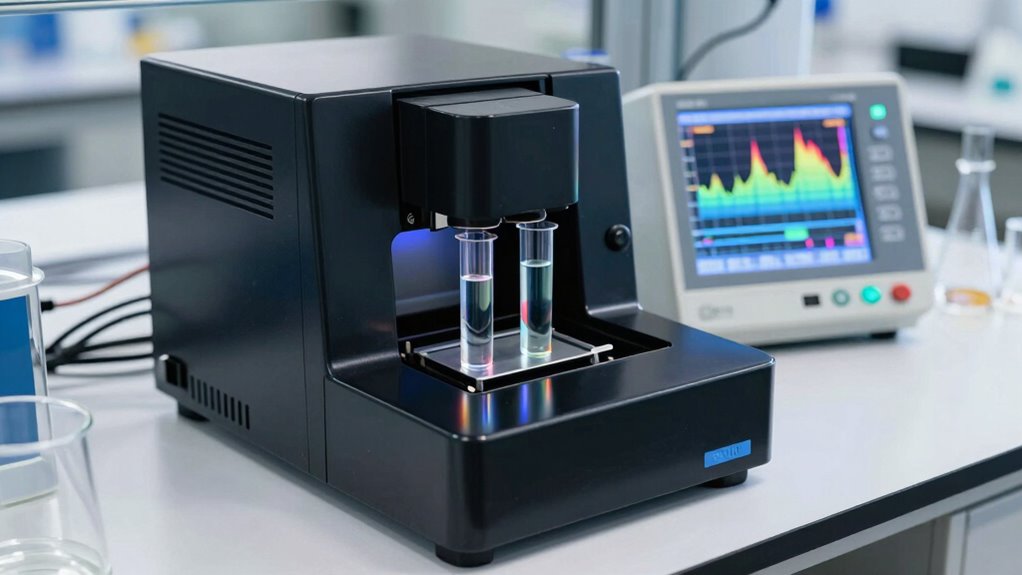

UV-Vis spectrophotometers measure how molecules absorb light across ultraviolet and visible wavelengths with high precision. They accurately detect changes in light absorption, giving you detailed spectral fingerprints that identify substances and determine their concentrations. Their ability to target specific wavelengths guarantees reliable, consistent results, especially important in fields like pharmaceuticals. As you explore further, you’ll discover how these instruments reveal structural insights and differentiate complex mixtures with impressive accuracy.

Prime made for students and young adults
- Fast, free delivery for dorm and study essentials
- Prime Video and Amazon Music included
- Member-only deals
Key Takeaways
- They precisely measure light absorption across ultraviolet to visible wavelengths.
- They accurately detect spectral fingerprints unique to different molecules.
- They quantify substance concentrations based on absorption intensity.
- They maintain wavelength accuracy for reliable substance identification.
- They differentiate complex compounds through detailed spectral analysis.
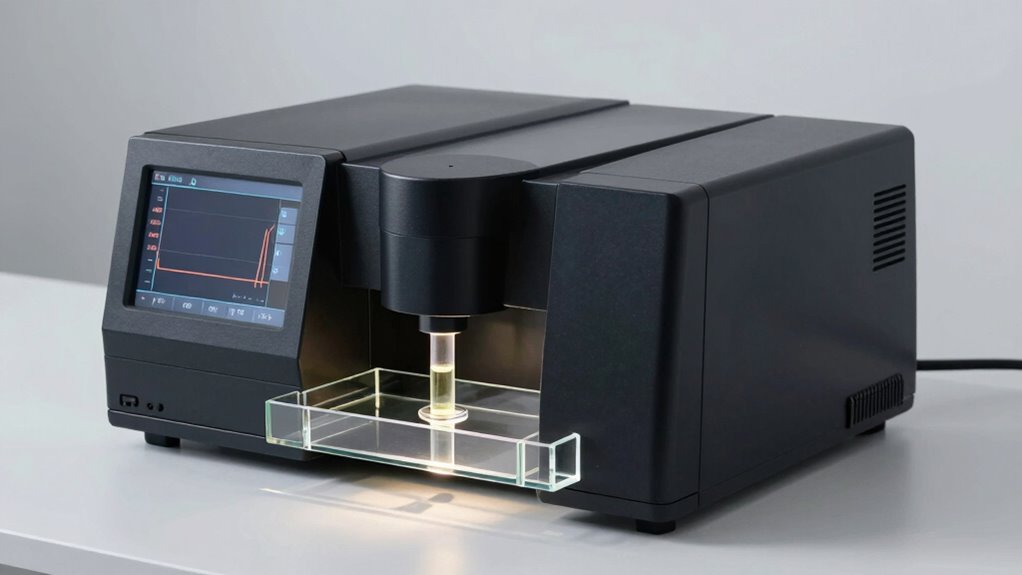
Have you ever wondered how scientists determine the composition of a substance quickly and accurately? UV-Vis spectrophotometers are powerful tools that make this possible. They work by measuring how much light a sample absorbs across a specific range of wavelengths, typically from ultraviolet to visible light. This light absorption provides insights into the molecules present, their concentrations, and even some structural information. When you use a spectrophotometer, the device shines a beam of light through your sample and detects how much light makes it through. The key to its effectiveness lies in its ability to precisely measure changes in light absorption at different wavelengths.
One of the main strengths of UV-Vis spectrophotometers is their capacity for wavelength accuracy. This means the instrument can target specific wavelengths with precision, allowing you to identify substances based on their unique absorption patterns. Each molecule absorbs light at characteristic wavelengths, creating a spectral fingerprint. By accurately measuring these absorption peaks, you can determine the presence and concentration of particular compounds in your sample. This precision is vital in applications like pharmaceuticals, where identifying specific compounds quickly can impact safety and efficacy.
UV-Vis spectrophotometers precisely identify compounds by their unique absorption patterns, crucial for safety and efficacy in pharmaceuticals.
Light absorption is at the heart of what these instruments measure. When light hits a molecule, some of it gets absorbed, exciting electrons to higher energy states. The amount of light absorbed correlates directly with the concentration of the absorbing substance, according to Beer-Lambert’s Law. This relationship enables you to quantify the amount of a substance in your sample with remarkable accuracy. The spectrophotometer’s ability to detect subtle differences in light absorption at various wavelengths means you can distinguish between similar compounds, even in complex mixtures. Additionally, the effectiveness of these instruments relies heavily on the wavelength accuracy, which ensures measurements are both consistent and reliable. Proper calibration and maintenance are essential to maintain the measurement reliability, making it a trusted tool in analytical laboratories. Furthermore, understanding the spectral fingerprint of compounds enhances the instrument’s capability to identify and analyze complex samples accurately. Maintaining these calibration standards is crucial for ensuring ongoing precision and confidence in your results.
UV Vis Spectrophotometer for laboratory
As an affiliate, we earn on qualifying purchases.
As an affiliate, we earn on qualifying purchases.
Frequently Asked Questions
How Does a UV Vis Spectrophotometer Differ From Other Spectrometers?
You’ll find that a UV-Vis spectrophotometer differs from other spectrometers mainly in spectral resolution and instrument calibration. It specifically measures absorption in the ultraviolet and visible light ranges, offering precise spectral resolution for these wavelengths. Its calibration guarantees accurate, reproducible results when analyzing samples, making it ideal for applications like concentration determination. Other spectrometers might target different wavelength ranges or use alternative calibration methods, but UV-Vis excels in its specific focus and accuracy.
Can UV Vis Spectrophotometers Detect Non-Absorbing Compounds?
UV-Vis spectrophotometers generally can’t detect non-absorbing compounds directly because these compounds don’t absorb visible or ultraviolet light. However, you can use alternative detection methods, like derivatization or indirect measurement techniques, to analyze non-absorbing compounds. These approaches enable you to indirectly quantify or identify non-absorbing substances, expanding the spectrophotometer’s usefulness beyond just those that absorb light.
What Sample Types Can Be Analyzed With UV Vis Spectrophotometers?
You can analyze a wide range of sample types with UV-Vis spectrophotometers, from liquids like water, serum, and pharmaceuticals, to solids like powders and thin films. Proper sample preparation, such as diluting or filtering, guarantees accurate readings. Calibration techniques, like using standard solutions, are essential for reliable results. This versatility makes UV-Vis ideal for diverse applications across scientific, medical, and industrial fields.
How Accurate Are UV Vis Measurements for Complex Mixtures?
UV-Vis measurements for complex mixtures can be quite accurate, but calibration challenges and matrix effects may impact results. You need to carefully calibrate your instrument with standards similar to your samples, as matrix effects can cause interference and skew readings. By optimizing your calibration procedures and accounting for potential matrix effects, you can improve the accuracy of your measurements, even with complex sample compositions.
What Are Common Sources of Error in UV Vis Spectroscopy?
You should be aware that common sources of error in UV-Vis spectroscopy include issues like instrument calibration and wavelength precision. If your instrument isn’t properly calibrated, measurements can be off, leading to inaccurate results. Additionally, if the wavelength calibration drifts, it can cause errors in identifying specific absorbance peaks. Regular maintenance, calibration checks, and ensuring wavelength accuracy help minimize these errors, improving your measurement reliability.
spectrophotometer wavelength calibration
As an affiliate, we earn on qualifying purchases.
As an affiliate, we earn on qualifying purchases.
Conclusion
Think of UV-Vis spectrophotometers as your scientific lighthouse, guiding you through the fog of complex samples. They shine a precise beam of light to reveal the hidden secrets within substances, measuring how they absorb specific wavelengths. This clarity helps you understand composition and concentration effortlessly. So, when you rely on them, you’re steering the vast ocean of data with confidence, knowing this instrument illuminates the unseen details with remarkable accuracy.
digital UV-Vis spectrophotometer
As an affiliate, we earn on qualifying purchases.
As an affiliate, we earn on qualifying purchases.
spectrophotometer for chemical analysis
As an affiliate, we earn on qualifying purchases.
As an affiliate, we earn on qualifying purchases.
Fall Picks
fall essentials
As an affiliate, we earn on qualifying purchases.