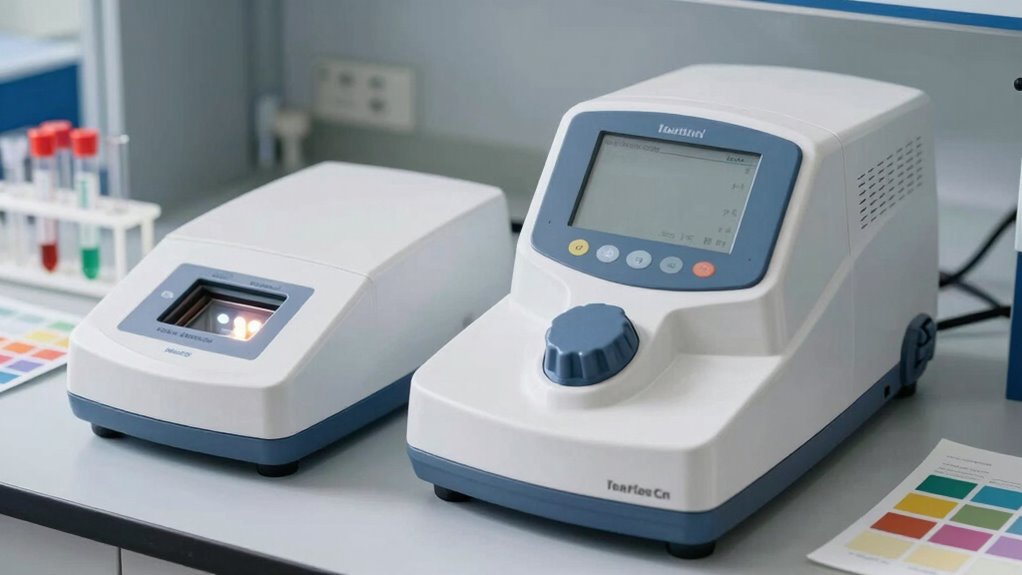

If you’re doing everyday testing, a colorimeter is usually the best choice because it’s simple, quick, and cost-effective. It works well for routine quality control and basic color matching, saving you time and money. However, if your projects demand high precision or detailed color analysis, a spectrophotometer provides more accurate spectral data, though at a higher cost. To find the right tool for your needs, and discover detailed insights, there’s more to explore beyond this overview.

Prime made for students and young adults
- Fast, free delivery for dorm and study essentials
- Prime Video and Amazon Music included
- Member-only deals
Key Takeaways
- Colorimeters are more cost-effective and suitable for quick, routine color testing in everyday applications.
- Spectrophotometers offer higher accuracy and detailed spectral data, ideal for precise color matching needs.
- For basic quality control, a colorimeter provides sufficient results with less complexity.
- Spectrophotometers justify their higher cost when detailed analysis prevents costly errors.
- Choose a colorimeter for simplicity and speed; opt for a spectrophotometer when precision and detailed data are essential.
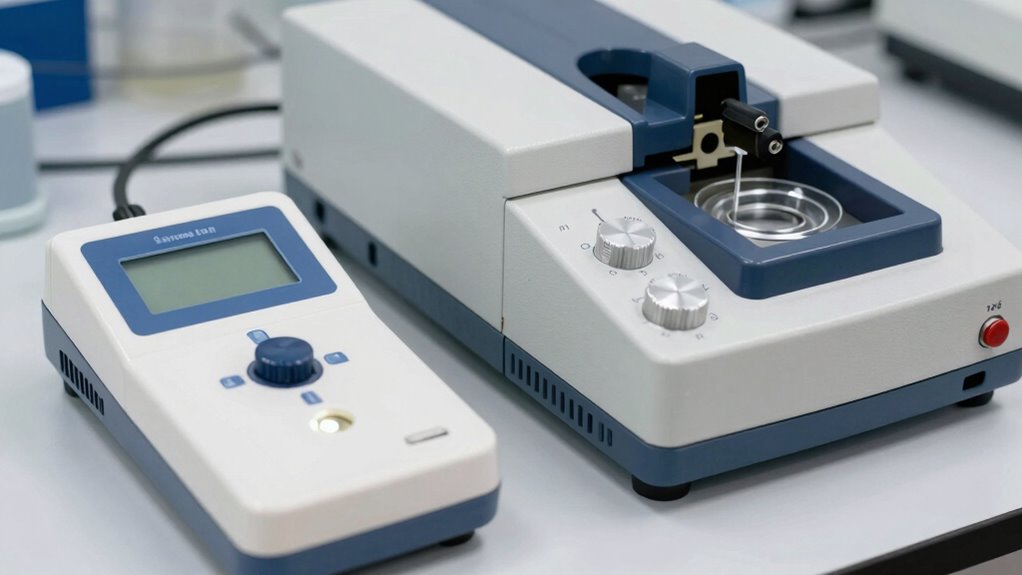
When choosing between a colorimeter and a spectrophotometer, understanding their differences is essential for accurate color measurement. You want tools that provide reliable readings, but you also need to take into account how much you’re willing to spend and the level of precision required for your everyday testing. A colorimeter is typically more straightforward and user-friendly, making it a popular choice for routine applications. It measures color by analyzing how light reflects off or transmits through a sample, providing quick results. While it offers decent color accuracy for many tasks, it may struggle with complex or subtle color variations, especially when dealing with less common shades or materials with unique properties.
On the other hand, a spectrophotometer provides a more detailed analysis by measuring the entire spectrum of reflected or transmitted light. This detailed spectral data allows for highly precise color matching and differentiation, making it ideal when color accuracy is critical. However, this precision comes at a higher cost, not just in purchase price but also in maintenance and training. If you need to frequently perform thorough color assessments, investing in a spectrophotometer can be cost-effective in the long run due to its ability to reduce errors and rework caused by inaccurate readings. Additionally, spectrophotometers are often used in industries where detailed color analysis is a standard requirement, emphasizing their importance in achieving consistent quality. Understanding the spectral data they provide helps in making more informed decisions about color matching and quality control. Moreover, having a clear grasp of color measurement tools can improve overall project outcomes. Using advanced measurement techniques can further enhance your understanding of color properties and differences.
For everyday testing, your decision should balance cost efficiency with your specific needs. If you’re working in a setting where rapid, consistent results are more important than absolute precision—like quality control in manufacturing or simple color matching in design—then a colorimeter might be enough. It’s less expensive and easier to operate, which helps you save time and money. Yet, keep in mind that its limitations in detailed color analysis might lead to inaccuracies if your projects demand high color fidelity. Additionally, understanding the cost-effectiveness of each tool can help optimize your workflow and budget.
Conversely, if your work involves complex color matching, color formulation, or detailed color analysis, investing in a spectrophotometer could be justified. While the initial cost is higher, the ability to capture the full spectrum and achieve high color accuracy can reduce costly mistakes over time. You’ll benefit from more consistent results, especially when exact color matching impacts your product quality or brand standards.
Ultimately, your choice hinges on your specific application and budget constraints. If quick, routine measurements suffice, a colorimeter offers a cost-efficient solution. But if precision and comprehensive data are paramount, a spectrophotometer, despite its higher cost, can deliver the accurate, detailed results you need for everyday testing.
digital colorimeter for quality control
As an affiliate, we earn on qualifying purchases.
As an affiliate, we earn on qualifying purchases.
Frequently Asked Questions
Which Device Is More Cost-Effective for Small Businesses?
A colorimeter is more cost-effective for small businesses because it has a lower initial price and simpler maintenance requirements. When doing a cost comparison, you’ll find that colorimeters cost less upfront and are easier to maintain, saving you money over time. Spectrophotometers, while more precise, tend to be pricier and require more maintenance, making them less ideal if you’re focused on affordability for daily testing needs.
Can Both Devices Measure Transparent or Reflective Samples Equally Well?
Think of these devices as different lenses on the same camera; they view the world uniquely. Both devices can measure reflective samples effectively, capturing surface colors accurately. However, for transparent samples, a spectrophotometer often performs better, as it can analyze transmitted light through clear materials. A colorimeter may struggle with transparency, making the spectrophotometer your better choice for accurate readings across both transparent and reflective samples.
How Long Does Calibration Typically Take for Each Instrument?
Calibration procedures for both devices usually take a few minutes, but it depends on the instrument’s complexity. A colorimeter often requires less calibration time, around 5-10 minutes, guaranteeing measurement accuracy for routine tests. Spectrophotometers might take longer, sometimes 10-20 minutes, because they need precise calibration for more detailed spectrum analysis. Regular calibration is essential to maintain measurement accuracy and ensure consistent, reliable results.
Are There Specific Industries Where One Device Is Preferred Over the Other?
Imagine choosing a tool tailored to your needs—some industries favor spectrophotometers for their superior measurement accuracy, especially in pharmaceuticals and textiles, where precision is paramount. Conversely, colorimeters are preferred in food and paint manufacturing for quick, cost-effective color assessments. Your decision hinges on industry applications; understanding these specifics guarantees you select the device best suited for accurate, reliable results in your everyday testing needs.
What Is the Typical Lifespan of a Colorimeter Compared to a Spectrophotometer?
You can expect a colorimeter to last around 3 to 5 years with proper calibration procedures, maintaining decent measurement accuracy. A spectrophotometer typically has a longer lifespan of 5 to 10 years, thanks to its more advanced technology. Regular calibration helps both devices stay accurate over time, but the spectrophotometer’s durability makes it ideal for environments demanding consistent precision.
spectrophotometer for color matching
As an affiliate, we earn on qualifying purchases.
As an affiliate, we earn on qualifying purchases.
Conclusion
In the clash of colorimeter versus spectrophotometer, your choice depends on your needs. If you want quick, cost-effective color checks, a colorimeter could be your trusty tool. But if precision and detailed data matter most, a spectrophotometer stands tall. Remember, whether you’re measuring, matching, or monitoring, selecting the suited device simplifies your task, saves your time, and sharpens your sight for superb, specific results. Pick wisely, and your color accuracy will always be on point!
As an affiliate, we earn on qualifying purchases.
professional spectrophotometer for precise color analysis
As an affiliate, we earn on qualifying purchases.
As an affiliate, we earn on qualifying purchases.
Columbus Day / Indigenous Peoples' Day Picks
long weekend sales
As an affiliate, we earn on qualifying purchases.