
When plants face stress signals like drought or salinity, they activate biochemical and hormonal responses that help them adapt. You’ll see hormones like auxins and cytokinins guiding root growth, while reactive oxygen species signal protective actions. These responses can pause growth temporarily, strengthen cell structures, or change root architecture for better resource access. If you’re curious how plants fine-tune these adjustments, keep exploring how these intricate processes work together to boost survival.
Key Takeaways
- Stress signals activate biochemical pathways that modulate growth, such as hormone adjustments and reactive oxygen species production.
- Hormonal regulation balances growth and defense, redirecting resources to stress mitigation.
- Environmental cues trigger structural root adaptations, like deeper extension or aerenchyma formation.
- Stress-induced biochemical responses may temporarily halt growth to prioritize survival.
- Plant signaling networks coordinate structural and biochemical changes to optimize resilience under stress conditions.

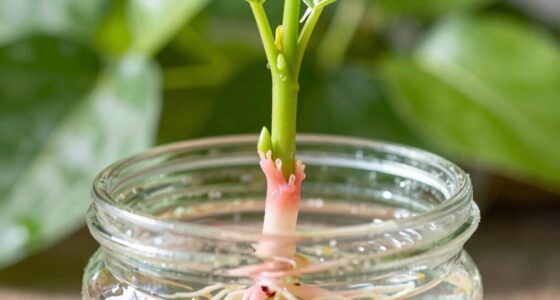
Root adaptation is another essential aspect of how plants respond to stress. When the environment changes, roots actively modify their growth to seek out water, nutrients, or stability. Under drought conditions, roots extend deeper into the soil, driven by hormonal cues—auxins and cytokinins—that signal where resources are more abundant. These signals stimulate the elongation of root hairs and lateral roots, increasing the plant’s ability to access scarce water sources. Additionally, soil conditions influence how roots grow and adapt, prompting specific structural changes to optimize resource acquisition. Conversely, in flooded soils, roots may suppress growth or develop structures like aerenchyma to cope with low oxygen levels. This dynamic adjustment helps the plant maintain its overall health despite adverse conditions. Additionally, understanding these responses highlights the importance of environmental cues in shaping plant adaptation strategies. Recognizing how stress responses are triggered at the biochemical level can further enhance our understanding of plant resilience.
Stress signals also trigger a cascade of biochemical responses that influence plant growth. For instance, when exposed to high salinity, plants produce reactive oxygen species (ROS), which serve as secondary messengers in stress signaling pathways. These molecules activate specific genes involved in protective mechanisms, such as producing osmoprotectants or strengthening cell walls. These responses may temporarily halt growth but ultimately help the plant withstand the stress. As the plant detects ongoing stress, hormonal regulation fine-tunes these responses, balancing growth and defense. This delicate interplay ensures that the plant doesn’t overcommit to growth when survival is at stake. Recognizing the role of biodiversity in resilient ecosystems underscores the importance of diverse plant adaptations in coping with environmental challenges.
In essence, stress signals act as messengers that inform the plant of environmental challenges, prompting precise hormonal and structural responses. Root adaptation exemplifies how plants modify their growth patterns to cope, guaranteeing survival despite adversity. Your understanding of these processes reveals how resilient plants are—they don’t just passively endure stress but actively adjust their growth strategies through complex signaling networks. This intricate system underscores the remarkable ability of plants to thrive in unpredictable environments, constantly fine-tuning their development in response to the stresses they encounter.

4 Pack Paint by Numbers Kit for Adults with Frame, Black Cat & Green Plant
- Relaxing Painting Experience: Helps reduce stress and promote tranquility
- High-Quality Materials: HD canvas with clear numbers and vibrant acrylic paints
- Ideal for Beginners: Simple steps for easy artistic creation
As an affiliate, we earn on qualifying purchases.
As an affiliate, we earn on qualifying purchases.
Frequently Asked Questions
How Do Plants Distinguish Between Different Types of Stress Signals?
You can see that plants distinguish between different stress signals through specialized signal transduction pathways. When a stress occurs, your plant perceives it via stress perception receptors, which activate specific signaling cascades. These cascades then trigger tailored responses, allowing the plant to adapt appropriately. This precise communication guarantees that each type of stress—be it drought, salt, or pathogen—elicits the right response, helping your plant survive and grow despite challenges.
Can Stress Signals Be Transmitted Between Neighboring Plants?
Yes, stress signals can be transmitted between neighboring plants through root signaling and chemical communication. When one plant faces stress, it releases chemicals into the soil, which neighboring plants detect via their roots. These signals alert nearby plants to prepare defenses, enhancing their resilience. This underground communication helps plants coordinate responses, ultimately improving their survival chances during stressful conditions.
What Role Do Hormones Play in Stress Responses?
Hormones play a vital role in stress responses by maintaining hormonal balance and amplifying signals. When plants face stress, hormones like abscisic acid increase, triggering protective actions. They help coordinate responses, ensuring efficient adaptation. Signal amplification occurs as hormones activate multiple pathways, boosting the plant’s ability to cope. By fine-tuning hormonal levels, plants optimize their defense mechanisms, enhancing survival during stressful conditions.
Are Some Plant Species More Resilient to Stress Signals?
Yes, some plant species are more resilient to stress signals. You’ll notice their root adaptation allows better water and nutrient uptake, while delayed leaf senescence helps sustain photosynthesis longer. These plants effectively manage stress by adjusting their growth responses, giving them an advantage during droughts or extreme temperatures. Their ability to adapt their roots and delay leaf senescence makes them better equipped to survive and thrive under challenging conditions.
How Do Stress Signals Influence Flowering and Reproduction?
Stress signaling plays a vital role in influencing flowering and reproduction. When plants detect stress, they often adjust flowering timing to guarantee survival, usually delaying or accelerating it based on the type of stress. This adaptive response helps optimize reproductive success under challenging conditions. By modulating stress signaling pathways, plants can balance growth and reproduction, making certain they flower at the most advantageous time, even amid environmental stressors.

Sunday Liquid Lawn Fertilizer for Drought, Hose-End Sprayer, 2 Pack
- Drought-Resilient Lawn Care: Uses local soil and climate data
- Easy Hose-End Application: Spray up to 10,000 sq. ft. in 10-15 mins
- Effective 18-0-3 NPK Formula: Supports lawns in dry, hot conditions
As an affiliate, we earn on qualifying purchases.
As an affiliate, we earn on qualifying purchases.
Conclusion
Understanding how stress signals impact plant growth helps you appreciate nature’s resilience. When plants face challenges, they adapt, signaling pathways activate, and growth patterns shift. Isn’t it fascinating to think that, despite adversity, plants can still thrive? By studying these responses, you can better support plant health and growth, even in tough conditions. So, next time you see a resilient plant, ask yourself: how might I apply this knowledge to nurture and protect our green world?

Miracle-Gro Water Storing Crystals, 12 oz.
- Moisture Regulation: Prevents over and underwatering
- Water Stress Reduction: Protects plants from heat and drought
- Versatile Use: Suitable for indoor and outdoor plants
As an affiliate, we earn on qualifying purchases.
As an affiliate, we earn on qualifying purchases.

Bonide Garden Rich Root & Grow Root Stimulator & Plant Starter
- Ideal for Various Plants: Suitable for transplants, houseplants, vegetables, and more
- Stimulates Root Growth: Encourages early root development and stronger roots
- Contains IBA Hormone: Includes Indole-3-butyric acid for root initiation
As an affiliate, we earn on qualifying purchases.
As an affiliate, we earn on qualifying purchases.