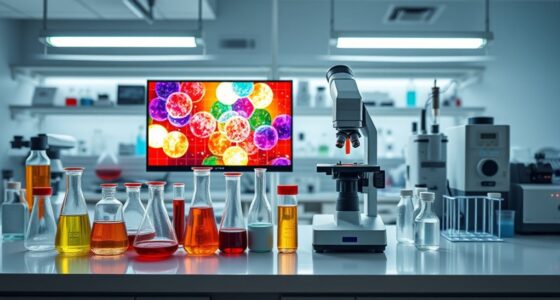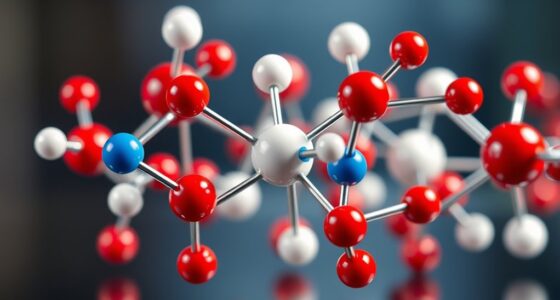
You can increase reaction speed by adjusting factors like temperature, concentration, and surface area. Raising the temperature boosts particle energy, leading to more successful collisions that overcome activation energy barriers. Higher concentration means more particles collide frequently, while increasing surface area exposes more particles for reaction. Understanding these factors helps you control reaction rates effectively. If you want to discover more about how these aspects influence reaction speed, keep exploring these concepts further.
Key Takeaways
- Increasing temperature boosts particle energy, leading to more successful collisions and faster reaction rates.
- Higher concentration raises collision frequency, accelerating the overall reaction speed.
- Enlarging surface area exposes more particles, promoting more effective collisions.
- Overcoming activation energy is essential; reactions occur when particles collide with sufficient energy.
- Proper orientation during collisions enhances the likelihood of successful reactions and influences reaction rate.

Understanding the rates at which chemical reactions occur is essential for predicting and controlling chemical processes. One of the key factors influencing reaction speed is the concept of activation energy. Activation energy is the minimum amount of energy that reacting particles need to collide with each other to break existing bonds and form new ones. Think of it as the energy hurdle that must be overcome for a reaction to proceed. If the particles don’t possess enough energy during collisions, they simply bounce apart without reacting. When particles collide with sufficient energy, the likelihood of a successful reaction increases.
Understanding activation energy is key to controlling how fast chemical reactions happen.
This is where collision theory comes into play. Collision theory states that for a chemical reaction to happen, particles must collide with the right orientation and enough energy—specifically, the activation energy. Not every collision results in a reaction; many particles just bounce off each other harmlessly. The rate of reaction depends heavily on how often particles collide with enough energy and proper alignment. If you increase the temperature, you’re giving particles more kinetic energy, which raises the number of collisions with enough energy to surpass the activation energy barrier. As a result, the reaction rate speeds up because more particles are energetic enough to react upon collision.
Similarly, increasing the concentration of reactants also boosts the reaction rate. When more particles are present in a given volume, they collide more frequently. The more frequent the collisions, the higher the chance that enough particles will collide with sufficient energy to overcome the activation energy barrier. This relationship explains why reactions tend to accelerate in more concentrated solutions.
The surface area of reactants plays a significant role as well, especially in reactions involving solids. When you increase the surface area—think of grinding a solid into smaller pieces—you expose more particles to potential collisions. This increase in collision opportunities leads to a faster reaction rate because more particles can reach the activation energy threshold simultaneously.
In essence, by understanding activation energy and collision theory, you can manipulate reaction conditions to control how quickly a reaction occurs. Whether by adjusting temperature, concentration, or surface area, these factors directly influence how often particles collide with enough energy to react. Recognizing these principles allows you to optimize chemical processes, whether in industrial manufacturing, laboratory experiments, or everyday chemical reactions.
Additionally, vetted knowledge about diverse reaction conditions emphasizes the importance of material choice and environmental factors in achieving desired reaction speeds.

Innovating Science – Rate Law of the Fading of a Dye Using Beer's Law – Chemical Kinetics Lab Kit
- Investigate Chemical Kinetics: Determine the rate law of dye reaction
- Apply Beer's Law Principles: Prepare dilutions and generate calibration curve
- Hands-On Quantitative Analysis: Combine spectroscopy, dilution, and kinetics
As an affiliate, we earn on qualifying purchases.
As an affiliate, we earn on qualifying purchases.
Frequently Asked Questions
How Do Catalysts Alter Reaction Mechanisms Without Being Consumed?
You see, catalysts improve reaction mechanisms by providing alternative pathways with lower activation energy, which boosts enzyme efficiency. They often work through surface adsorption, where reactants cling to their surface, making bonds easier to break or form. Importantly, catalysts aren’t consumed in the process, so they keep facilitating reactions repeatedly. This ability to remain unchanged allows enzymes and other catalysts to accelerate reactions without being depleted over time.
What Is the Role of Activation Energy in Reaction Speed?
Think of activation energy as a mountain you must climb to start a reaction. It’s the energy barrier you need to overcome to reach the reaction threshold. The higher this barrier, the slower the reaction, because fewer molecules have enough energy to get over it. Conversely, lowering the activation energy makes it easier for molecules to react quickly, speeding up the process without changing the overall reaction.
How Does Temperature Influence Reaction Rate Constants?
You’ll notice that as temperature increases, the reaction rate constant also increases due to temperature dependence. This happens because higher temperatures provide more energy to particles, increasing the chances of successful collisions. Consequently, the reaction speeds up. Conversely, lowering the temperature decreases the rate constant, slowing the reaction. So, temperature plays a vital role in determining how quickly a reaction proceeds by influencing the rate constant.
Can Reaction Rates Be Controlled in Biological Systems?
Yes, you can control reaction rates in biological systems through enzyme regulation and feedback inhibition. Enzymes act as catalysts, and their activity is adjusted to speed up or slow down reactions. Feedback inhibition allows the end product of a pathway to inhibit an earlier enzyme, effectively controlling the overall rate. This dynamic regulation ensures that reactions occur efficiently and adaptively within living organisms.
How Do Reaction Orders Affect the Overall Reaction Rate?
Your reaction order determines how the rate law affects the overall reaction rate. If the reaction is first order, doubling the concentration doubles the rate. For second order, doubling concentration increases the rate fourfold. Zero order means changes in concentration don’t affect the rate. Understanding the reaction order helps you predict how the rate law responds to concentration changes, allowing better control of reaction speed in various processes.
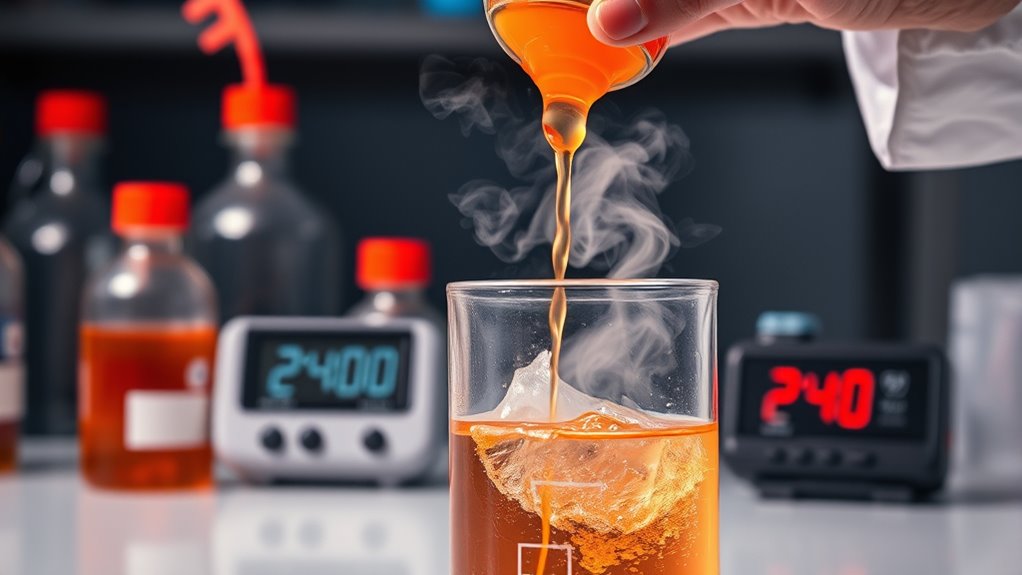
catalyst reaction rate demonstration
As an affiliate, we earn on qualifying purchases.
As an affiliate, we earn on qualifying purchases.
Conclusion
As you explore the factors influencing reaction rates, you realize how temperature, concentration, catalysts, and surface area unexpectedly work together to speed up or slow down reactions. It’s almost like a coincidence that increasing temperature can double the rate, or that catalysts are hidden helpers you never see. These intertwined factors remind you that understanding kinetics is like uncovering a secret code—hidden connections that shape how quickly reactions happen, often in ways you least expect.

TECHTONGDA 5L Lab Jacketed Reactor 110V Single-Layer Glass Reactor, Chemical Reaction Distillation Equipment Kit with Electric Heating Sleeve, 0-600 RPM Stepless Speed Regulation
- High-Quality Borosilicate Glass: Resists corrosion and high temperatures
- Durable Stainless Steel Components: Ensures long-term durability
- Efficient Electric Heating Jacket: Uniform heating up to 842℉ (450℃)
As an affiliate, we earn on qualifying purchases.
As an affiliate, we earn on qualifying purchases.

12 LED RC Lighting Kit,Steering/Brake/Smart Simulation Flash Lights for 1/10 Scale Crawler Car Yokomo Tamiya HSP HPI AXIAL SCX10 RC4WD D90 Traxxas TRX4 Upgrade Parts (12 LED RC Lighting Kit)
- Realistic Multi-Functional Lighting: Headlights, taillights, brake, and turn signals
- Two Control Modes: Independent or synchronized light control
- Wide Compatibility: Supports high-voltage and standard receivers
As an affiliate, we earn on qualifying purchases.
As an affiliate, we earn on qualifying purchases.