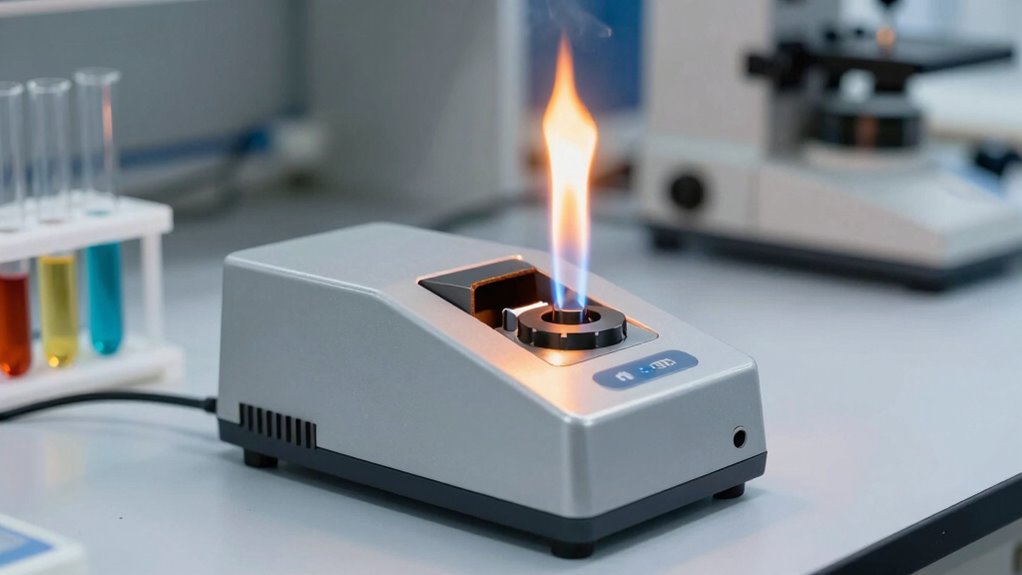

Flame photometers still matter in some labs because they provide fast, simple, and cost-effective analysis of crucial metal ions like sodium, potassium, and calcium. They are especially useful in resource-limited settings where advanced equipment isn’t practical or affordable. Their ease of operation means you don’t need extensive training, and their durability ensures reliable results over time. If you want to understand how these devices continue to serve essential roles, there’s more to uncover ahead.
Key Takeaways
- Flame photometers are cost-effective and easy to operate, making them ideal for resource-limited or small laboratories.
- They provide rapid, reliable measurements of essential metal ions like sodium, potassium, and calcium.
- Their simplicity and durability reduce maintenance and calibration requirements, ensuring consistent results over time.
- They remain useful for targeted screening where high sensitivity and multi-element analysis are not critical.
- Their proven reliability and long-standing use give confidence in their results within various environmental and medical applications.
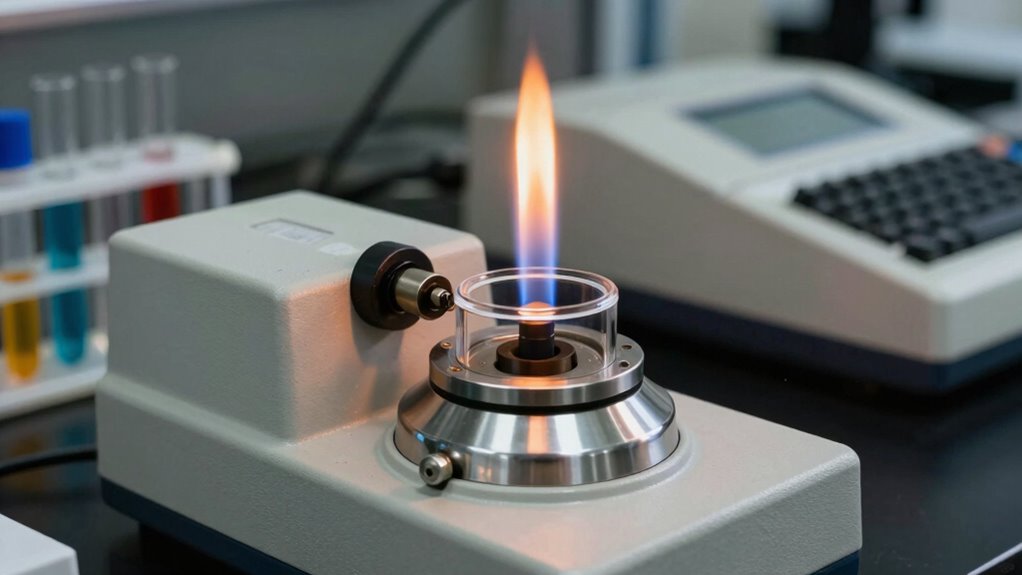
Despite the rise of advanced spectroscopic techniques, flame photometers remain relevant in many laboratories because they offer a quick, cost-effective way to analyze metal ions like sodium, potassium, and calcium. These devices have a rich historical significance, marking the early days of atomic emission spectroscopy. When flame photometry first emerged, it revolutionized clinical and agricultural testing by providing a simple, reliable method to quantify essential metal ions. Its development was pivotal in establishing standardized procedures for analyzing bodily fluids, soil, and water, making it a cornerstone in environmental and medical laboratories. Over the decades, flame photometers became an integral part of routine testing, especially in resource-limited settings where sophisticated equipment might be too expensive or complex to operate.
However, as technology advanced, modern alternatives like inductively coupled plasma optical emission spectrometry (ICP-OES) and atomic absorption spectrometry (AAS) gained popularity. These techniques offer higher sensitivity, broader element detection, and improved accuracy. Yet, despite their advantages, they also come with increased costs, maintenance requirements, and operational complexity. This makes flame photometry still attractive for many labs that prioritize simplicity, speed, and affordability. You find that flame photometers excel in quick screening scenarios, where rapid results are more valuable than exhaustive analysis. Their straightforward operation allows technicians to perform tests with minimal training, making them accessible in settings where specialized skills are scarce. Additionally, the simplicity of design of flame photometers contributes to their durability and ease of use in various environments.
Furthermore, the historical significance of flame photometers isn’t just nostalgic. It underscores their proven reliability and the foundational role they’ve played in analytical chemistry. Many healthcare and environmental labs still rely on these instruments because they deliver consistent results for specific ions, with minimal calibration fuss. Their long-standing use over decades demonstrates their effectiveness in targeted testing scenarios. The cost-effectiveness of flame photometry also remains a crucial factor for many small or underfunded laboratories. Moreover, advancements in instrument calibration techniques have helped maintain their accuracy over time, further solidifying their role in specific applications. While modern methods might outperform flame photometry in multi-element detection and precision, the latter remains a vital tool for targeted, cost-efficient testing. In many developing regions or small-scale labs, flame photometers continue to provide essential data without the need for high-tech infrastructure.
In essence, flame photometers have carved out a niche where their historical significance and practical advantages meet. They serve as an accessible, dependable solution for analyzing key metal ions, especially when speed and affordability are priorities. While modern alternatives expand the horizons of analytical chemistry, flame photometry’s simplicity and proven track record ensure it still matters in numerous laboratory settings today.
flame photometer for metal ion analysis
As an affiliate, we earn on qualifying purchases.
As an affiliate, we earn on qualifying purchases.
Frequently Asked Questions
How Do Flame Photometers Compare to Atomic Absorption Spectrometers?
You’ll find that flame photometers are simpler and quicker for analyzing alkali and alkaline earth metals, while atomic absorption spectrometers offer higher sensitivity and precision for a broader range of elements. With flame photometers, you perform straightforward calibration procedures and follow safety protocols easily, making them ideal for routine tests. Atomic absorption spectrometers, however, require more complex calibration and safety measures but provide detailed, accurate results for diverse samples.
Are Flame Photometers Suitable for Detecting Multiple Elements Simultaneously?
Yes, flame photometers are suitable for multi-element detection, enabling simultaneous analysis of specific elements like sodium, potassium, calcium, and lithium. They quickly measure multiple elements by switching between different emission wavelengths, making them efficient for routine testing. However, they may lack the sensitivity and versatility of atomic absorption spectrometers for complex or trace element analysis. Overall, flame photometers excel in applications requiring rapid, multi-element detection with straightforward operation.
What Are the Maintenance Requirements for Flame Photometers?
You need to regularly perform calibration procedures to guarantee accurate readings from your flame photometer. Keep the instrument clean and check the electrodes for wear. Follow safety precautions, like wearing protective gear and working in well-ventilated areas, to prevent accidents. Also, routinely inspect the fuel and reagent supplies, and replace parts as needed to sustain peak performance. Proper maintenance keeps your device dependable and safe to operate.
Can Flame Photometers Be Used for Qualitative Analysis?
Yes, flame photometers can be used for qualitative detection and element identification. You can identify specific elements by observing the characteristic emission lines they produce when introduced to a flame. While they’re primarily quantitative tools, their ability to detect the presence of certain ions makes them useful for qualitative analysis. This quick identification helps you determine which elements are present in your sample before conducting more detailed quantitative measurements.
What Are the Training Needs for Operating a Flame Photometer?
You need proper training to operate a flame photometer effectively. This includes understanding calibration protocols to guarantee accurate results and following safety procedures to prevent accidents. You should learn how to handle reagents safely, operate the instrument correctly, and troubleshoot common issues. Regular practice and adherence to safety guidelines help maintain precision and safety, ensuring reliable data collection in the lab.
portable flame photometer sodium potassium calcium
As an affiliate, we earn on qualifying purchases.
As an affiliate, we earn on qualifying purchases.
Conclusion
While digital analyzers often steal the spotlight, flame photometers still hold a essential place in some labs. They’re simple, reliable, and cost-effective—qualities that can’t be overlooked. Just as a vintage camera captures timeless moments, these instruments remind us that sometimes, tradition outperforms innovation. In a world racing toward high-tech solutions, don’t underestimate the enduring value of tried-and-true methods. Because in certain settings, these flame photometers prove that old tools can still do new tricks.
affordable flame photometry device
As an affiliate, we earn on qualifying purchases.
As an affiliate, we earn on qualifying purchases.

Fp640 Flame Photometer Flame Photometer Laboratory Digital Flame Spectroradiometer
As an affiliate, we earn on qualifying purchases.
As an affiliate, we earn on qualifying purchases.