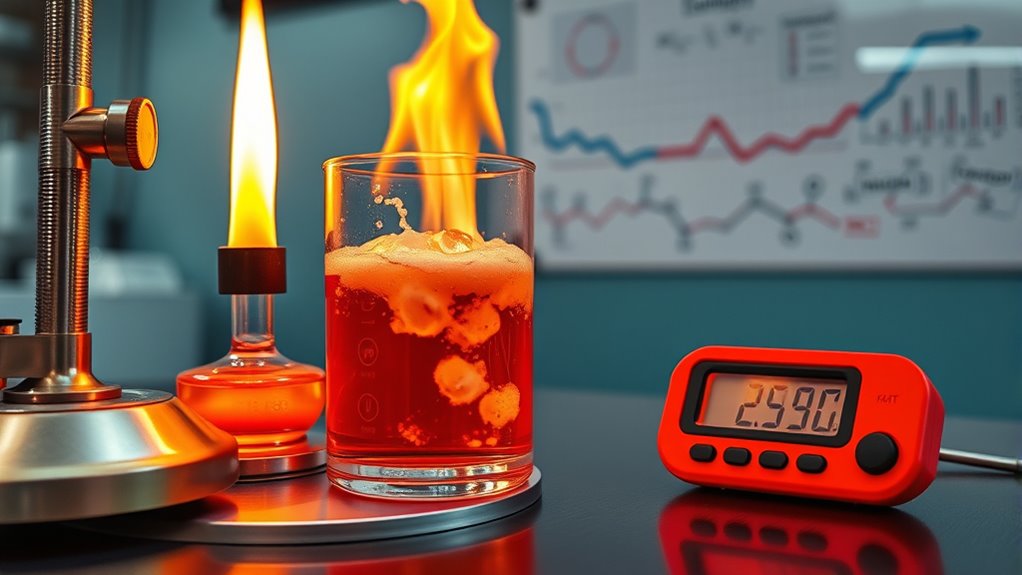

Thermochemistry helps you understand how energy flows during chemical reactions by focusing on enthalpy and entropy. Enthalpy shows whether heat is absorbed or released, while entropy measures how disorder changes. Together, they determine if a reaction is spontaneous through the Gibbs free energy equation. Reactions that release heat and increase disorder are more likely to happen naturally. Keep exploring to see how these concepts predict real-world chemical behaviors.
Key Takeaways
- Enthalpy (ΔH) measures heat absorbed or released at constant pressure during a reaction.
- Entropy (ΔS) reflects the change in disorder or randomness of a system.
- Negative ΔH indicates exothermic reactions; positive ΔH indicates endothermic processes.
- The Gibbs free energy equation (ΔG = ΔH – TΔS) predicts whether a reaction is spontaneous.
- Both enthalpy and entropy changes influence reaction spontaneity and energy flow.

Have you ever wondered how energy changes during chemical reactions? It’s a fascinating process, and understanding it starts with grasping the concepts of thermochemistry. When you look at a reaction, one of the first questions you might ask is whether it will happen on its own or need a push. That’s where reaction spontaneity comes into play. Spontaneous reactions occur naturally without added energy, but whether a reaction is spontaneous depends on multiple factors, including changes in enthalpy and entropy. Enthalpy calculations are essential here because they measure the heat energy absorbed or released during a reaction at constant pressure. If the enthalpy decreases, meaning energy is released, the reaction is often favorable, tending toward spontaneity. However, this isn’t the whole story; the entropy change also influences whether a process occurs spontaneously.
In thermochemistry, you need to analyze both enthalpy and entropy to predict reaction behavior accurately. For example, a reaction that releases heat (exothermic) typically has a negative enthalpy change, which favors spontaneity. But, if the disorder of the system decreases considerably (negative entropy change), the reaction might not be spontaneous at all. Conversely, an endothermic reaction that absorbs heat can still be spontaneous if it results in a substantial increase in entropy, making the overall free energy change negative. This interplay is formalized through the Gibbs free energy equation, ΔG = ΔH – TΔS, which combines enthalpy and entropy to determine spontaneity at a given temperature. When ΔG is negative, the reaction proceeds spontaneously. If the enthalpy calculations show a negative value and the entropy change is positive, the reaction is likely to happen without external input at the temperature considered.
Additionally, the concept of reaction spontaneity plays a crucial role in many scientific and industrial processes, guiding chemists in optimizing conditions for desired outcomes. Your understanding of thermochemistry hinges on these concepts because they help you predict and control chemical processes. By calculating enthalpy changes, you can estimate how much energy is involved, whether it’s absorbed or released. This information is fundamental in designing chemical reactions for industrial applications or understanding natural processes. Reaction spontaneity isn’t just about energy release but also about the disorder within the system. When both enthalpy and entropy are considered together, you gain an extensive picture of what drives a reaction forward. So, mastering enthalpy calculations and the factors influencing spontaneity allows you to better grasp how energy flows and transforms during chemical reactions, making thermochemistry an essential part of understanding the physical world.
calorimeter for chemistry experiments
As an affiliate, we earn on qualifying purchases.
As an affiliate, we earn on qualifying purchases.
Frequently Asked Questions
How Does Temperature Affect Enthalpy and Entropy Changes?
Temperature dependence markedly influences enthalpy and entropy changes, causing thermodynamic variability. As temperature rises, you’ll notice that enthalpy changes often increase due to greater molecular energy. Similarly, entropy, which measures disorder, tends to increase with temperature because molecules move more randomly. This relationship means that higher temperatures generally amplify the spontaneity of reactions, making it essential to take into account temperature effects when analyzing thermodynamic processes.
Can Enthalpy and Entropy Be Negative in Reactions?
Your curiosity sparks like a lightning bolt! Yes, enthalpy variations can be negative, indicating an exothermic reaction that releases heat, while the entropy sign can also be negative, showing decreased disorder. These negative values reveal a reaction’s nature, such as cooling or becoming more ordered. Remember, both enthalpy and entropy can be negative depending on the process, illustrating the fascinating complexities of thermochemistry.
How Do Phase Changes Influence Thermodynamic Properties?
During phase shifts, thermodynamic properties like enthalpy and entropy change profoundly. You’ll notice energy absorption or release, such as melting or vaporization, affects enthalpy. These phase changes also increase entropy as the system becomes more disordered. So, as you observe a phase transition, you’re witnessing how energy absorption or release drives the shift between different states, directly impacting the thermodynamic properties involved.
What Is the Role of Entropy in Spontaneous Reactions?
Entropy considerations play a vital role in reaction spontaneity. When you evaluate whether a reaction is spontaneous, you look at how entropy increases or decreases. If the entropy of the universe increases, the reaction tends to be spontaneous. You can predict spontaneity by analyzing entropy changes alongside enthalpy. Basically, a positive change in entropy favors reaction spontaneity, making the process more likely to occur naturally without external energy input.
How Are Thermodynamic Principles Applied in Real-World Engineering?
Imagine designing a new engine that maximizes energy efficiency. You apply thermodynamic principles by analyzing energy flow and entropy changes, ensuring ideal material design for durability and performance. These principles help you predict how systems behave under different conditions, minimizing waste and improving efficiency. In real-world engineering, understanding thermodynamics guides innovations like renewable energy systems, making them more sustainable and cost-effective.
As an affiliate, we earn on qualifying purchases.
Conclusion
Now that you’ve grasped how enthalpy and entropy influence energy changes, you see the bigger picture of thermochemistry. Keep in mind that understanding these concepts is key to mastering chemical reactions and energy efficiency. Don’t throw in the towel when things get complex; every challenge is a stepping stone. With perseverance, you’ll reveal the secrets of the universe’s energy flow. Remember, where there’s a will, there’s a way to turn knowledge into power.
As an affiliate, we earn on qualifying purchases.
chemical reaction energy measurement tools
As an affiliate, we earn on qualifying purchases.
As an affiliate, we earn on qualifying purchases.