To make certain your fertilizer spreader applies the correct amount, you need to calibrate it properly. Fill the spreader with a sample fertilizer, operate it over a designated area, and collect the dispensed material in a catch container. Measure the amount spread, then adjust the controls accordingly until it meets your target rate. Regular calibration helps avoid waste and environmental harm. Keep in mind, mastering this process can make a significant difference—more tips follow to help you achieve precision.
Key Takeaways
- Use appropriate tools like catch plates or measuring containers to accurately gauge fertilizer output during calibration.
- Operate the spreader over a known area at normal speed, collecting dispensed fertilizer for measurement.
- Adjust spreader controls incrementally based on measurement results to match the desired application rate.
- Recalibrate regularly, especially when changing fertilizer types, equipment, or field conditions.
- Maintain calibration tools and follow a routine calibration schedule to ensure consistent, accurate fertilizer application.

Proper fertilizer spreader calibration is vital to guarantee your crops receive the right amount of nutrients. If your spreader isn’t properly calibrated, you risk over-application, which can lead to nutrient runoff, environmental harm, and wasted resources. Conversely, under-application can deprive your crops of essential nutrients, stunting growth and reducing yields. To prevent these issues, you need to focus on accurate spread rate adjustment, which involves fine-tuning your equipment to dispense fertilizer at the correct rate. Using reliable calibration tools simplifies this process, allowing you to measure and set your spreader’s output precisely.
Start by choosing the right calibration tools for your spreader. Many farmers rely on simple catch plates, measuring jars, or calibrated containers to determine how much fertilizer is being dispensed over a set area or time. These tools help you accurately gauge your spread rate adjustment, enabling you to make precise modifications. Once you have your tools ready, fill your spreader with a known quantity of fertilizer—preferably a representative sample of what you’ll use in the field. Operate the spreader over a designated area, following your typical application speed and pattern. Collect the fertilizer that falls outside the intended area or in the catch container, then measure the amount dispensed.
Next, compare your measurements with your target application rate. If the amount of fertilizer dispensed is too high, you’ll need to decrease the spread rate adjustment. Conversely, if it’s too low, increase the adjustment accordingly. Most spreaders have simple controls—such as a dial or lever—that modify the spread rate. Adjust these controls incrementally, then repeat the calibration process until your measurements align with the desired application rate. This iterative process ensures you’re applying fertilizer accurately, time and time again. Regular calibration helps maintain accuracy and prevents costly errors, especially when field conditions change. Calibration isn’t a one-time task; it’s an ongoing process that should be performed regularly, especially when changing fertilizer types, adjusting for different field conditions, or after maintenance. Proper calibration tools make this routine straightforward and precise, preventing costly errors. Remember, consistent calibration leads to uniform fertilizer application, which improves crop health and maximizes yield potential.

Scotts Turf Builder EdgeGuard Mini Broadcast Spreader for Seed, Weed and Feed, Fertilizer, Salt, Ice Melt, Push Spreader Holds up to 5,000 sq.ft. Product
Mini broadcast spreader: Scotts Turf Builder EdgeGuard Mini Broadcast Spreader can be used to apply lawn care products…
As an affiliate, we earn on qualifying purchases.
As an affiliate, we earn on qualifying purchases.
Frequently Asked Questions
How Often Should I Calibrate My Fertilizer Spreader?
You should calibrate your fertilizer spreader at least once a season or whenever you notice uneven application. Regular calibration ensures your spread pattern stays accurate, preventing over- or under-fertilizing. If you change products or adjust settings, recalibrate immediately. Also, after repairs or transportation, check the calibration to maintain consistent application. Frequent calibration helps you achieve precise fertilizer spread, saving money and promoting healthy crop growth.
What Tools Are Best for Precise Calibration?
Forget magic wands—your best tools for precise calibration include a spread rate calculator, a measuring jug, and a scale. Use these with a detailed calibration checklist to avoid the chaos of uneven fertilizer. For accuracy, consider a digital flow meter or a stopwatch for timing. Remember, if you skip this step, your plants might as well be playing hide-and-seek with nutrients—ineffective and frustrating!
Can Calibration Vary With Different Fertilizer Types?
Yes, calibration can vary with different fertilizer types because of differences in fertilizer consistency and particle size. These factors influence the spread pattern, so you’ll need to adjust your spreader settings accordingly. Always test and calibrate when switching fertilizers to guarantee even application. By doing this, you maintain ideal crop growth and avoid waste, ensuring your fertilizer spreader delivers the right amount each time.
How Does Weather Affect Calibration Accuracy?
Weather impact can turn your calibration efforts into a rollercoaster ride, causing variability in application accuracy. High humidity, wind, or rain can slow down or speed up fertilizer dispersal, throwing off your calibration. Strong winds, for instance, blow fertilizer off course, making your spread uneven. To keep calibration reliable, always consider weather conditions before spreading, and recheck your calibration after significant weather changes.
Is Professional Calibration Necessary for Small-Scale Farms?
Yes, professional calibration can be beneficial even for small-scale farms. While manual techniques and calibration standards are useful, professional calibration guarantees your spreader applies fertilizer accurately, saving you money and reducing waste. It accounts for equipment variances and ensures consistency. If you want precise application without guesswork, investing in professional calibration is a smart move, especially as your farm grows or if you’re aiming for ideal crop yields.
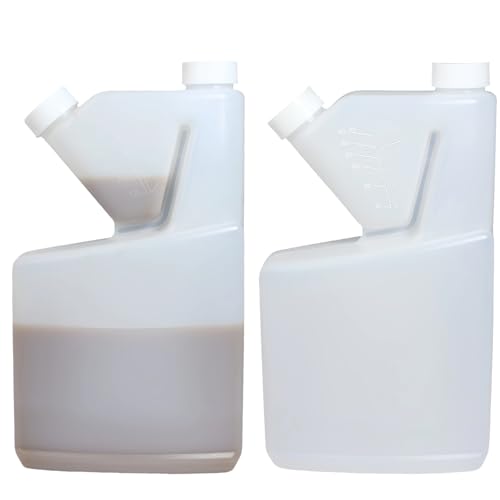
17oz Tip & Pour Measuring Containers with Lids (2 Pcs) – Plastic Tip Measure Bottles, Up to 2oz Precise Measuring Capacity, Reusable Measuring Cups, No Extra Measuring Cup Needed
Clear & Precise Measurement: Easily measure liquids up to 2oz (≈59ml) with clear markings. The semi-transparent design lets…
As an affiliate, we earn on qualifying purchases.
As an affiliate, we earn on qualifying purchases.
Conclusion
By regularly calibrating your fertilizer spreader, you guarantee each acre gets the right amount of nutrients, leading to healthier crops and cost savings. Imagine you’re planting a field, and after calibration, your spreader evenly distributes fertilizer, just like a precise artist. For instance, a farmer in Iowa calibrated their spreader and saw a 15% increase in yield while reducing fertilizer waste. Keep calibration top of mind, and watch your fields thrive with ideal, accurate application.

WORX 20V Cordless Seed Spreader 6-Speeds 5-Ft. Max Distance, Fertilizer Spreaders 8 Flow-Rate Settings, Broadcast Spreader Easier Than Hand Spreaders for Lawns WG869 – Battery & Charger Included
SEEDING MADE SIMPLE: This grass seed spreader eliminates the slow, uncomfortable struggles of using a manual spreader. With…
As an affiliate, we earn on qualifying purchases.
As an affiliate, we earn on qualifying purchases.

WAC/Cosmo Fertilizer Spreader Lower Agritator Kit
Replacement lower agitator kit for WAC / Cosmo Spreaders, includes Lower Agitator,Cast Entrainer, Lower Sealing Rubber Ring, and…
As an affiliate, we earn on qualifying purchases.
As an affiliate, we earn on qualifying purchases.