If you’re looking for the best home AED trainers and kits, I recommend options that are safe, realistic, and easy to use. Top choices include the WNL Practi-Trainer, Philips HeartStart AED kits, and portable simulators with voice prompts and scenario modes. These kits support adult and pediatric practice, have durable designs, and offer real-time feedback. Continuing aligns you with ideal training solutions that guarantee safety and confidence—stay tuned to learn more about the best options for your needs.
Key Takeaways
- Choose trainers with realistic scenarios, voice prompts, and bilingual options for effective home emergency preparedness.
- Opt for durable, reusable pads and impact-resistant materials to ensure long-term training reliability.
- Select compact, portable kits with clear visual symbols and easy setup for quick deployment during emergencies.
- Prioritize devices with real-time feedback and multiple training modes to enhance user confidence and skill retention.
- Ensure compatibility with various CPR mannequins and adherence to AHA guidelines for comprehensive, safe practice.
AED Trainer & AED Simulator for Home and First Aid Training
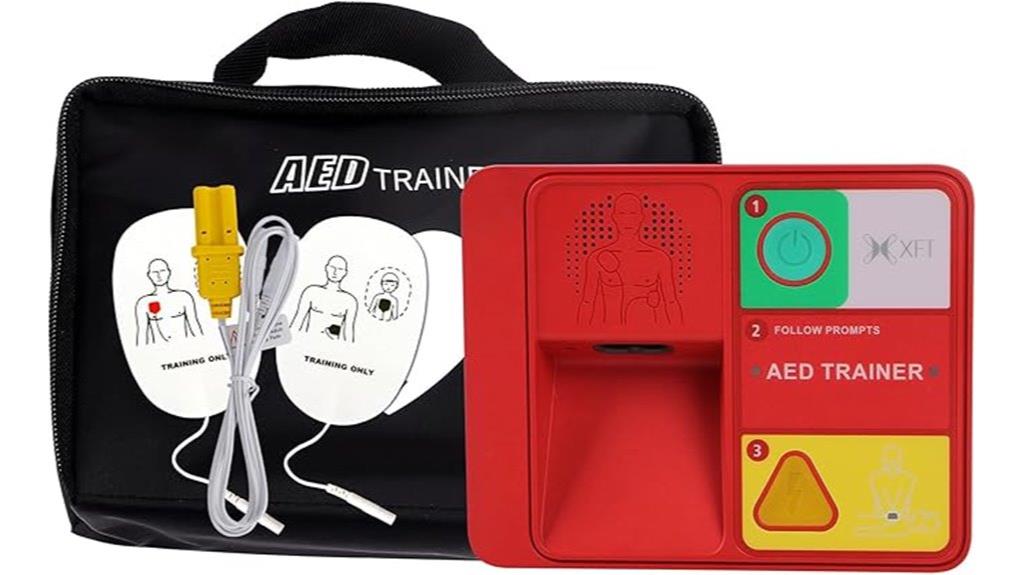
If you’re looking for a safe and realistic way to learn CPR and AED use at home, the AED Trainer & Simulator is an excellent choice. It’s lightweight, portable, and designed specifically for training, so it can’t deliver real shocks. I appreciate its safety features, like the absence of high voltage. The device offers multiple training modes, including scenario simulations, voice prompts, and adjustable volumes. It also supports adult and pediatric settings, providing realistic practice aligned with the latest guidelines. With real-time feedback and multilingual options, it’s perfect for beginners wanting effective, safe first aid training in the comfort of their home.
Best For: beginners and home users seeking a safe, realistic, and effective way to learn CPR and AED usage without risk of electric shock.
Pros:
- Safe for home use with no high voltage, ensuring user safety during training
- Supports multiple modes, including scenario simulations and real-time feedback for comprehensive practice
- Multilingual voice prompts and adjustable volume enhance user understanding and accessibility
Cons:
- Designed solely for training, cannot be used for actual patient defibrillation
- Limited to practice scenarios; lacks the capability to deliver real shocks or medical treatment
- May require additional CPR mannequins or accessories for full training setup
WNL Practi-Trainer AED Training Kit
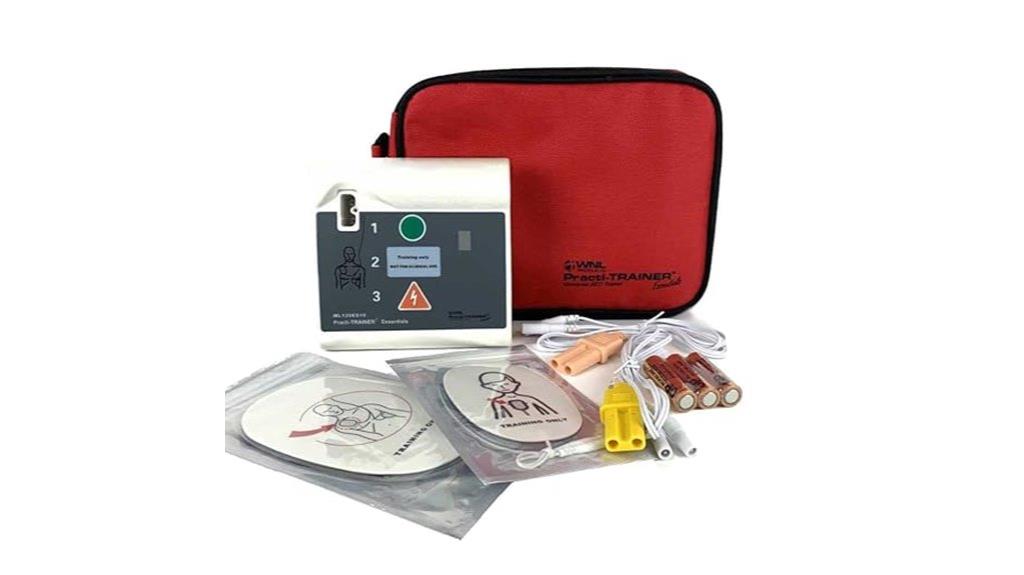
The WNL Practi-Trainer AED Training Kit stands out as an ideal choice for instructors and training programs seeking a realistic, cost-effective simulation tool. It includes a non-functional AED trainer, reusable adult and child pads, batteries, a nylon case, and an instructor manual. The kit offers five preprogrammed scenarios with voice prompts and a metronome to guide CPR compression timing. Fully compliant with AHA guidelines and compatible with most CPR manikins, it guarantees standardized training. Built for durability, the reusable pads reduce ongoing costs, making it perfect for classroom or portable AED training. Overall, it’s a reliable, budget-friendly solution for effective emergency preparedness.
Best For: CPR instructors, training programs, and educational institutions seeking a realistic, durable, and cost-effective AED simulation tool for classroom or portable emergency preparedness training.
Pros:
- Fully compliant with AHA guidelines ensuring standardized instruction
- Reusable pads and durable construction reduce long-term training costs
- Includes multiple preprogrammed scenarios with voice prompts and a metronome for effective CPR guidance
Cons:
- The AED trainer is non-functional and cannot deliver actual defibrillation shocks
- Limited to simulation training, not suitable for real-life emergency use
- May require additional CPR manikins for comprehensive training sessions
WNL Products AED Training Kit (4 Pack)
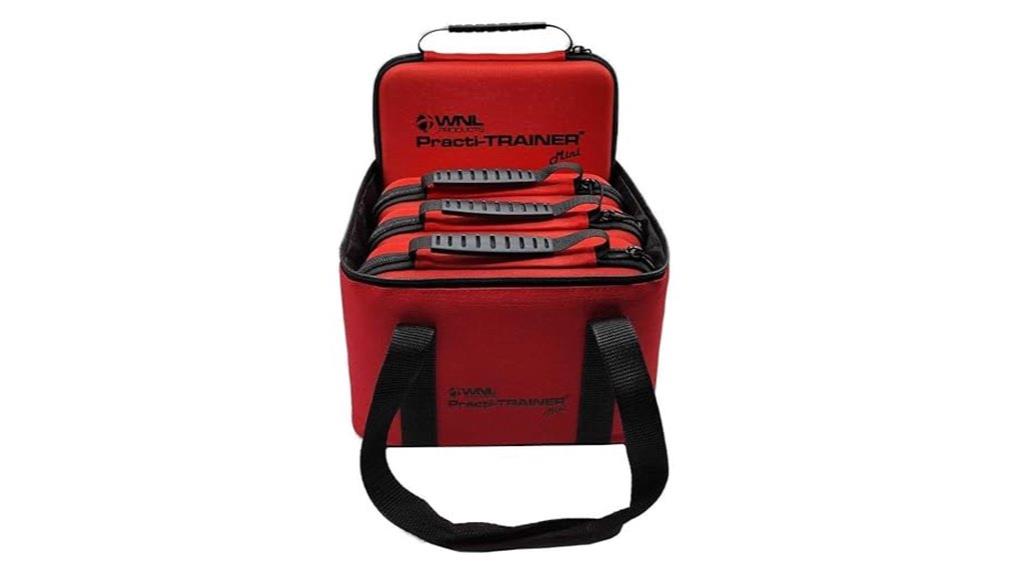
For instructors and training centers seeking an affordable yet realistic AED practice solution, the WNL Products AED Training Kit (4 Pack) stands out. This compact, lightweight set includes four Practi-Trainer Minis, perfect for multiple training sessions. Each unit features realistic scenarios with pre-programmed responses, voice prompts, and LED indicators to mimic real emergency situations. Its bilingual voice prompts in English and Spanish make it accessible for diverse learners. The kits are compatible with any CPR manikin and come with reusable pads, batteries, and an instructor manual. Durable and portable, this set offers effective, hands-on AED training at an excellent price point.
Best For: training centers, instructors, and schools seeking affordable, realistic AED practice kits for multiple learners and scenarios.
Pros:
- Realistic training scenarios with pre-programmed responses, voice prompts, and LED indicators
- Bilingual voice prompts in English and Spanish for diverse accessibility
- Compact, lightweight, and portable design with durable carrying case for easy transport
Cons:
- Solely for training purposes; cannot be used for actual defibrillation
- Requires batteries (included) for operation, which need replacement over time
- Limited to AED training; not suitable for advanced medical or emergency response beyond basic AED use
AED Trainer Device for First Aid Practice with 5 Modes and Voice Prompts

Designed specifically for training purposes, the AED Trainer Device with 5 modes and voice prompts offers a secure and realistic practice experience without the risks associated with real defibrillation. It features semi/full auto, scenario, metronome, CPR, and language modes, supporting adult and pediatric settings. The device provides real-time feedback on CPR quality and guides users with clear voice prompts, enhancing learning effectiveness. With adjustable volume, multiple language options, and compatibility with most AED manikins, it’s ideal for first aid training. Its safety features and extensive scenario options ensure effective, risk-free practice, making it a reliable tool for confident emergency preparedness.
Best For: First aid instructors and training organizations seeking a safe, realistic AED practice device with versatile scenarios and user-friendly features.
Pros:
- Provides realistic training with 5 diverse scenarios and real-time CPR feedback.
- Ensures safety with no high voltage, making it suitable for educational environments.
- Supports multiple languages and adjustable settings for comprehensive user accommodation.
Cons:
- Limited to training use; cannot be used on actual patients or for real defibrillation.
- May require additional accessories or compatible manikins for full functionality.
- The device’s complexity might necessitate initial training or familiarization for new users.
AED Trainer XFT CPR Defibrillator Simulator for First Aid Training

If you’re looking for a reliable training tool that guarantees safety and realism, the AED Trainer XFT CPR Defibrillator Simulator stands out. It’s specifically designed for first aid practice, featuring automatic activation when you open the lid. With multiple training modes, scenario settings, and voice prompts, it closely mimics real AED responses. The device supports semi- and full-auto modes, adjustable CPR rhythms, and language options, making training versatile. Its rechargeable battery offers up to 12 hours of use, and it’s compatible with most CPR manikins. Plus, its safety-focused design ensures no high voltage, making it perfect for a safe, effective learning experience.
Best For: First aid trainers, medical educators, and CPR certification programs seeking a safe, realistic AED training device with versatile features.
Pros:
- Realistic simulation with multiple training scenarios and voice prompts for effective learning.
- Safe for training environments due to lack of high voltage, ensuring user safety.
- Long-lasting rechargeable battery provides up to 12 hours of continuous use, reducing downtime.
Cons:
- Limited to training use; cannot be used for actual patient defibrillation.
- May require familiarity with multiple language settings for optimal use in diverse environments.
- Compatibility with specific CPR manikins might require additional adapters or setup.
AED Response kit
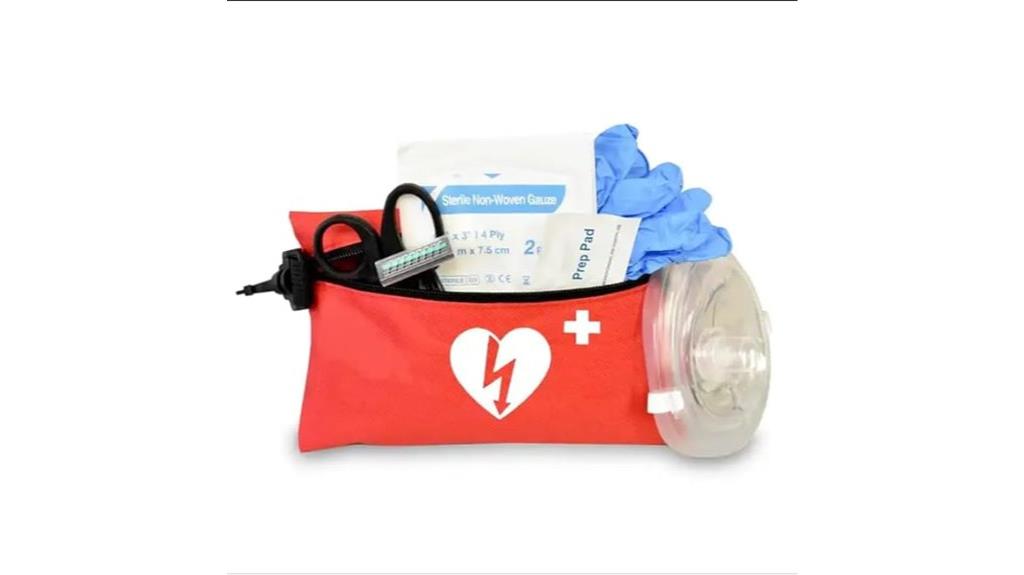
The AED Response kit stands out as an essential tool for workplaces, public spaces, and first responders seeking quick and reliable access to life-saving equipment. Its compact, lightweight design makes it easy to store inside AED cabinets or transport in vehicles, bags, or containers for on-scene use. The eye-catching red bag, marked with AED symbols, allows for instant recognition during emergencies. Inside, it contains all necessary components to facilitate AED use, ensuring responders are prepared for cardiac emergencies. Whether in a busy office, a public venue, or on the move, this kit provides the essential items needed for effective AED deployment in critical moments.
Best For: workplaces, public spaces, and first responders seeking quick, reliable access to AED emergency response essentials.
Pros:
- Compact and lightweight for easy storage and transportation
- Eye-catching red bag with AED symbols for quick recognition
- Contains all necessary components for effective AED deployment
Cons:
- May require regular replenishment of consumable items
- Limited space might restrict additional supplies or accessories
- Not suitable for large-scale or mass emergency setups
WNL Products AED Training Kit (4 Units) and Carry Bag
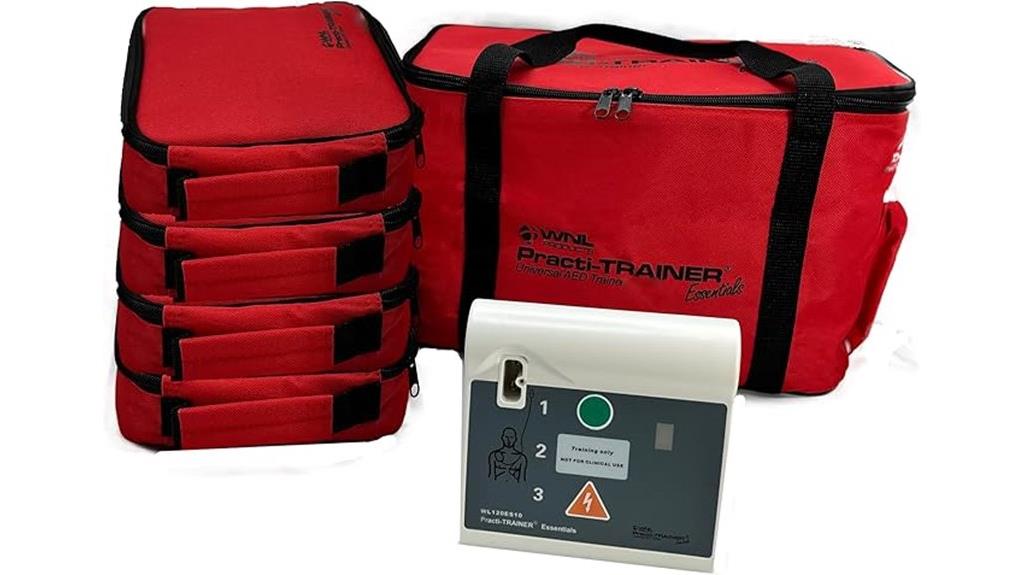
For organizations or training programs seeking a realistic and convenient AED practice solution, the WNL Products AED Training Kit (4 Units) and Carry Bag stands out. This extensive set includes four AED trainers, reusable adult and child training pads, connectors, batteries, and an instructional manual, all stored in a custom-fit carrying bag. It offers a lifelike training experience with voice prompts and a metronome to guarantee proper CPR rhythm. Fully compliant with AHA 2023 guidelines, it’s perfect for effective CPR and AED education. Known for quality and affordability, this kit is an excellent choice for facilitating consistent, realistic practice sessions.
Best For: organizations and training programs seeking a realistic, comprehensive, and cost-effective AED practice solution for effective CPR and AED education.
Pros:
- Includes four trainers, reusable training pads, batteries, and an instructional manual, providing a complete training package.
- Features voice prompts and a metronome for realistic and effective CPR practice.
- Fully compliant with AHA 2023 guidelines, ensuring standardized and up-to-date training.
Cons:
- Designed solely for training; cannot deliver actual defibrillation shocks for real-life emergency treatment.
- May require additional AED manikins or practice devices for comprehensive training scenarios.
- Bulkier carrying bag may be less convenient for transportation compared to smaller kits.
Philips HeartStart Home AED Defibrillator
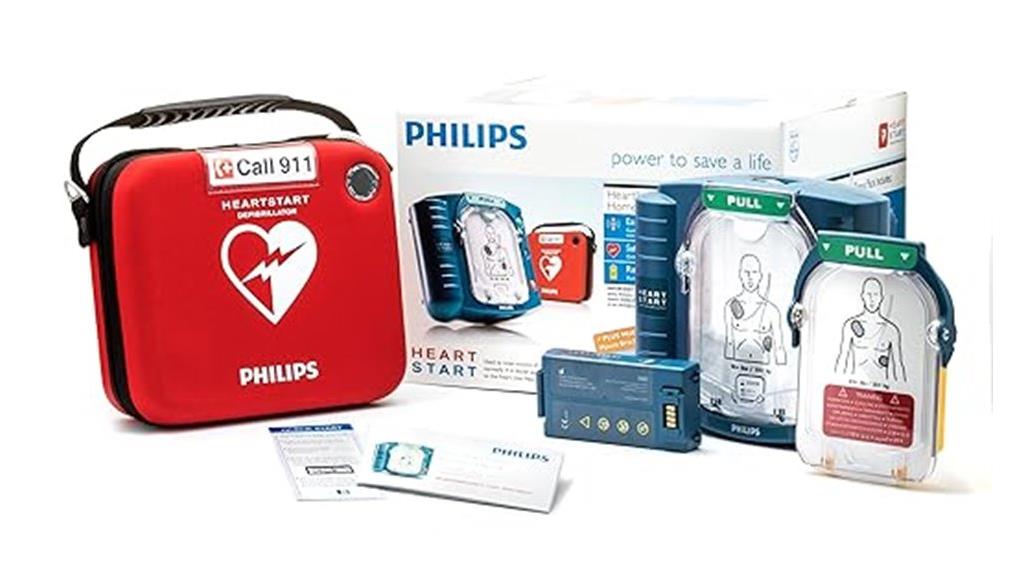
The Philips HeartStart Home AED Defibrillator stands out as an excellent choice for homeowners seeking a reliable, easy-to-use device that provides real-time guidance during cardiac emergencies. It’s portable and designed for quick deployment, even in wet or metal environments. With advanced SMART Analysis technology, it assesses heart rhythms and determines if a shock is necessary, delivering therapy within 8 seconds with the Quick Shock feature. The device offers step-by-step voice prompts and adapts instructions based on user responses. Its thorough accessories, including training pads and manuals, ensure proper use and maintenance. Overall, it’s a dependable, life-saving tool perfect for home safety.
Best For: homeowners and private individuals seeking a reliable, easy-to-use defibrillator for emergency cardiac care at home.
Pros:
- User-friendly with step-by-step voice prompts suitable for untrained users
- Rapid therapy delivery with the Quick Shock feature within 8 seconds
- Safe and effective even in wet or metal environments, ensuring versatility
Cons:
- Requires periodic self-tests and maintenance to ensure readiness
- Comes with optional accessories and training materials that may entail additional costs
- Limited to private settings; not designed for professional or public use
Training AED Ultratrainer, Single, Training Prestan AED

If you’re looking for a highly realistic and versatile AED training solution, the Prestan AED UltraTrainer is an excellent choice. It mimics real AED operation with authentic voice prompts, scenario options, and adjustable settings like adult or child training modes. The preconnected pads detect when they’re attached to a manikin, providing immediate feedback. Compact and lightweight, it’s easy to transport for training anywhere. Durable and long-lasting—each set supports 25 to 30 uses—without messy residue. With customizable prompts and multiple language options, the UltraTrainer offers a thorough, safe, and realistic training experience, making it ideal for effective AED education.
Best For: instructors and training organizations seeking a realistic, durable, and customizable AED training device for effective CPR and AED education.
Pros:
- Provides authentic AED operation simulation with clear voice prompts and scenario options.
- Durable design supports 25 to 30 uses per set without messy residue.
- Compact and lightweight for easy transportation and versatile training environments.
Cons:
- Batteries are required but not included, which may require additional purchase.
- Limited to training scenarios; not suitable for actual emergency use.
- May have a learning curve for new users to fully utilize all customizable features.
Philips HeartStart OnSite AED Defibrillator, Business Package M5066A-C02BPB
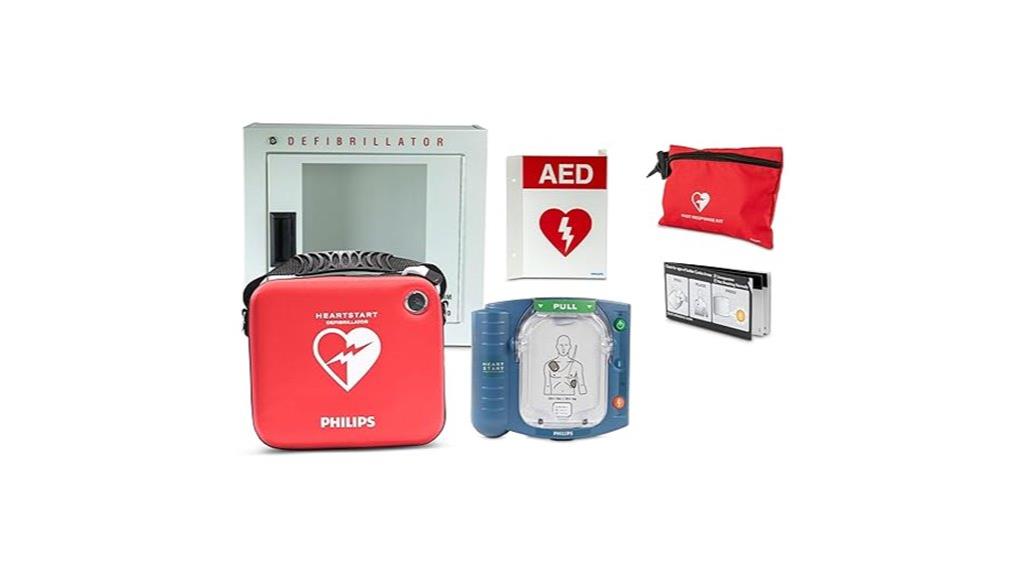
The Philips HeartStart OnSite AED Defibrillator Business Package M5066A-C02BPB stands out as an ideal choice for workplaces and public venues seeking a dependable, easy-to-use emergency device. Its portable design, paired with clear voice prompts and real-time CPR guidance, makes it accessible even for those with no training. The device employs SMART Analysis technology to accurately assess heart rhythms and deliver shock swiftly if needed, with a Quick Shock feature that activates within 8 seconds. The all-inclusive package includes everything needed for immediate deployment, plus self-testing ensures reliability. This AED provides peace of mind, knowing help can be delivered quickly during cardiac emergencies.
Best For: public venues, workplaces, and businesses seeking a reliable, easy-to-operate AED for sudden cardiac emergencies accessible to untrained personnel.
Pros:
- User-friendly design with intuitive voice prompts and real-time CPR guidance.
- Advanced SMART Analysis technology ensures accurate rhythm assessment and quick shock delivery.
- Complete package includes all necessary components for immediate setup and ongoing maintenance.
Cons:
- Limited warranty duration (8 years for the AED, 4 years for the battery) may require eventual replacement.
- Optional training pads and accessories are sold separately, which could increase overall setup costs.
- Self-testing is automatic but requires regular maintenance awareness to ensure readiness.
Laerdal Mini Anne Global Set CPR Manikin

For anyone seeking a realistic, portable CPR training tool, the Laerdal Mini Anne Global Set CPR Manikin stands out. It features an inflatable design for quick setup and easy storage, making it perfect for home or on-the-go practice. The manikin includes landmarks for accurate compressions, a visible chest rise during ventilations, and an audible compression clicker to ensure proper depth. The set also comes with a simulated AED trainer and an express bag for portability. Plus, a QR code links to instructional videos, enhancing learning. This kit provides extensive, realistic CPR and AED training, helping users build confidence and skills for emergency situations.
Best For: individuals and professionals seeking a realistic, portable, and comprehensive CPR and AED training tool for effective skill development.
Pros:
- Inflatable design allows for quick setup and easy storage, ideal for on-the-go training.
- Includes realistic landmarks and features like visible chest rise and audible compression feedback for accurate practice.
- Comes with a simulated AED trainer and instructional QR code, enhancing hands-on learning experience.
Cons:
- May be less durable over extended frequent use compared to more advanced manikins.
- Limited features compared to high-end, full-featured CPR training mannequins.
- Requires proper handling of the inflatable components to maintain longevity and performance.
Philips HeartStart AED Trainer with Carry Case

The Philips HeartStart AED Trainer with Carry Case stands out as an essential tool for responders seeking realistic, portable CPR and AED practice. This training device simulates AED use with eight preconfigured scenarios, including adult and pediatric cases, guiding you with authentic voice prompts identical to the real HeartStart AEDs. The package includes reusable training pads, a nylon carry case, and helpful instructions, making it easy to practice anywhere. While it can’t be used in actual emergencies, it’s perfect for building confidence and reducing errors in real situations. Philips offers a one-year warranty on accessories, ensuring reliable, ongoing training support.
Best For: responders and training organizations seeking a realistic, portable AED practice device to enhance CPR and AED skills safely.
Pros:
- Realistic voice prompts matching actual HeartStart AEDs for authentic training experience
- Includes reusable adult training pads and a convenient carry case for portability
- Supports adult and pediatric scenarios to prepare responders for various emergencies
Cons:
- Cannot be used in real-life cardiac arrest situations, only for training purposes
- Pediatric scenarios require separate purchase of child/infant training pads
- Limited to preconfigured scenarios, which may not cover all emergency variations
AED Trainer, XFT AED Training Kit CPR Equipment Simulator (XFT-120GA)
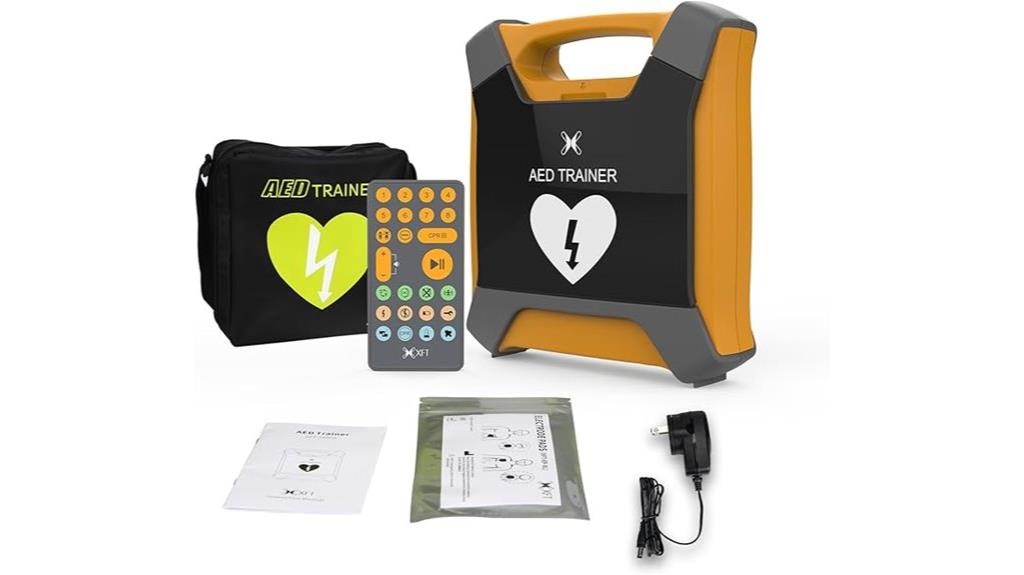
If you’re looking for a reliable training tool that combines realistic scenarios with user-friendly features, the XFT AED Training Kit (XFT-120GA) stands out. It’s designed exclusively for training, not real defibrillation, ensuring safety with no high voltage risks. The device offers customizable settings, voice prompts, and automatic scenario saving, making sessions intuitive and efficient. With eight realistic emergency scenarios and easy mode switching between adult and pediatric, it closely mimics real-life use. The rechargeable battery lasts up to 12 hours, and the device supports multiple languages. Compact and convenient, it’s an excellent choice for extensive AED training at home or in training centers.
Best For: training instructors, healthcare students, or first responders seeking a realistic, customizable AED practice device for comprehensive CPR and AED training sessions.
Pros:
- Realistic emergency scenarios with scenario saving and voice prompts for effective training.
- User-friendly features such as automatic power on when lid opens and easy mode switching between adult and pediatric.
- Long-lasting rechargeable battery supporting up to 12 hours of continuous use and multi-language support.
Cons:
- Designed solely for training, not suitable for actual medical emergencies or defibrillation.
- May require additional CPR manikins and accessories for full training setups.
- Limited to 8 pre-set scenarios, which might restrict variety for advanced training needs.
Philips HeartStart AED Defibrillator with Emergency Medical Kit

The Philips HeartStart AED Defibrillator with Emergency Medical Kit stands out as an excellent choice for homeowners or residential settings where quick, reliable emergency response is essential. This portable, user-friendly device offers clear voice prompts, real-time CPR guidance, and SMART Analysis technology to assess heart rhythms automatically. It can deliver shocks within 8 seconds using Quick Shock technology and performs regular self-tests to guarantee readiness. The kit includes everything needed for immediate response, such as pads, a carry case, and maintenance tools. Designed for those with no training, it simplifies emergency situations, making it an invaluable safety tool for any home.
Best For: Homeowners or residents seeking a reliable, easy-to-use AED for emergency cardiac situations without prior medical training.
Pros:
- User-friendly with clear voice prompts and real-time CPR guidance.
- Automatic self-tests ensure the device is always ready for use.
- Quick Shock technology delivers defibrillation within 8 seconds, saving critical time.
Cons:
- Requires additional purchase of training pads if used for AED training purposes.
- Limited to home and residential use; not designed for professional or outdoor emergency services.
- Battery and pads have expiration dates, requiring regular replacement to maintain readiness.
WNL Products WL320ES Training Kit with Voice Prompts & LED Indicators

Designed for instructors seeking an effective, bilingual training tool, the WNL Products WL320ES Training Kit with Voice Prompts & LED Indicators offers a compact and user-friendly solution. Measuring just 3” x 0.5” x 3.75”, it’s lightweight and portable, perfect for classroom or mobile training. The device features built-in English and Spanish voice prompts, along with LED indicators, to enhance learning and engagement. It’s compatible with any CPR training manikin and includes reusable adult and child pads, batteries, a manual, and a durable nylon case. WNL Products is known for reliable, high-quality training equipment, making this kit a practical choice for effective emergency preparedness.
Best For: Instructors and training centers seeking a portable, bilingual CPR training device to enhance learning with visual and auditory cues.
Pros:
- Compact and lightweight design for easy portability and storage
- Built-in English and Spanish voice prompts with LED indicators for effective, bilingual training
- Compatible with any CPR manikin and includes reusable training pads and accessories
Cons:
- Designed solely for training purposes, not for actual life-saving use on humans
- May require batteries replacement over time for continuous use
- Limited to training scenarios; not suitable for emergency response outside instructional settings
Factors to Consider When Choosing Home AED Trainers and Kits

When selecting a home AED trainer, I focus on how realistic and effective the simulation feels, since it impacts the training quality. I also consider whether the interface is easy to use and if it works well with my existing manikin. Finally, I check for durability, portability, and the variety of scenarios and modes to guarantee thorough practice.
Realism and Simulation Quality
Choosing a home AED trainer that offers high realism and simulation quality can substantially boost your confidence and competence. Realistic prompts, scenarios, and responses closely mimic actual AED operation, making practice more effective. The quality of simulation scenarios, including diverse emergency situations and patient conditions, ensures you’re prepared for real-life challenges. Accurate visual and auditory cues, like lifelike voice prompts and LED indicators, increase engagement and help you follow procedures correctly. The realism of pads and electrode placement, combined with scenario variability, aids in developing muscle memory and confidence. Features such as adjustable CPR feedback, multiple language options, and scenario complexity customization further enhance the authenticity of training, ensuring you’re well-equipped for emergency situations with realistic, effective practice.
User-Friendly Interface Design
A user-friendly interface is essential for guaranteeing that even those with no prior training can operate a home AED trainer confidently during an emergency. Intuitive design features like clear voice prompts and visual indicators guide users smoothly through procedures, reducing panic. Large, labeled buttons and straightforward menu navigation minimize errors under stress. Features such as scenario-based guidance and automatic configuration saving help users feel confident, even if they’re unfamiliar with AEDs. Multi-language support ensures accessibility for diverse users, promoting better understanding across different populations. Responsive feedback systems, including LED indicators and real-time CPR quality metrics, make it easier to follow correct techniques. Overall, a well-designed interface enhances safety by making AED training accessible, simple, and reliable for everyone in critical moments.
Compatibility With Manikins
Ensuring compatibility between your home AED trainer and manikins is crucial for effective training. You want to make sure the AED trainer supports the specific CPR manikins you’re using, so pads attach correctly and communication is seamless. Check that the device supports standard electrode connector types matching your manikins, guaranteeing easy setup. If you plan to train with both adult and pediatric scenarios, verify the trainer can simulate these conditions to provide thorough practice. Also, consider the size and shape of your manikin’s chest surface, as compatibility here affects realistic pad placement and accurate feedback. Lastly, ensure the trainer’s features, like scenario modes and feedback mechanisms, work well with your existing manikins for maximum learning outcomes. Compatibility is key to effective, realistic training.
Scenario and Mode Options
When selecting a home AED trainer, it’s important to look at the variety of scenario and mode options it offers. I recommend choosing one with multiple training modes like semi-automatic, fully automatic, and scenario-based setups to mimic real-life emergencies. Features such as CPR feedback, adjustable compression rates, volume, and beeping frequency allow customization to suit different learners’ needs. It’s also beneficial if the device supports switching between adult and pediatric modes, ensuring thorough training across age groups. Additionally, pre-programmed emergency scenarios aligned with current guidelines enhance realistic practice. The ability to save and recall different scenarios helps streamline repeated training sessions, making practice more consistent and effective. These options ensure your training is both realistic and adaptable to your skill level.
Durability and Portability
Choosing a durable home AED trainer means prioritizing high-quality materials like reinforced plastics and impact-resistant components that can withstand frequent handling and storage. I look for trainers that are built with weather-resistant features such as sealed compartments and rugged shells to protect against dust, moisture, and accidental drops. Portability is also key—compact designs with lightweight frames, often under 2 pounds, make it easy to move or store the kit anywhere in my home. Sturdy carrying cases or storage bags add extra protection and convenience. I also consider the longevity of rechargeable batteries, ensuring consistent performance over time without frequent replacements. Overall, durability and portability are essential for reliable, everyday use and peace of mind during emergency preparedness.
Cost and Maintenance
Cost and maintenance are essential factors that can make or break your experience with home AED trainers and kits. I always recommend considering the initial purchase price to guarantee it aligns with your budget. Don’t forget to evaluate ongoing expenses like replacement pads, batteries, or software updates, which can add up over time. Look for models with reusable components—they help save money on consumables. Also, check if the device needs special calibration or software updates, as these can incur extra fees. Durability and lifespan matter too, since a long-lasting trainer offers better value. Balancing upfront costs with long-term maintenance ensures you’ll get a reliable, cost-effective training tool that stays functional when you need it most.
Frequently Asked Questions
How Long Does It Take to Become Proficient With a Home AED Trainer?
It usually takes me about a few hours of consistent practice to become proficient with a home AED trainer. I focus on mastering the pad placement, rhythm recognition, and the shock delivery process. Repeating the training sessions helps me build confidence and muscle memory, ensuring I can respond quickly in an emergency. I recommend dedicating regular practice sessions over several days to really solidify your skills and feel prepared when it counts.
Are Home AED Trainers Suitable for Children’s First Aid Practice?
Yes, home AED trainers are suitable for children’s first aid practice, but with supervision. I recommend choosing kid-friendly models that simplify instructions and use gentle prompts. They help children understand basic AED use safely and confidently. I always guarantee that an adult guides them through the process, making it a safe, educational experience. These trainers are a great way to introduce kids to emergency preparedness early on.
Can AED Trainers Be Used for Group Emergency Preparedness Training?
Absolutely, AED trainers are perfect for group emergency preparedness training. I imagine a room buzzing with anticipation as everyone practices quick, confident responses, feeling empowered. These trainers simulate real-life scenarios, helping us stay sharp. Using them in a group setting boosts teamwork and readiness. I’ve seen firsthand how engaging and effective hands-on practice with AED trainers can be, making everyone more prepared to act swiftly during emergencies.
What Maintenance Is Required for Home AED Training Kits?
I make sure to regularly inspect my home AED training kit, checking the batteries and guaranteeing the pads are within their expiration dates. I also wipe down the equipment to keep it clean and functional. It’s important to replace any worn or expired parts promptly. Additionally, I review the training materials annually to stay prepared. Proper maintenance keeps my kit ready for real emergencies and ensures safety during practice sessions.
Do AED Trainers Include Real-Life Scenario Simulations?
Many AED trainers are like a movie set, complete with real-life scenario simulations that make training feel authentic. They often include prompts for CPR, shock delivery, and emergency response, helping you practice under realistic conditions. This immersive approach boosts confidence and prepares you to act swiftly in actual emergencies. I’ve found that these scenario-based trainings are invaluable—they turn theory into practical, muscle-memory skills that can save lives.
Conclusion
Choosing the right home AED trainer is like finding a trusted friend in an emergency—you want reliability, ease of use, and confidence. With options like the WNL Practi-Trainer and Philips HeartStart, you’re well-equipped to prepare for the unexpected. Remember, safety isn’t just a feature; it’s a mindset. So, invest wisely, practice often, and turn readiness into your superpower—because when every second counts, your preparedness can truly save a life.