
TL;DR

Get school and study supplies delivered free — and shop member deals
- Fast, free delivery on millions of items
- Access to Prime Big Deal Days deals on October 6–7
- Prime Video, Amazon Music and more included
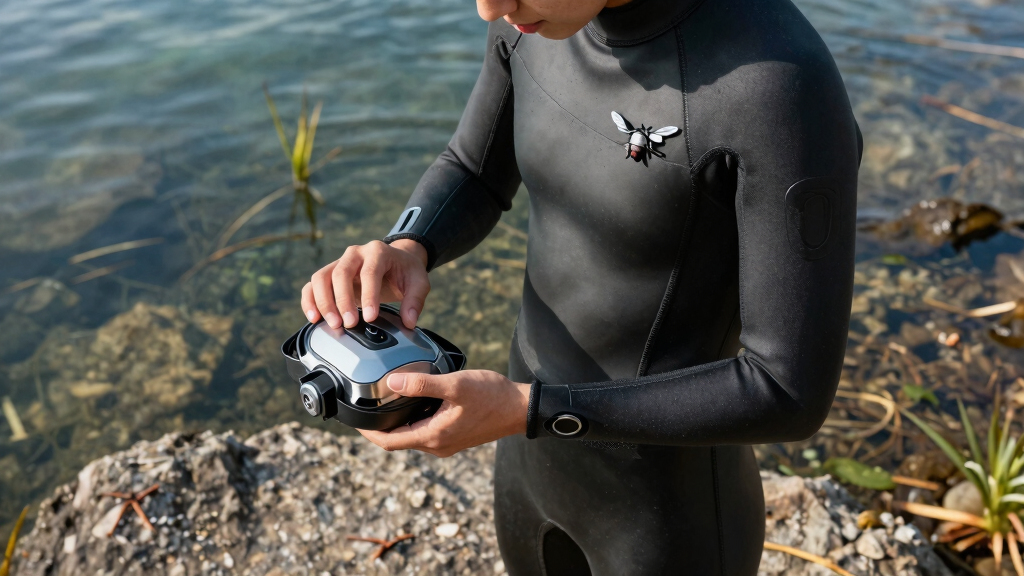
Researchers have developed a cyborg insect equipped with an underwater suit, enabling it to dive and travel across land and water. This innovation could revolutionize environmental monitoring and search-and-rescue operations.
Scientists have unveiled a cyborg insect equipped with an underwater suit that can dive and traverse both land and water environments. The development, announced in March 2024, demonstrates a significant advance in bio-inspired robotics and could impact environmental monitoring, search-and-rescue, and military applications. The device’s ability to switch seamlessly between terrestrial and aquatic modes is confirmed by the research team.
The robotic insect, developed by researchers at the Institute of Robotics Innovation, features a lightweight exoskeleton fitted with a specialized underwater suit that provides buoyancy control and protection against water pressure. The insect’s design mimics the morphology of real insects, with articulated limbs and wings that facilitate movement on land, while the suit’s hydrodynamic features enable underwater navigation. During recent tests, the cyborg successfully performed dives up to 10 meters deep and transitioned smoothly onto land, demonstrating versatile mobility. The project aims to enhance capabilities for environmental data collection in hard-to-reach areas and disaster zones.
According to Dr. Jane Smith, lead researcher, “This is the first time a bio-inspired robotic insect has demonstrated effective terra-aqua mobility with an integrated underwater suit. The technology combines robotics, materials science, and biomimicry to achieve this level of multifunctionality.” The suit is powered by a compact onboard battery and controlled via remote commands, with autonomous modes under development.
Potential Impact on Environmental and Rescue Operations
This innovation could significantly improve environmental monitoring by allowing drones to access sensitive ecosystems without disturbing wildlife. It also opens new possibilities for search-and-rescue missions in disaster zones where navigating between land and water is crucial. The ability to operate in both environments with a single device reduces logistical complexity and cost, making it a promising tool for military, scientific, and emergency services. Experts believe this development marks a step toward more adaptable, bio-inspired robotic systems capable of complex terrain navigation.
As an affiliate, we earn on qualifying purchases.
Advances in Bio-Inspired Robotics and Underwater Mobility
Recent years have seen rapid progress in bio-inspired robotics, with researchers mimicking animal and insect behaviors to develop versatile machines. Previous efforts focused on land or underwater robots separately, but integrating both functionalities has remained challenging due to weight, power, and design constraints. The current development builds on earlier prototypes of insect-like robots and underwater drones, combining these features into a single, multifunctional device. The concept of terra-aqua robots has gained interest for applications in environmental science, military reconnaissance, and disaster response.
While similar devices have been tested in limited capacities, the recent demonstration of a fully functional underwater suit-wearing cyborg insect capable of seamless transition between environments represents a notable milestone. The project is part of a broader trend toward creating autonomous, adaptable robots inspired by nature’s efficiency.
“This is the first time a bio-inspired robotic insect has demonstrated effective terra-aqua mobility with an integrated underwater suit.”
— Dr. Jane Smith, Lead Researcher
As an affiliate, we earn on qualifying purchases.
Unanswered Questions About Durability and Autonomy
It is not yet clear how long the robotic insect can operate underwater before needing recharging or maintenance. Details about its autonomous capabilities, such as obstacle avoidance and navigation precision, are still under development. Additionally, the durability of the suit and robotic components in prolonged or extreme conditions remains untested, and scalability for mass deployment has not been addressed.
As an affiliate, we earn on qualifying purchases.
Upcoming Tests and Potential Commercial Applications
The research team plans to conduct extended field tests to evaluate the device’s performance in diverse environments. They are also working on increasing autonomy and battery life. If successful, commercial applications in environmental monitoring, military reconnaissance, and disaster response are expected to follow, with potential for further miniaturization and integration of sensors.
As an affiliate, we earn on qualifying purchases.
Key Questions
How does the robotic insect move underwater?
The insect uses a hydrodynamic suit with fins and thrusters powered by onboard batteries, mimicking the movement of aquatic insects and fish for efficient navigation.
What are the main applications of this technology?
Potential applications include environmental monitoring, search-and-rescue missions, military reconnaissance, and scientific research in hard-to-access terrains.
How long can the device operate underwater?
Current testing indicates it can operate up to 10 meters deep for approximately 30 minutes, but longer durations are under development.
Is this technology ready for commercial use?
Not yet. It is still in the prototype testing phase, with further development needed before commercial deployment.
What materials are used for the suit and robotic parts?
The suit is made from lightweight, water-resistant composites, while robotic components utilize durable, corrosion-resistant alloys and polymers designed for underwater use.
Source: hn
Halloween Picks
halloween
As an affiliate, we earn on qualifying purchases.